





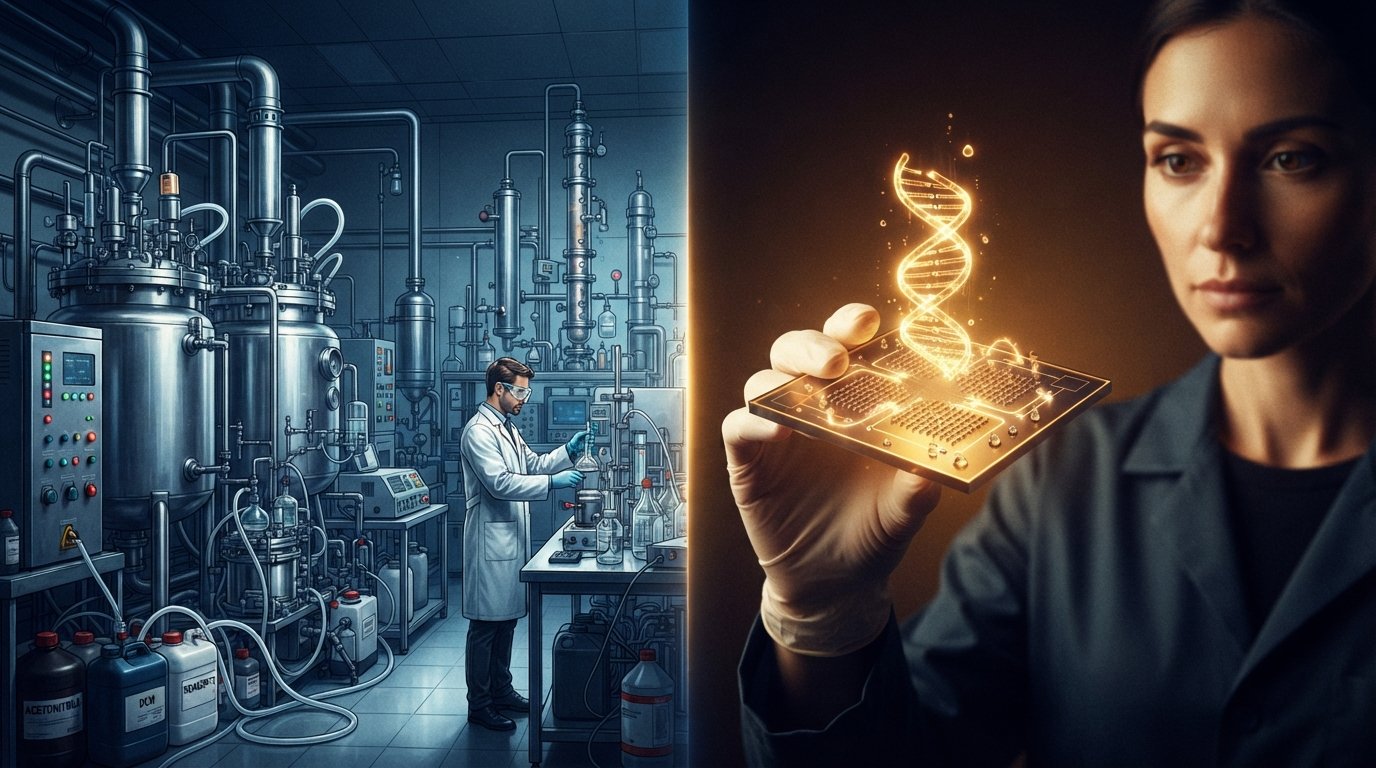
Silicon chips have powered computers for decades. Now, researchers at Harvard have given them an entirely new job: writing DNA.
Published in Nature Electronics, a Harvard-led research team unveiled a silicon chip capable of synthesizing 64 different DNA sequences simultaneously — using nothing but electricity and water-based enzymes, instead of the hazardous chemicals typically required for DNA manufacturing.
The research was led by Donhee Ham, the John A. and Elizabeth S. Armstrong Professor of Engineering and Applied Sciences at Harvard’s John A. Paulson School of Engineering and Applied Sciences (SEAS).
Why DNA Manufacturing Needs A Cleaner Approach
Synthetic DNA is essential to modern science and medicine — used in diagnostics, genome engineering, and cancer research. Today, most custom DNA is produced using phosphoramidite chemistry, a well-established method capable of manufacturing millions of DNA sequences in parallel.
Scientists Created “Slow Chaos” Inside Plastic To Block Heat Without Making It Weaker
The problem is that this process depends on hazardous organic solvents and typically requires specialized, centralized manufacturing facilities. It’s effective, but not clean, and not easily scaled down to smaller or more distributed settings.
Scientists have been exploring enzymatic DNA synthesis — a water-based approach that more closely mirrors how living cells naturally build DNA — as a gentler alternative. The appeal is clear: smaller, safer, more widely available DNA synthesis systems that don’t require industrial-scale solvent infrastructure.
The catch has been scale. Previous enzymatic synthesis demonstrations were limited to producing about a dozen sequences at once — far behind what conventional chemistry could achieve. The Harvard team’s chip pushed that number to 64 sequences simultaneously, each up to 39 nucleotides long, setting a new benchmark for the technology.
How The Chip Actually Writes DNA
DNA is built one nucleotide at a time. After each nucleotide is added, a temporary blocking group prevents further growth until it’s ready. Before the next nucleotide can attach, that blocking group must be removed through a process called deprotection, which is triggered by acidic conditions — low pH — in water.
To produce many different DNA sequences at once, researchers needed a way to lower pH only at selected locations during each synthesis cycle, without those acidic conditions spreading to nearby sites.
The Harvard chip solves this using tiny electrical currents. Its surface contains 64 synthesis sites, each built around two concentric ring electrodes surrounding DNA molecules anchored at the center.
- The inner electrode generates protons that lower local pH, allowing the DNA strand at that specific site to grow
- The outer electrode simultaneously removes protons that spread outward, keeping the acidic reaction tightly confined to that single site
By repeating this cycle across multiple rounds, the chip independently builds 64 unique DNA sequences at once — each site growing its own distinct strand, precisely controlled by electrical signals rather than chemical baths.
From Neuroscience Tool To DNA Synthesizer
Here’s the part of the story that makes this discovery particularly interesting: the chip wasn’t originally designed to make DNA at all.
Jeffrey Abbott, a former PhD student in Ham’s laboratory, initially developed the underlying silicon electronics for a completely different purpose — recording electrical activity inside large populations of neurons. This kind of chip is used in brain research to capture signals from many brain cells simultaneously.
After redesigning the surface electrodes, the researchers realized the same underlying technology could be repurposed to precisely control the chemical conditions needed for DNA synthesis.
“A defining feature of the chip was precision current injection, which we used to permeabilize neuronal membranes for intracellular access,” Ham explained. “At a certain point, we wondered whether that same current control could be redirected from cells to molecules, replacing the neuron-facing electrodes with ring-electrode pairs that could localize pH for DNA synthesis. It worked.”
It’s a striking example of how foundational engineering — in this case, precise electrical current control — can find entirely unexpected applications once researchers start asking creative questions about what else the same underlying capability might do.
A Glimpse Of DNA Data Storage
Beyond its potential applications in synthetic biology and medical diagnostics, the research team demonstrated something genuinely futuristic: they used the chip’s 64 synthesized DNA sequences to encode a 169-byte piece of text.
DNA-based data storage has long been discussed as a potential future technology, because DNA is remarkably dense and stable as an information storage medium — theoretically capable of storing enormous amounts of data in an extraordinarily small physical space, for very long periods of time without degrading.
The challenge has always been scale. DNA data storage would require manufacturing DNA at a volume far beyond today’s typical needs. This is exactly where water-based enzymatic synthesis could become increasingly valuable as production demands grow.
“DNA data storage asks DNA synthesis to operate at a scale far beyond today’s needs,” said Woo-Bin Jung, co-first author of the study and now an assistant professor of chemical engineering at Pohang University of Science and Technology (POSTECH), who conducted this research as a postdoctoral researcher in Ham’s lab. “That is why enzymatic synthesis in water can matter. If far more than 64 sequences can be synthesized in parallel, it could offer an environmentally friendly route toward writing DNA at very large scale.”
The Next Obstacle: Chemistry, Not Silicon
Encouraged by their results, the researchers wanted to know how much further the chip could be scaled. They fabricated new chips with synthesis sites placed closer together, hoping to fit more parallel DNA sequences onto the same surface area.
That particular experiment didn’t succeed — but it revealed something important about exactly where the real limitation lies.
The chip itself performed exactly as intended, precisely confining low pH to each targeted location. The actual bottleneck came from the chemistry used during deprotection.
Rather than directly removing the blocking groups, low pH generates intermediate molecules that carry out the deprotection step. These intermediate molecules can drift into neighboring synthesis sites, effectively blurring the separation between adjacent reactions — even though the chip’s electrical control of pH remained precise and accurate.
“The chip did what we asked it to do: it localized low pH at selected sites,” said Han Sae Jung, co-first author of the study and a postdoctoral researcher at Harvard. “The limitation came from the deprotection chemistry, not from the silicon. That leaves a clear next step for the field — develop a more direct acid-driven deprotection chemistry that can keep pace with the chip.”
This is an important distinction for the field going forward. The electrical engineering problem — precisely controlling pH at many independent locations — has been solved. The remaining challenge is now squarely a chemistry problem: finding deprotection reactions that stay confined as tightly as the electrical signals that trigger them.
A Multi-Institution Collaboration
This research was a collaboration among scientists at Harvard, the Broad Institute, DNA Script, and later POSTECH. Harvard’s Office of Technology Development has already filed intellectual property related to the platform, signaling institutional confidence in its commercial potential.
The work received support from the Office of the Director of National Intelligence (ODNI) through the Intelligence Advanced Research Projects Activity (IARPA), Horizon Europe’s Hyperion project, and Samsung Electronics’ Research Funding & Incubation Center for Future Technology.
Key Takeaways
- Harvard researchers built a silicon chip that synthesizes 64 different DNA sequences simultaneously using electricity and water-based enzymes
- This approach avoids the hazardous organic solvents required by conventional DNA manufacturing methods
- The chip was originally developed for recording neural activity, then repurposed to control DNA synthesis chemistry
- Researchers successfully used the chip to encode a 169-byte text message into DNA, demonstrating potential for future DNA data storage
- Further scaling revealed that the chip’s electrical precision works well — the current bottleneck is in the deprotection chemistry, not the silicon technology itself
- This is early-stage research; new chemistry will be needed before the platform can scale significantly further
Source: Harvard John A. Paulson School of Engineering and Applied Sciences — July 8, 2026
Journal Reference: Woo-Bin Jung, Han Sae Jung, Jun Wang, et al. Parallel enzymatic DNA synthesis using a semiconductor chip. Nature Electronics, 2026.
DOI: 10.1038/s41928-026-01662-9