




Going a single day without food is uncomfortable for most animals. Going five years without a meal sounds biologically impossible.
Yet the supergiant deep-sea isopod — a creature that can grow larger than a football — does exactly that, routinely surviving years between meals in one of the most nutrient-starved environments on the planet: the deep ocean floor.
A research team from the Institute of Oceanology of the Chinese Academy of Sciences just uncovered the biological mechanism behind this extraordinary survival strategy, publishing their findings in the journal Cell. The answer involves an enormous internal storage system, a drastically slowed metabolism, and — most surprisingly — a gene the isopod appears to have stolen from bacteria millions of years ago.
An Animal Built Around A Giant Stomach
To understand how deep-sea isopods survive prolonged starvation, researchers examined two species living at different ocean depths: Bathynomus jamesi, found roughly 898 meters below the surface, and Bathynomus doederleini, found around 300 meters deep.
Scientists Discovered Why Some Brains Resist Alzheimer’s Even When The Disease Is Already There
Using a combination of comparative genomics, anatomical analysis, physiology, behavior, and studies of associated gut microbes, the team identified a clear survival strategy — one they describe as “increasing revenue and reducing expenditure” in response to unpredictable and scarce food availability.
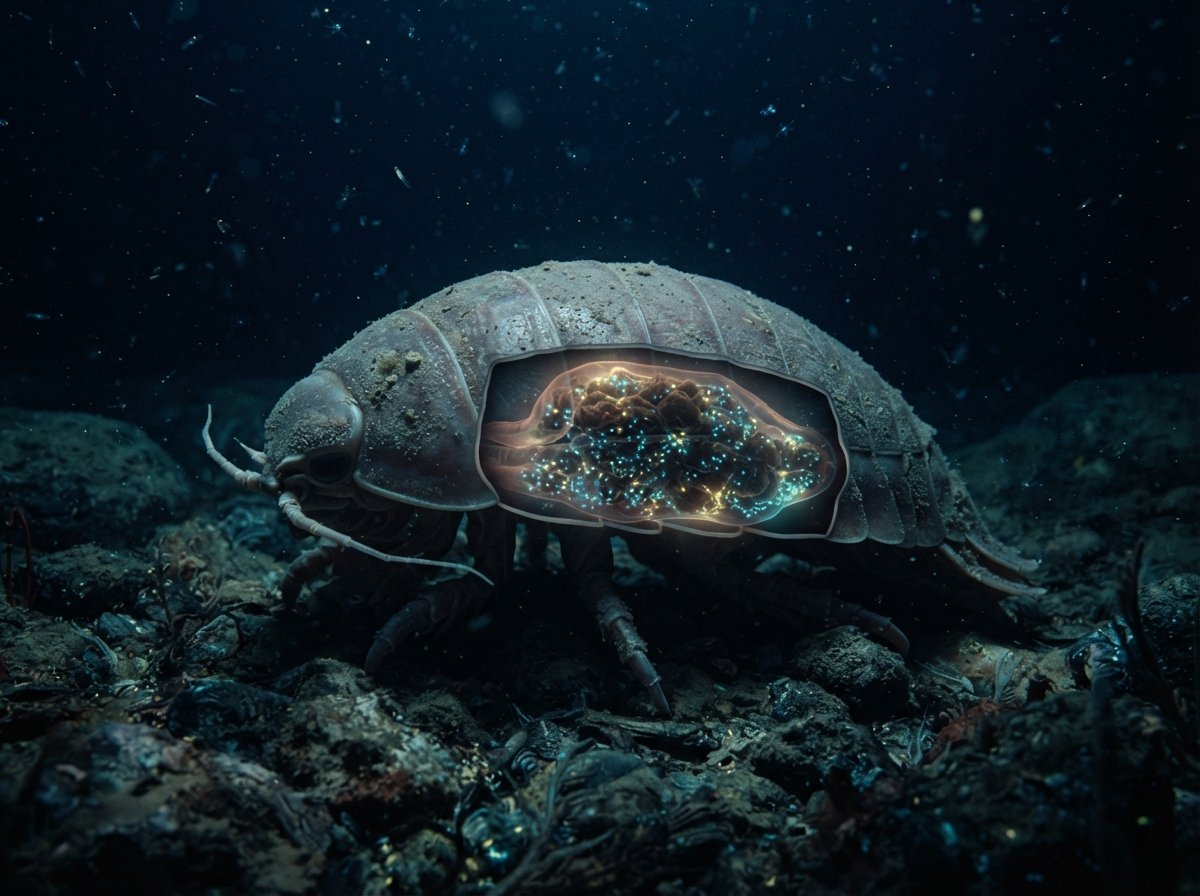
The most immediately striking anatomical feature is the isopod’s stomach, which makes up roughly two-thirds of its entire body — dramatically larger than the stomachs of related isopod species living in shallower waters or intertidal zones.
When full, this oversized stomach holds a finely ground, heavily digested, mud-like mixture of food, relatively low in typical digestive bacteria such as Firmicutes, but notably rich in a bacterial group called Chlamydiae, which is linked to lipid (fat) storage.
Taken together, this suggests the isopod’s strategy is straightforward in concept, if extraordinary in execution: eat enormous, opportunistic meals whenever food becomes available in the food-scarce deep sea, then dramatically lower its metabolic rate — allowing those stored reserves to be broken down and used slowly over years rather than days or weeks.
A Gene Borrowed From Bacteria
The most scientifically remarkable finding in this research involves a specific gene called ND1.
Researchers discovered that ND1 did not originate within the isopod’s own evolutionary lineage. Instead, it was acquired through a process called horizontal gene transfer — meaning it came from an external symbiotic bacterium and was later incorporated permanently into the isopod’s own genome.
ND1 is homologous to a component of Complex I in the electron transport chain, the cellular machinery responsible for producing energy inside mitochondria. In other words, this bacterial gene became a functional part of the isopod’s own energy metabolism system.
Genes acquired through horizontal transfer often face significant biological barriers that limit how effectively they can function in a new host genome. But ND1 appears to have overcome many of these obstacles. After being incorporated into the isopod genome, it duplicated and reached extremely high expression levels — meaning the isopod’s cells were producing large amounts of this borrowed genetic material.
The researchers also identified a precise regulatory mechanism controlling this process: epigenetic changes to histones — proteins that help package and control access to DNA. Specifically, ND1’s unusually high expression is controlled through a process called histone acetylation, achieving what the researchers describe as “high efficiency, energy conservation, and precise control.”
Testing ND1 In Other Species
To understand exactly what ND1 does, researchers inserted the gene into three very different organisms: zebrafish, nematodes (roundworms), and human 293T cells — a commonly used laboratory human cell line.
The results revealed something genuinely fascinating: ND1’s effect depended entirely on temperature.
- At normal temperatures, ND1 increased energy metabolism in these organisms — and made them less able to tolerate starvation
- Under low-temperature conditions simulating the cold deep-sea environment, the same gene had the opposite effect — it suppressed energy metabolism and lowered mitochondrial activity
In zebrafish specifically, ND1 under cold conditions increased starvation tolerance by 37% compared to fish without the gene.
This temperature-dependent switch is the biological key to the entire survival strategy. In the cold, nutrient-poor deep sea, ND1 helps isopods conserve energy dramatically. The same gene, in a warmer environment, would actually work against starvation tolerance — demonstrating just how precisely this adaptation is tuned to the isopod’s specific extreme habitat.
Solving The Puzzle Of Deep-Sea Gigantism
This discovery helps resolve a long-standing biological puzzle: how can an animal grow to such an impressive size — a trait typically associated with high energy requirements — while living in one of the most energy-poor environments on Earth?
The researchers concluded that ND1 helps fine-tune the isopod’s mitochondrial metabolic network, allowing for precise metabolic depression when needed. This appears to directly resolve the core tradeoff between the high energy demands of large body size and the need for extreme energy conservation in the deep sea.
“Our work not only deciphers the mystery of ultra-long starvation tolerance in deep-sea isopods,” said Jianbo Yuan, first author of the study, “but also provides an important paradigm for understanding how life balances growth and survival in extreme environments.”
The researchers describe this as the first documented case of deep-sea megafauna reshaping their energy allocation strategy through a combination of horizontal gene transfer and epigenetic optimization — a genuinely novel evolutionary strategy not previously characterized in large deep-sea animals.
Why This Research Matters Beyond The Deep Sea
While the supergiant isopod itself may seem like a biological curiosity, this research carries broader scientific significance.
Understanding how organisms achieve extreme metabolic flexibility — the ability to shift dramatically between high-energy and low-energy states depending on environmental conditions — has relevance for fields well beyond marine biology, including research into human metabolic conditions, hibernation biology, and the broader question of how life adapts to extreme and resource-limited environments.
The discovery also adds to a growing body of evidence that horizontal gene transfer — long considered primarily a phenomenon among microorganisms — can play a meaningful evolutionary role in complex animals, including large, structurally sophisticated species living in Earth’s most extreme habitats.
Key Takeaways
- Supergiant deep-sea isopods can survive years without eating, combining an oversized stomach (two-thirds of their body) with an extremely low metabolic rate
- Researchers identified a bacterial gene, ND1, acquired through horizontal gene transfer and now embedded in the isopod’s genome
- ND1’s effect is temperature-dependent: it increases metabolism in warm conditions but suppresses it in cold, deep-sea-like conditions
- In zebrafish, ND1 raised starvation tolerance by 37% under cold conditions
- This is the first documented case of deep-sea megafauna using horizontal gene transfer combined with epigenetic control to manage extreme energy conservation
Source: Institute of Oceanology, Chinese Academy of Sciences — June 5, 2026
Journal Reference: Jianbo Yuan, Xiaojun Zhang, Shihao Li, et al. Deep-sea megafauna co-opts microbial energy metabolism genes to withstand ultra-long starvation. Cell, 2026.
DOI: 10.1016/j.cell.2026.05.012