



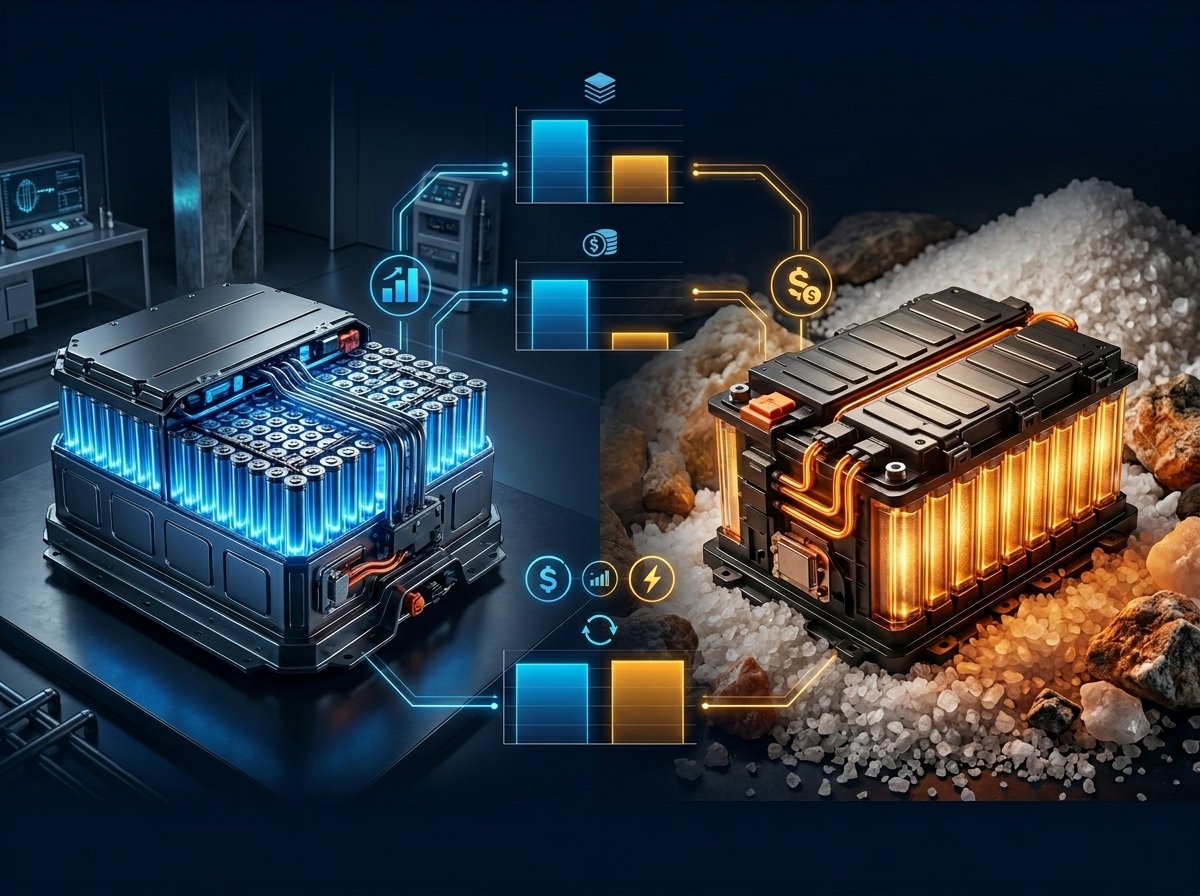

The electric vehicle revolution runs on lithium. It powers the batteries in almost every EV on the road today, from budget commuter cars to premium Tesla models. But lithium comes with real problems — it’s scarce, geographically concentrated in a handful of countries, expensive to mine, and increasingly subject to supply chain tensions that make long-term cost reduction difficult.
Sodium, by contrast, is one of the most abundant elements on the planet. It’s in seawater, salt deposits, and mineral formations worldwide. If sodium-ion batteries could genuinely match lithium-ion performance, the implications for EV affordability and energy storage economics would be transformative.
A new study published in Cell Reports Physical Science suggests that moment may be closer than expected.
Taking A Battery Apart
Researchers at RWTH Aachen University in Germany, led by battery scientist Moritz Schütte, conducted a detailed teardown and characterization of a commercial sodium-ion battery produced by Chinese manufacturer Hina — one of the first commercially available sodium-ion products on the market.
The team examined 120 sodium-ion cells using impedance spectroscopy, a non-destructive technique that measures how uniformly a batch of batteries is manufactured. They then tested the cells across a range of real-world conditions — different current levels and temperatures ranging from minus 20 to plus 45 degrees Celsius. Internal X-ray imaging was followed by physical disassembly to analyze electrode dimensions, material composition, and microscopic structural features in detail.
Researchers Discovered That Twisting A Material Like Cheese Slices Could Unlock Quantum Computing
What they found was considerably more impressive than they had anticipated.
The Tesla Comparison Nobody Expected
The most striking single finding was the battery’s internal architecture. The Hina sodium-ion cell uses a tabless, double-aluminum current collector design — a configuration that reduces electrical resistance and promotes more even heat distribution throughout the cell.
This design closely mirrors the architecture currently used in Tesla’s lithium-ion batteries — a design Tesla itself developed and implemented as a significant engineering advance in battery performance and manufacturing consistency.
“We were positively surprised by how uniform the cells are,” said Schütte. The cell-to-cell consistency across 120 batteries was high — comparable to what you’d expect from a mature lithium-ion manufacturing operation, not an early-stage commercial sodium product.
Power performance was also stronger than expected. The battery delivered high-power output better than most would predict for a first-generation commercial sodium cell, making it genuinely competitive for applications where power density matters.
Where It Still Trails Lithium
Despite the encouraging results, the researchers were clear about the gaps that remain before sodium-ion can fully compete with the best lithium-ion batteries.
The most significant limitation is cold-weather charging. While the battery maintains good performance delivering power in cold conditions, charging efficiently at low temperatures remains a clear weakness. In applications that require frequent charging below zero — particularly EVs operating in cold climates — this is a meaningful practical constraint that would need to be addressed through thermal management systems or improved electrolyte formulations.
Energy density is the other key gap. Today’s commercial sodium-ion cells store less energy per unit of weight and volume than the best lithium-ion cells. This makes them less suitable for applications where maximum driving range is the priority — long-range passenger EVs, for instance — while leaving them well positioned for applications where range matters less than cost and durability.
“The combination of good uniformity, high power capability, and strong low-temperature performance makes these cells attractive for stationary storage, grid services, and shorter-range or commercial vehicles where potential lower cost and resource availability matter more than maximum driving range,” Schütte noted.
One unexpected finding also warrants further investigation. The researchers detected unusually high concentrations of copper in certain regions of the battery’s cathode — distributed unevenly across those areas. The role this copper plays in the battery’s performance and how it affects long-term aging remains unclear. “It raises interesting questions about its role in performance and aging,” Schütte said.
Why Sodium’s Advantage Could Matter Enormously
The core appeal of sodium-ion technology comes down to a simple economic and geopolitical reality.
Lithium reserves are concentrated primarily in a small number of countries — predominantly in South America, Australia, and China — creating supply chain dependencies that affect battery costs and energy security for countries and manufacturers operating outside those regions. Demand for lithium is expected to surge dramatically as EV adoption accelerates globally, putting further pressure on both pricing and supply availability.
Sodium doesn’t have these problems. It is genuinely abundant worldwide, available from multiple sources including seawater and common mineral deposits, and dramatically cheaper to source than lithium. A mature sodium-ion battery industry could potentially reduce raw material costs significantly compared to lithium-ion, making EVs and grid-scale energy storage more affordable — particularly for markets currently priced out of the EV transition.
What Comes Next
The research team is focused on two priority areas for improving sodium-ion performance. The first is low-temperature charging — developing electrolyte formulations and charging strategies that enable safe, efficient charging below zero degrees. The second is energy density — finding electrode materials and cell designs that close the gap with lithium on the amount of energy stored per kilogram and per liter.
Schütte pointed to specific promising directions: “Advances in hard-carbon anodes and electrolyte formulations may be especially promising.” He also expressed enthusiasm for the longer-term possibility of eliminating nickel and copper from sodium-ion cells entirely while achieving competitive energy density — a combination that would make the chemistry both cheaper and more sustainable.
“It will be exciting to see future sodium-ion technologies that are free of nickel and copper while achieving competitive energy density,” he said.
The gap between sodium and lithium is real but narrowing. And if a first-generation commercial product is already matching Tesla’s battery architecture in cell uniformity and design sophistication, the pace of that narrowing may be faster than most in the industry have assumed. ⚡🔋
Source: Cell Press / RWTH Aachen University — June 21, 2026
Journal Reference: Christian Siebert, Moritz Schütte, Jonas Rinner, et al. Cell teardown and characterization of a Hina commercial sodium-ion battery. Cell Reports Physical Science, 2026; 7 (6): 103323.
DOI: 10.1016/j.xcrp.2026.103323