





In five decades of modern immunology, scientists have catalogued an extraordinary variety of ways that cells kill each other. T cells. Natural killer cells. Neutrophils. Macrophages. Each with its own strategy, its own speed, its own precision.
Stanford researchers just added something to that list that nobody predicted — a cell that simply explodes.
The Creature That Revealed It
The discovery came from one of biology’s most famous regenerative wonders: the planarian flatworm. These small, freshwater creatures have captivated researchers for years because of their near-miraculous ability to regrow lost body parts. Cut one in half, and both halves regenerate into complete animals. They seem, in many ways, nearly indestructible.
Postdoctoral researcher Chew Chai at Stanford’s Wang Lab was studying something specific about flatworm biology — whether these animals can distinguish their own tissue from tissue belonging to a different individual. To test it, she cut flatworms lengthwise and fused them with tissue from unrelated worms, creating what she described as “Frankenstein worms.”
What happened next was not what she expected.
The flatworms rejected the foreign tissue violently — mounting an inflammatory response reminiscent of organ rejection in humans. And within that inflammatory chaos, Chai noticed cells behaving in a way that had never been documented before.
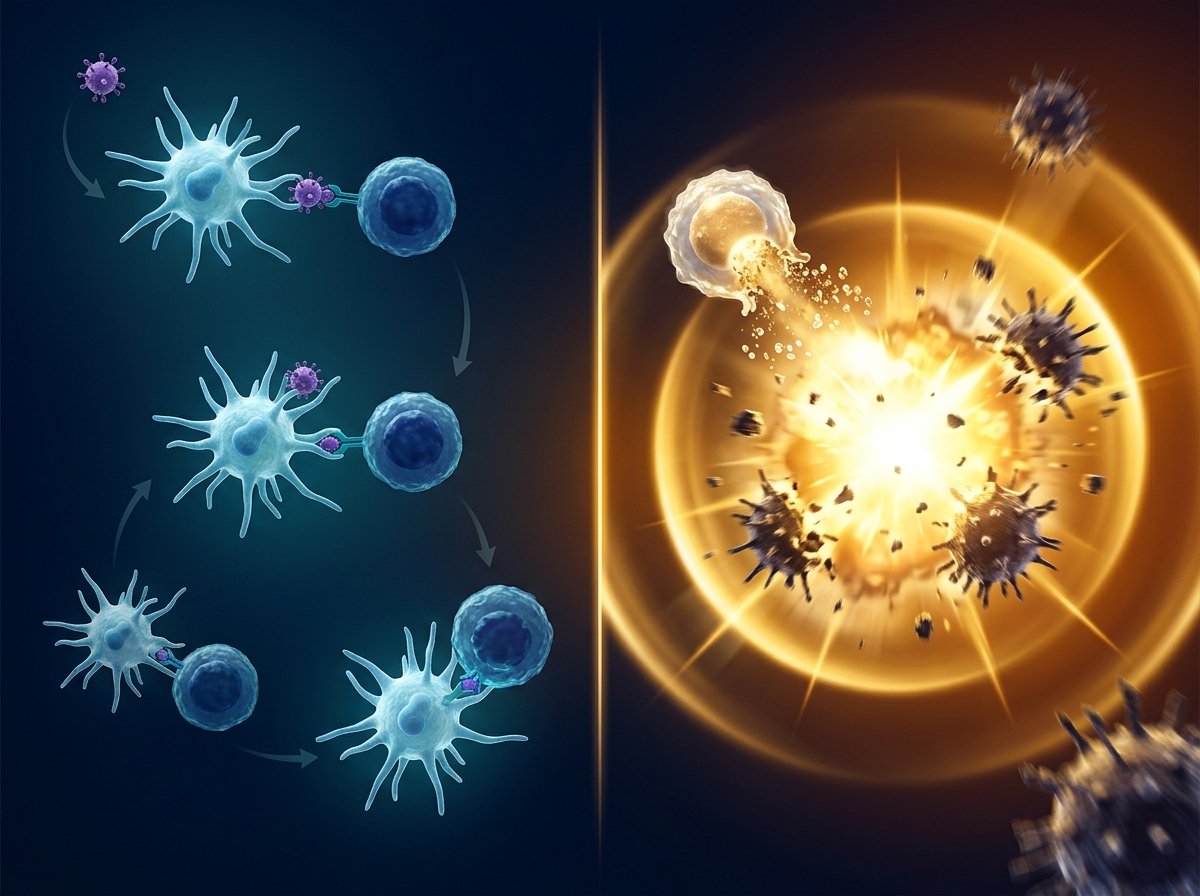
They burst open. Released toxic substances. Killed every cell around them. And then disappeared entirely — within five minutes of activation.
Naming A New Phenomenon
Chai and senior author Bo Wang, associate professor of bioengineering at Stanford, named the newly identified cells “ruptoblasts” and the process they undergo “ruptosis.”
Using live cell microscopy and flow cytometry — a laser-based method for analyzing individual cells — the team was able to watch ruptosis happen in real time and characterize exactly what was occurring at the cellular level.
The speed alone sets it apart from anything previously described in immunology. Some mammalian cells and certain bacteria can undergo a form of explosive cell death, but those processes unfold over several hours as small pores slowly leak cellular contents. Ruptosis is categorically different.
“Ruptosis happens within seconds to minutes,” said Chai. “It’s this huge inflammatory response. Like there’s a fire and an alarm goes off, and the cells just blow up.”
The Spin Of Alien Worlds Just Revealed A Stunning Hidden Secret About How Planets Are Born
The trigger for ruptosis is a hormone called activin. When activin levels surge — which happens when the flatworm detects foreign tissue — ruptoblasts activate, rapidly enhance their secretory machinery with the help of a sharp calcium release from inside the cell, and detonate.
Precision Without Collateral Damage
The obvious concern with a cell that explodes and kills its neighbors is collateral damage. An immune mechanism that indiscriminately destroys surrounding tissue would be far more dangerous than useful.
But the Stanford team found something remarkable. The destruction caused by ruptosis is highly localized. Cell death is limited to the immediate vicinity of the explosion — there is no chain reaction, no cascading damage spreading through tissue, no lasting toxicity beyond the target zone.
To test the cells’ destructive reach and selectivity, the researchers exposed ruptoblasts to three very different targets: E. coli bacteria, human kidney cells, and mouse blood cells. The ruptoblasts successfully destroyed all three — demonstrating both potency and versatility — while maintaining that contained, precision footprint.
Wang immediately recognized the therapeutic implications.
“The effects remained highly localized,” he noted, adding that this precision could make ruptosis useful for developing treatments aimed at bacterial infections or tumors — two of the most challenging targets in modern medicine.
Why Humans Don’t Have This
If ruptoblasts are so effective, why don’t we have them?
The researchers believe the answer lies in regeneration. Ruptosis is an inherently destructive process — even in its precision, it damages tissue. Flatworms can absorb that cost because they possess an extraordinary abundance of stem cells that rapidly repair tissue damage. Humans, with our far more limited regenerative capacity, simply couldn’t sustain an immune strategy that causes localized tissue destruction every time it activates.
When Chai searched other animals for similar cells, she found them only in basal bilaterians — ancient, simple animals like flatworms — suggesting that ruptoblasts represent a genuinely ancient immune strategy that vertebrates discarded somewhere along their evolutionary path, as they traded regenerative ability for greater physiological complexity.
In other words, we gave up the exploding immune cells when we gave up the ability to regrow our limbs.
What This Means For Medicine
The finding, published in the journal Cell, is significant on multiple levels.
At the most fundamental level, it demonstrates that the diversity of immune strategies across the animal kingdom is far greater than biomedical research has assumed. Modern immunology has been built almost entirely on studies of mammals — and for understandable reasons. But in doing so, the field may have overlooked entire categories of biological innovation that evolved in simpler creatures hundreds of millions of years ago.
“It demonstrates there are lots of different immune mechanisms out there,” said Wang. “There’s all these animals that live in environments with lots of bacteria, lots of viruses, and we know so little about their immune mechanisms.”
At the applied level, a mechanism that can deliver targeted, localized cell death to bacteria or cancer cells — with contained blast radius and no chain reaction — represents exactly the kind of precision that oncologists and infectious disease researchers have been searching for.
Whether ruptosis can be harnessed, mimicked, or translated into a therapeutic tool remains to be determined. But the discovery that it exists — that nature evolved a cell capable of detonating itself like a precision bomb and vanishing without a trace — opens a door that nobody knew was there.
Sometimes the most extraordinary biological solutions are hiding in the most unexpected places.
Source: Stanford University / Cell — June 2, 2026
Journal Reference: Chew Chai, Eliya Sultan, Souradeep R. Sarkar, et al. Explosive cytotoxicity of ruptoblasts bridges hormone surveillance and immune defense. Cell, 2026.
DOI: 10.1016/j.cell.2026.05.008