








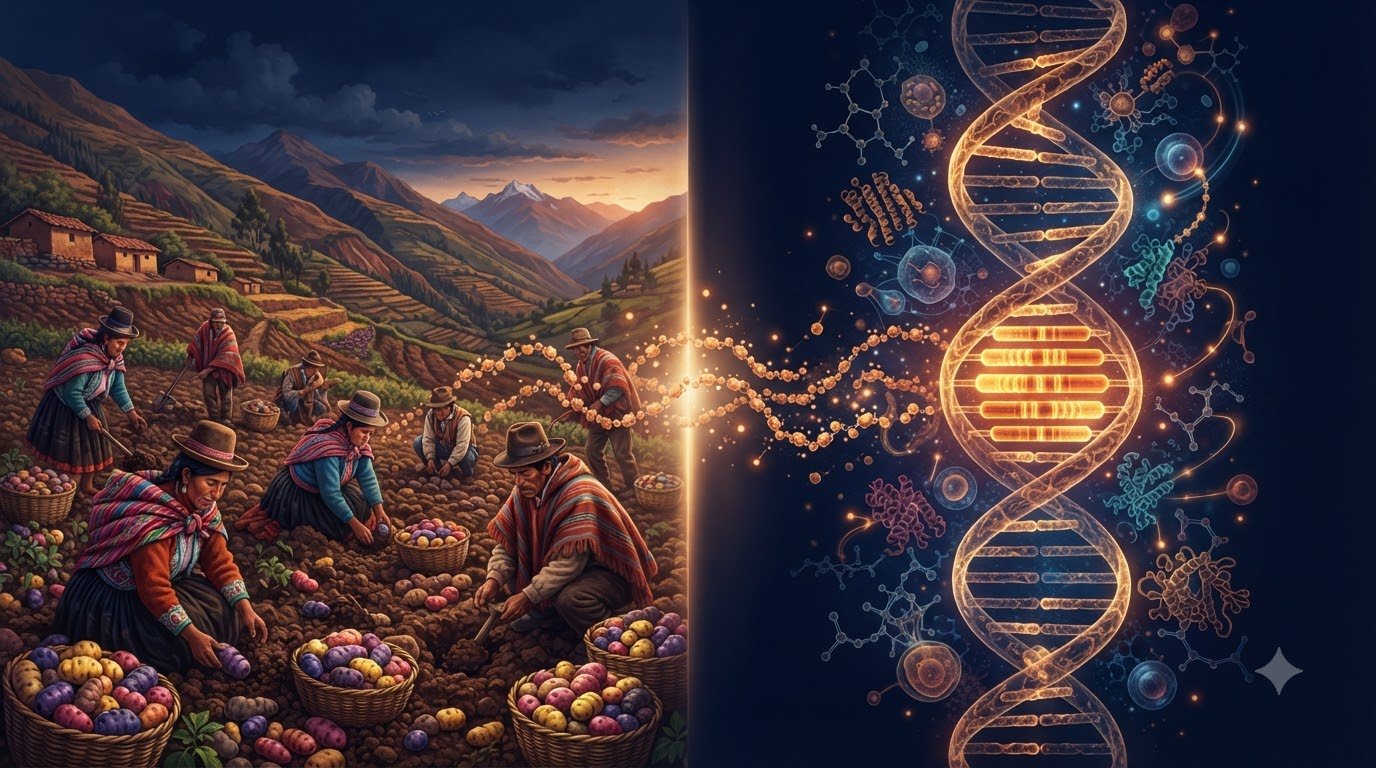
For thousands of years, potatoes have been central to life in the Andes. Indigenous Andean communities were the first to domesticate the starch-rich crop, turning it into a dietary staple long before potatoes spread around the world. Now, researchers have found evidence that this ancient reliance may also have shaped human evolution.
Indigenous people in Peru today carry more copies of a gene involved in starch digestion than any other known population. A study co-led by researchers at UCLA and the University at Buffalo suggests that natural selection began favoring Indigenous Andeans with especially high numbers of the salivary amylase gene, known as AMY1, around the same period that potatoes became established in the Andean highlands roughly 6,000 to 10,000 years ago.
The findings were published in the journal Nature Communications.
A Genetic Advantage for Digesting Starch
People who carry more copies of AMY1 generally produce greater amounts of the amylase enzyme in their saliva and are believed to process starch more efficiently, according to Abigail Bigham, an associate professor of anthropology at UCLA who studies populations in the Peruvian Andes.
For the study, Bigham and her team collected DNA from Peruvian Andean Quechua speakers and compared those samples with genomic databases containing thousands of DNA samples from dozens of present-day human populations.
“The high-altitude Andes are known for being a rich region for understanding human evolutionary adaptation — for instance, hypoxia,” Bigham said. “This new research highlights how the Andes are useful for understanding human evolutionary adaptation to other selective environmental pressures like diet.”
Co-corresponding author Omer Gokcumen, a University at Buffalo professor of biological sciences, noted that the findings provide unusually strong evidence that natural selection acted on this gene in the Andes after potato cultivation began.
“Biologists have long suspected that different groups of humans have evolved genetic adaptations in response to their diets,” he said, “but there are very few cases where the evidence is this strong.”
How Potato Farming Shaped Andean Evolution
The ancestors of Indigenous Andeans already possessed different numbers of AMY1 copies before settling in the highlands and domesticating potatoes. Some individuals carried relatively few copies, while others carried many.
Once potatoes became an important food source, people with higher AMY1 copy numbers appear to have gained an evolutionary advantage. The researchers estimated that beginning about 10,000 years ago, people with roughly 10 or more copies had a 1.24% survival or reproductive advantage per generation.
“Evolution is chiseling a sculpture, not constructing a building,” Gokcumen said. “It’s not as if Indigenous Andeans gained additional AMY1 copies once they started eating potatoes. Instead, those with lower copy numbers were eliminated from the population over time, perhaps because they had fewer offspring, and the ones with the higher copy numbers remained.”
Over many generations, that process produced a striking difference. Indigenous people living in Peru today carry an average of 10 AMY1 copies — approximately two to four more copies than any of the other 83 populations examined in the study.
Ruling Out the European Contact Bottleneck
The researchers also compared Indigenous Peruvians with the Maya, an Indigenous population in Mexico that shares evolutionary history with Andean peoples but does not have a tradition of potato farming. On average, Indigenous Peruvians carried 10 copies of AMY1, compared with six among the Maya.
A major challenge was determining whether the severe population decline that followed European contact in the 15th century — driven by disease, famine, and conflict — could have created the appearance of selection by reducing the number of people with fewer AMY1 copies.
Using advanced ultra-long DNA sequencing and comparative datasets, the team found that high AMY1 copy numbers had already become more common in the Andes several thousand years before Europeans arrived. That timing supports the conclusion that natural selection linked to diet, rather than the later population collapse, was responsible.
What This Reveals About Human Adaptation
Bigham noted that the findings could encourage broader research into human populations living at high elevations, where people face challenges that extend beyond low oxygen, including limited food resources and intense exposure to cold and ultraviolet rays.
The research also raises broader questions about how humans continue adapting to modern diets.
“There are ideas out there like the paleo diet, which is adapted to the Paleolithic environment and says we’re not suited to eat foods that come post-domestication,” Bigham said. “But I think this research shows that human populations have responded and evolved to changing food conditions within the last 10,000 years. Our metabolic pathways are not simply a product of that Paleolithic past.”
Key Takeaways
- Indigenous Peruvians carry an average of 10 copies of the AMY1 starch-digestion gene — the highest known of any population.
- Natural selection favoring higher copy numbers began roughly 6,000–10,000 years ago, coinciding with potato domestication in the Andes.
- People with ~10 or more copies had an estimated 1.24% survival or reproductive advantage per generation.
- The genetic pattern predates European contact, supporting diet-driven selection rather than a later population bottleneck.
- The findings provide unusually strong evidence that diet can shape human evolution.
Source: University of California – Los Angeles — August 10, 2026 Journal Reference: Kendra Scheer, Luane J. B. Landau, Kelsey Jorgensen, et al. Rapid adaptive increase of amylase gene copy number in Indigenous Andeans. Nature Communications, 2026; 17 (1). DOI: 10.1038/s41467-026-71450-8