




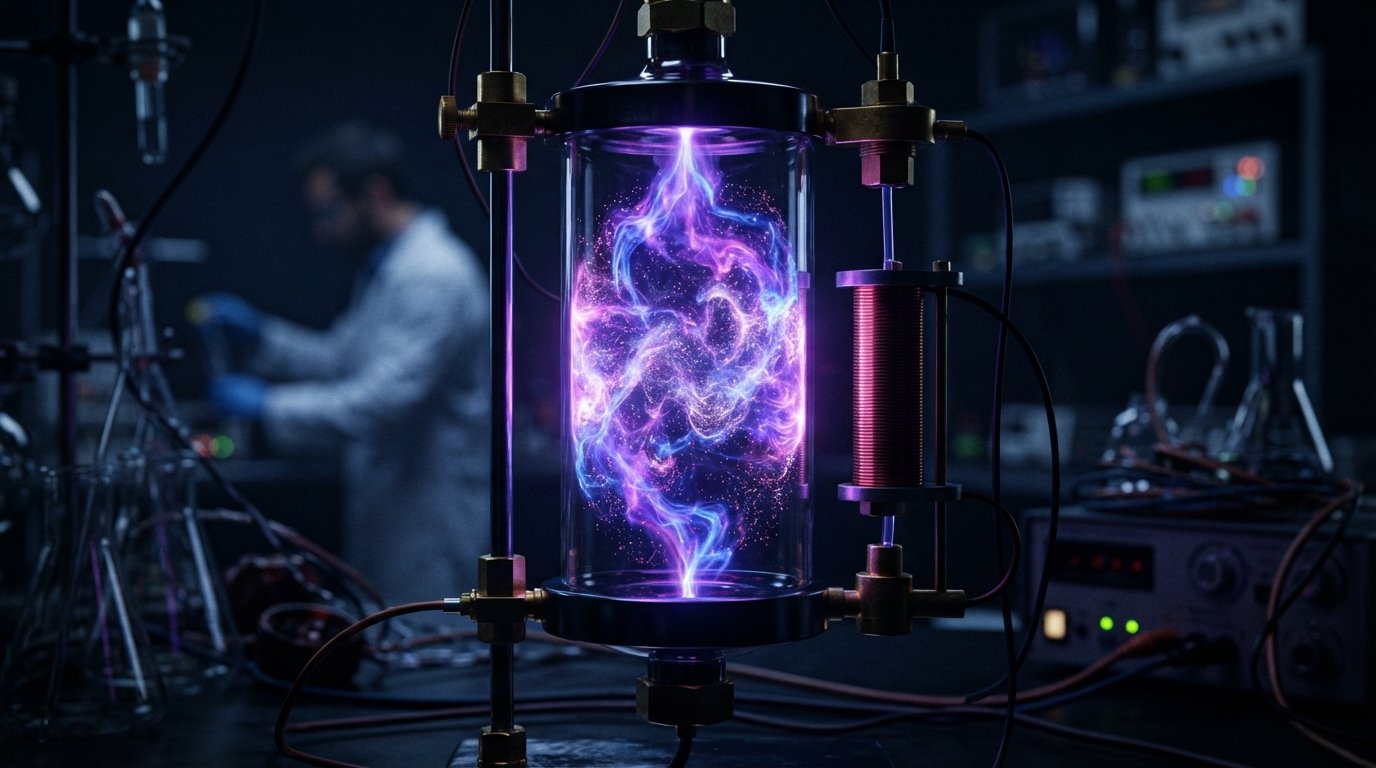
Some of science’s biggest questions get answered not with billion-dollar telescopes, but with a glass tube, a vacuum pump, and 10,000 volts of electricity.
A PhD student at the University of Sydney has done exactly that — recreating a small piece of the cosmos inside a laboratory bottle, offering fresh insight into one of humanity’s oldest questions: how did the chemical ingredients for life actually form in space?
Published in The Astrophysical Journal, the research was led by Linda Losurdo, a PhD candidate in materials and plasma physics in the University of Sydney’s School of Physics, working alongside her supervisor, Professor David McKenzie.
Recreating Space Inside A Glass Tube
To simulate the conditions found near stars and supernova remnants, Losurdo combined three gases — nitrogen, carbon dioxide, and acetylene — inside sealed glass tubes.
The process began with a vacuum pump removing air from the tubes, producing conditions approximating the near-emptiness of space. The gas mixture was then subjected to an electrical potential of around 10,000 volts for approximately one hour, creating a form of plasma known as a glow discharge.
Nanoplastics In Drinking Water May Be Making Dangerous Bacteria Stronger
This intense energy split the original gas molecules apart. Their components then recombined into larger, more complex chemical structures — gradually settling onto silicon chips placed inside the tubes and leaving behind a thin layer of dust. In some samples, the collected particles resembled sparkling fragments of genuine cosmic material.
“By making cosmic dust in the lab, we can explore the intensity of ion impacts and temperatures involved when dust forms in space,” said Professor McKenzie, a coauthor of the study. “That’s important if you want to understand the environments inside cosmic dust clouds, where life-relevant chemistry is thought to be happening.”
Dust Built From Life’s Essential Elements
The laboratory-made dust contained complex combinations of carbon, hydrogen, oxygen, and nitrogen — collectively known as CHON molecules. These four elements form the backbone of countless organic compounds considered essential for life as we understand it.
“We no longer have to wait for an asteroid or comet to come to Earth to understand their histories,” Losurdo said. “You can build analogue environments in the laboratory and reverse engineer their structure using the infrared fingerprints.”
This description of “reverse engineering” is central to why the experiment matters scientifically. In real space, cosmic dust forms under extreme conditions — molecules are repeatedly struck by ions and electrons, triggering chemical reactions that build increasingly complex material over time. Astronomers identify different types of cosmic dust by studying the infrared light these particles emit, which acts like a molecular fingerprint revealing the material’s underlying chemical structure.
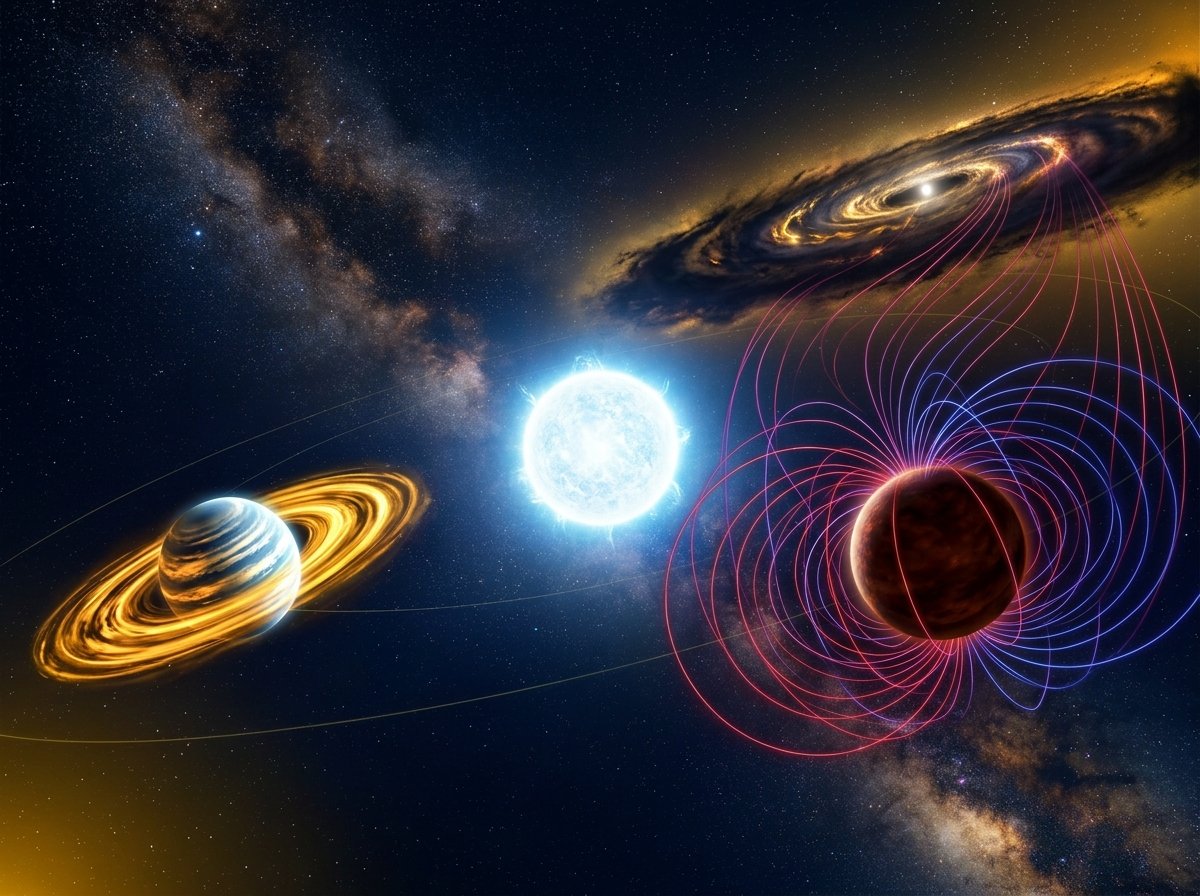
Remarkably, Losurdo’s lab-made dust produced the same distinctive infrared signatures observed in real cosmic dust found in space. That match strongly suggests the laboratory experiment closely reproduces the actual chemical processes believed to occur in genuine cosmic environments — around forming stars, inside dying stars, and throughout the interstellar medium.
“This can give us huge insight into how ‘carbonaceous cosmic dust’ can form in the plasma puffed out by giant, old stars or in cosmic nurseries where stars are being born and distribute these fascinating molecules that could be vital for life,” Losurdo explained. “It’s like we have recreated a little bit of the Universe in a bottle in our lab.”
One Of Science’s Great Unanswered Questions
How life began on Earth remains one of the most profound unresolved questions in all of science. Researchers continue investigating several competing (and potentially overlapping) possibilities: whether the first organic molecules formed directly on the young Earth, arrived aboard comets and meteorites from elsewhere in space, were delivered while the solar system itself was still forming, or resulted from some combination of all three.
What scientists do know is that from roughly 4.56 billion to 3.5 billion years ago, meteorites, micrometeorites, and interplanetary dust particles from asteroids and comets repeatedly struck Earth during a period of intense bombardment. Researchers believe these objects carried substantial quantities of organic material to the planet’s surface during this critical window.
What remains far less certain is where that organic material originally formed and which specific chemical processes created it in the first place.
“Covalently bonded carbon and hydrogen in comet and asteroid material are believed to have formed in the outer envelopes of stars, in high-energy events like supernovae, and in interstellar environments,” Losurdo said. “What we’re trying to understand are the specific chemical pathways and conditions that incorporate all of the CHON elements into the complex organic structures we see in cosmic dust and meteorites.”
Why Building Dust On Earth Matters
Studying cosmic dust directly in space is extraordinarily difficult — the material is scattered across vast distances, embedded in regions astronomers can only observe indirectly through telescopes, and largely inaccessible for direct physical analysis except in rare cases involving meteorite samples or sample-return missions.
By recreating analogous conditions in a controlled laboratory setting, researchers gain something genuinely valuable: the ability to systematically vary conditions — temperature, ion bombardment intensity, gas composition — and observe exactly how those variables shape the resulting chemistry. This kind of controlled experimentation simply isn’t possible when studying real cosmic environments from a distance.
“This also helps us interpret what a meteorite or asteroid fragment has been through over its lifetime,” McKenzie noted. “Its chemical signature holds a record of its journey, and experiments like this help us learn how to read that record.”
Building A Fingerprint Library For Astronomers
Beyond its immediate findings, the research team has a broader long-term goal: assembling a detailed database of infrared fingerprints produced by different types of laboratory-made cosmic dust, created under varying simulated conditions.
Astronomers could compare these laboratory-derived signatures against real telescope observations of star-forming regions and the remnants of dead stars. A matching infrared signal could reveal exactly where certain forms of cosmic dust are being produced in the universe, and help researchers reconstruct the specific physical and chemical processes occurring in those distant environments.
This database could also significantly improve scientists’ ability to interpret the chemical history preserved inside real meteorites and asteroid fragments recovered here on Earth — since their chemistry effectively records the temperatures, radiation exposure, and particle impacts they experienced throughout their long journeys through space.
Recognition For The Research
Losurdo’s work has already earned recognition within the scientific community — she received the award for best presentation for this research at the international Annual Meeting of the Meteoritical Society late last year.
The study received support from the University of Sydney node of Microscopy Australia, with funding provided by the Australian Research Council.
What This Means For Understanding Life’s Origins
This laboratory experiment represents a genuinely creative approach to one of science’s most enduring mysteries. Rather than waiting for rare meteorite samples or distant telescope observations, researchers can now systematically recreate the chemical conditions believed to exist throughout different cosmic environments — testing specific hypotheses about exactly how the building blocks of life might have first assembled among the stars, long before Earth itself even existed.
Every meteorite that struck the early Earth may have carried a piece of this same story — chemistry forged in the plasma surrounding dying stars or within the swirling nurseries where new stars are born, eventually seeding a young planet with the raw ingredients that, billions of years later, gave rise to life itself. 🌌🧬
Key Takeaways
- Researchers at the University of Sydney recreated cosmic dust in a laboratory by exposing nitrogen, carbon dioxide, and acetylene to 10,000 volts of electricity inside a vacuum-sealed glass tube
- The resulting dust contained CHON molecules (carbon, hydrogen, oxygen, nitrogen) — key building blocks associated with life
- The lab-made dust produced infrared signatures matching real cosmic dust observed in space
- This research could help scientists understand how organic chemistry unfolds around stars and how comets and meteorites may have delivered life’s ingredients to early Earth
- The team plans to build a broader database of infrared fingerprints to help astronomers interpret observations of star-forming regions and meteorite chemistry
Source: University of Sydney — July 19, 2026
Journal Reference: Linda R. Losurdo, David R. McKenzie. Carbonaceous Cosmic Dust Analogs Distinguish between Ion Bombardment and Temperature. The Astrophysical Journal, 2026; 997 (2): 335.
DOI: 10.3847/1538-4357/ae2bfe