





The human brain is often described as the most complex object in the known universe. About 86 billion neurons, each connected to thousands of others, woven into circuits of staggering intricacy. Building something like that from scratch — from a single fertilized cell — requires billions of individual neurons to form, travel, and connect with extraordinary precision.
A new study published in Nature just revealed something remarkable about that process: building the brain involves routinely breaking some of the most fundamental biological structures in existence.
The Journey Every Neuron Must Make
During fetal brain development, newly formed neurons don’t simply appear in their final positions. They must migrate — physically traveling through densely packed tissue to reach their designated locations in the cerebral cortex, where they will become permanent members of the brain’s communication network.
This journey forces neurons to squeeze through incredibly tight spaces between neighboring cells and tissue fibers. The cells must deform themselves to fit through gaps that are barely large enough to accommodate them, in a process that subjects their internal structures to significant mechanical stress.
Researchers from Kyoto University’s Institute for Integrated Cell-Material Sciences, led by Professor Mineko Kengaku, wanted to understand what this physical ordeal actually does to the cells. What they found was entirely unexpected.
DNA Breaks — The Most Severe Kind
To study the process in controlled conditions, the team guided neurons through tiny microchannels designed to mimic the confined spaces of developing brain tissue. Using fluorescent markers that make DNA damage visible, they watched what happened as the cells squeezed through.
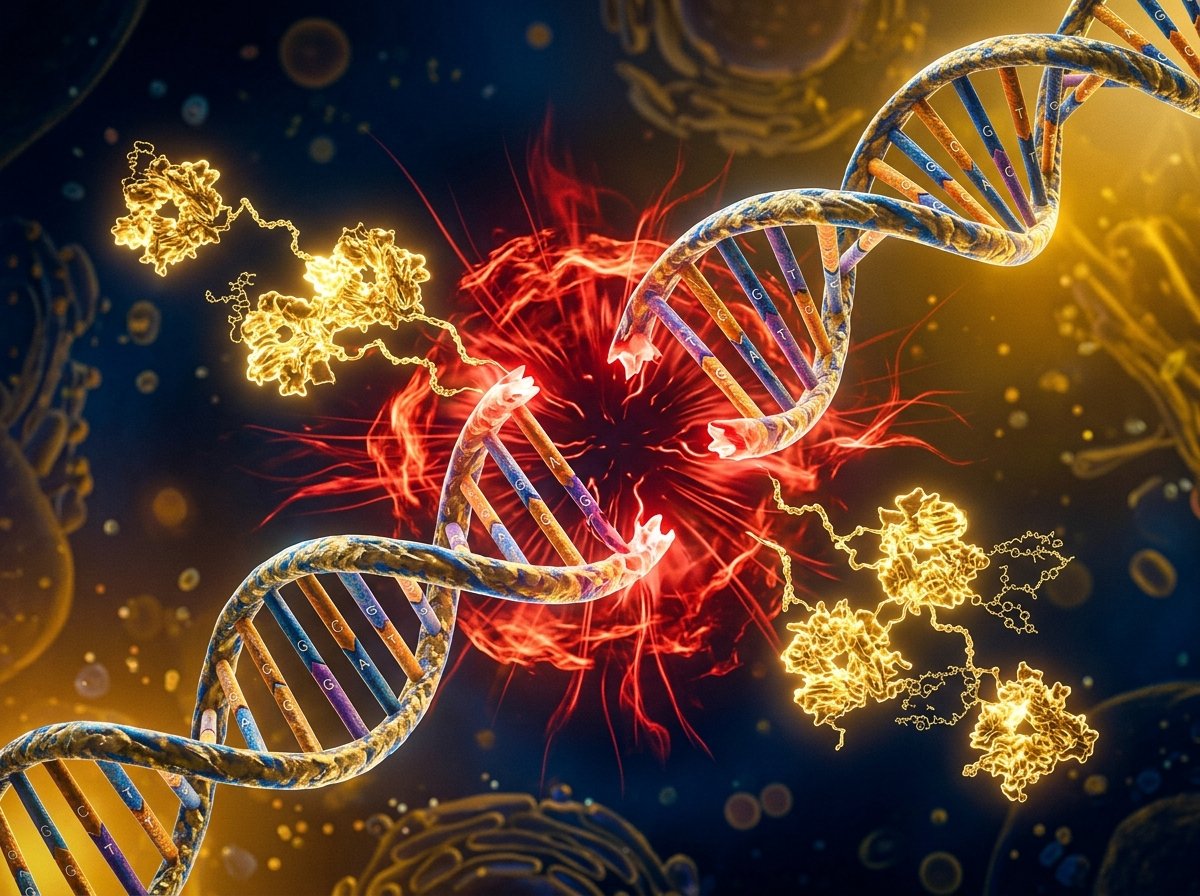
The neurons developed double-strand breaks — a form of DNA damage so severe that it cuts completely through both strands of the DNA double helix simultaneously, leaving the genetic material in pieces. This is the most catastrophic form of DNA damage a cell can experience. In most contexts, double-strand breaks trigger cell death, drive cancer, or cause lasting mutations.
In migrating developing neurons, they were happening routinely. As a normal part of brain construction.
The Enzyme Responsible
The researchers identified the specific mechanism causing the damage. An enzyme called Topoisomerase IIβ plays a normal and essential role in cellular biology — it helps relieve tension and twisting that builds up in DNA during ordinary cellular activities. It does this by temporarily cutting DNA strands, relieving the torsional stress, and then reconnecting them — a process comparable to cutting a tangled cable to remove its twists and then splicing it back together.
The problem arises when neurons are simultaneously under mechanical stress from squeezing through tight spaces. In those conditions, the enzyme can become trapped midway through its normal cut-and-reconnect cycle, leaving the DNA severed rather than repaired. The cell is then left with double-strand breaks that must be fixed through a separate DNA repair pathway called non-homologous end joining.
Why Neurons Survive When Other Cells Don’t
The natural question is: why don’t the neurons die? Double-strand breaks are supposed to be catastrophic.
The answer, the researchers found, lies in where the breaks occur. In developing neurons, the DNA damage was concentrated predominantly in regions of the genome that are not actively involved in critical gene functions. Essential genes — the ones the cell absolutely needs to survive and function — were largely spared from the damage. Because the breaks happened in relatively non-critical regions, the cell could maintain normal function despite the temporary molecular catastrophe happening in its nucleus.
In cancer cells going through the same microchannels, by contrast, DNA damage occurred more randomly and disrupted active cellular processes — consistent with the destructive consequences usually associated with this type of damage. The developing neuron’s genome, it seems, is somehow structured in a way that concentrates the mechanical damage away from the most essential regions during this critical period.
What Happens When Repair Fails
To understand the consequences of incomplete repair, the team engineered mice whose cerebellar neurons lacked Ligase 4, an enzyme required for the non-homologous end joining repair pathway. Without it, the neurons couldn’t properly fix the double-strand breaks they accumulated during migration.
The mice developed normally at first and showed no obvious early problems. But as they reached adulthood, they began developing mild balance difficulties that gradually worsened over time. These symptoms closely resemble those seen in certain human neurological conditions linked to genome instability — conditions that affect the cerebellum, the brain region responsible for motor coordination.
The connection between failed DNA repair during neuron migration and adult-onset neurological symptoms is exactly the kind of link researchers have been searching for.
Why Every Brain Is Genetically Unique
Beyond the immediate implications for neurodevelopmental and neurodegenerative disease research, the findings suggest something profound about brain biology at the most fundamental level.
All neurons in a brain originate from the same DNA — the same genome that was present in the original fertilized egg. But if neurons routinely break and repair their DNA during development, each repair event introduces the possibility of tiny genetic variations. Small differences in how breaks are rejoined could create subtle genetic distinctions between neurons that started out genetically identical.
“It shifts how we think about the neuronal genome,” said Professor Kengaku. “All neurons originate from the same DNA, but DNA damage and repair can introduce small genetic differences between individual neurons through a small mechanical journey. Some of that history may be written into the genome itself.”
This raises fascinating questions about whether the unique character of individual neurons — their specific connectivity, their particular functional properties — might in part reflect the physical history of their migration through the developing brain, written into their DNA one repaired break at a time. 🧠🧬
Source: Kyoto University / Nature — June 21, 2026
Journal Reference: Zhejing Zhang, Andres Canela, Junko Kurisu, et al. Confined migration induces non-lethal DNA damage in developing neurons. Nature, 2026.
DOI: 10.1038/s41586-026-10648-8