









There’s a particular cruelty to the plastic pollution problem. The material doesn’t disappear — it just moves. From a product to a landfill to a river to an ocean, where it breaks apart into smaller and smaller pieces, entering food chains and ecosystems in ways we’re still learning to measure.
In Hawaii, a group of researchers just proposed an unusually practical answer to at least part of that problem: grind it up and pave roads with it.
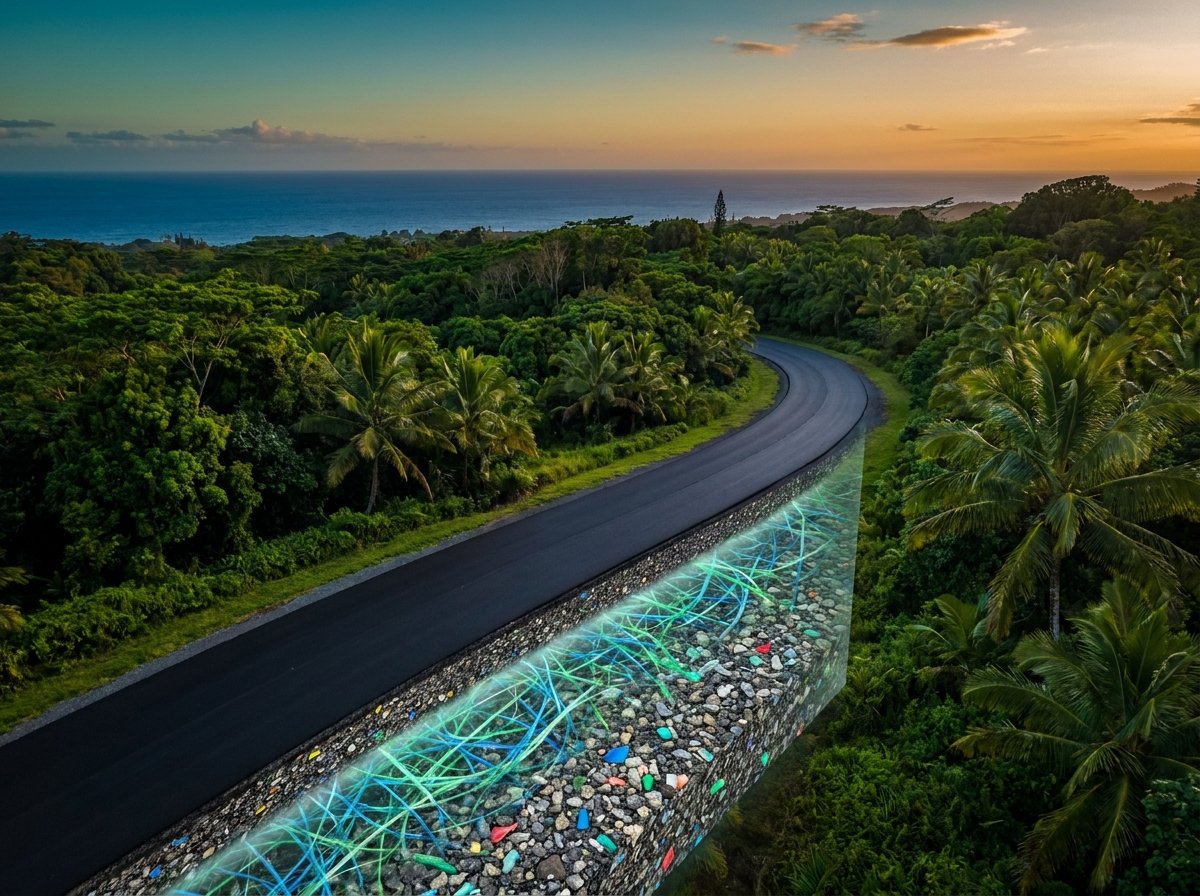
The concept, presented at the American Chemical Society spring meeting, involves incorporating recycled ocean plastic and discarded fishing nets into standard asphalt road material — creating infrastructure that simultaneously diverts marine plastic waste, reduces landfill pressure, and potentially produces roads that perform just as well as conventional pavement.
The early results are more encouraging than many expected.
The Problem Hawaii Was Trying To Solve
Hawaii occupies a unique and difficult position when it comes to waste management. As a remote island state in the middle of the Pacific Ocean, it faces two intersecting challenges that mainland regions don’t encounter in the same way.
Marine plastic pollution is not abstract for Hawaii — it’s a daily reality. Ocean currents deposit debris on Hawaiian shores constantly, including the particularly damaging category of ghost fishing gear: nets, lines, and traps lost or abandoned by fishing vessels that drift through the Pacific for years or decades, entangling marine life and accumulating into large debris fields. Hawaii is both a recipient of this waste and home to a significant fishing industry that generates its own end-of-life gear that needs disposal.
Landfill capacity is an existential constraint for island states in a way it simply isn’t for continental regions. When you run out of land, you run out of options. Hawaii’s landfills are under significant pressure, and finding alternatives to burying waste in limited island land is a genuine policy priority.
Turning one problem into feedstock for the other — using the plastic waste stream as a material input for road construction — is the kind of circular economy thinking that works elegantly on paper. The researchers at the University of Hawaii set out to determine whether it works in practice.
How Plastic Roads Are Made
The process of incorporating plastic into asphalt is not entirely new — countries including India, the Netherlands, and the UK have experimented with plastic-modified roads for years, with varying levels of success and durability.
The general approach involves shredding or granulating plastic waste into small particles, then either mixing those particles directly into the asphalt aggregate or using them to partially replace or modify the bitumen binder that holds the road surface together.
In Hawaii’s case, the researchers specifically focused on ocean-derived plastics and discarded fishing nets — materials that are abundant locally, difficult to recycle through conventional channels, and currently mostly destined for landfill. Fishing nets in particular are made from nylon and other durable synthetic fibers that don’t break down easily and are notoriously difficult to process through standard recycling infrastructure.
Incorporating these materials into asphalt gives them a defined, functional second life — turning a waste management problem into a construction material.
The Critical Safety Question: Microplastics
The most important concern about plastic-modified roads isn’t structural — it’s environmental. Specifically: if you build microplastics into road surfaces and then run vehicles over those surfaces for years, do you end up releasing more microplastic particles into the surrounding environment than a conventional road would?
This question matters enormously. Roads are major sources of tire wear particles — a form of microplastic generated as rubber tires gradually abrade against road surfaces during normal driving. These particles are washed into waterways by rain and are now recognized as a significant pathway for microplastic contamination of aquatic ecosystems.
Adding more plastic material to the road surface could, in theory, add another source of microplastic particles on top of the existing tire wear problem. If true, plastic roads could inadvertently make the microplastic pollution problem worse rather than better.
The Hawaii researchers tested this directly. They analyzed particle releases from their recycled plastic asphalt and compared them to standard conventional road surfaces under equivalent conditions.
The finding was reassuring — and somewhat counterintuitive. The recycled plastic roads did not release meaningfully more plastic particles than standard pavement. In fact, the plastic signal from the recycled road material was effectively overwhelmed by the microplastic particles already being generated by tire wear on the road surface itself.
Tire wear is such a dominant source of road-associated microplastics that the additional contribution from the recycled plastic content of the asphalt was statistically indistinguishable from noise. The plastic roads and conventional roads were essentially equivalent in terms of particle release.
This is a significant finding for the technology’s viability. It suggests that the environmental microplastic risk of using ocean plastic in road construction may be comparable to the risk already present in conventional road surfaces — removing one of the most obvious potential objections to the approach.
What Still Needs To Be Proven
The researchers are appropriately cautious about the scale of what’s been demonstrated so far. Early safety results are encouraging — but several important questions remain unanswered before this technology could be deployed at scale.
Durability is the most critical unknown. Roads need to survive years of heavy traffic, temperature extremes, rain, UV exposure, and the mechanical stress of repeated vehicle loads. Whether plastic-modified asphalt performs as well as conventional pavement over the full lifecycle of a road surface — and whether it degrades differently in ways that could affect both structural performance and environmental particle release — needs to be established through longer-term testing.
Scalability of the supply chain is another practical question. Hawaii’s ocean plastic and fishing gear waste stream is real but finite. Understanding how much material can realistically be collected, processed, and incorporated into road construction — and what that means for the economics of the approach — requires more detailed analysis.
Long-term environmental monitoring around plastic-modified road surfaces will be needed to confirm that the early particle release findings hold up under real-world conditions over extended periods.
The Bigger Picture
If future studies confirm durability and ongoing safety, the Hawaii research points toward a genuinely scalable application for a category of plastic waste — ocean debris and fishing gear — that currently has very few viable end-of-life destinations.
Road construction is a massive, global, continuously active industry. Even modest incorporation of recycled ocean plastic into asphalt across major road networks could represent a significant and permanent sink for material that currently has nowhere productive to go.
And in Hawaii specifically, it would mean that the plastic washing up on beaches and the fishing nets coming off boats at the end of their working lives don’t just become another thing to bury in dwindling landfill space — they become part of the road you’re driving on. ♻️🛣️
Source: American Chemical Society / University of Hawaii — June 28, 2026
Note: Research presented at the American Chemical Society spring meeting. Full peer-reviewed journal publication pending.