



Here’s something that might change the way you think about every sweetened drink and processed snack you’ve ever consumed.
Fructose and glucose — the two sugars found in virtually every sweetened product in the modern food supply — contain the exact same number of calories. On a nutrition label, they’re indistinguishable. For decades, most scientific models assumed that what mattered for hunger and satiety was the total calorie content, not the specific type of sugar providing those calories.
A landmark new study published in Neuron by scientists at the Monell Chemical Senses Center just proved that assumption wrong — at the level of individual neurons in the brain.
The research reveals that fructose and glucose communicate with hunger-regulating brain cells through completely separate biological pathways, and the difference in how strongly each sugar suppresses hunger is striking.
Scientists Built A Skin-Like AI Patch That Detects Heart Attacks In Milliseconds
How Your Brain Normally Registers Fullness
To understand why this matters, you need to understand a specific type of brain cell called AgRP neurons — short for agouti-related protein neurons.
These neurons are among the most powerful hunger signals in the brain. When AgRP neurons are active, you feel hungry. When their activity is suppressed — by food, by hormones, by nutrients reaching the gut — hunger fades and you feel satiated.
The degree to which eating suppresses AgRP neuron activity is a direct measure of how satisfying that food is to the brain. And it’s here that fructose and glucose diverge dramatically.
Glucose Strongly Silences Hunger Neurons
When researchers administered glucose to mice and recorded AgRP neuron activity, the results were clear.
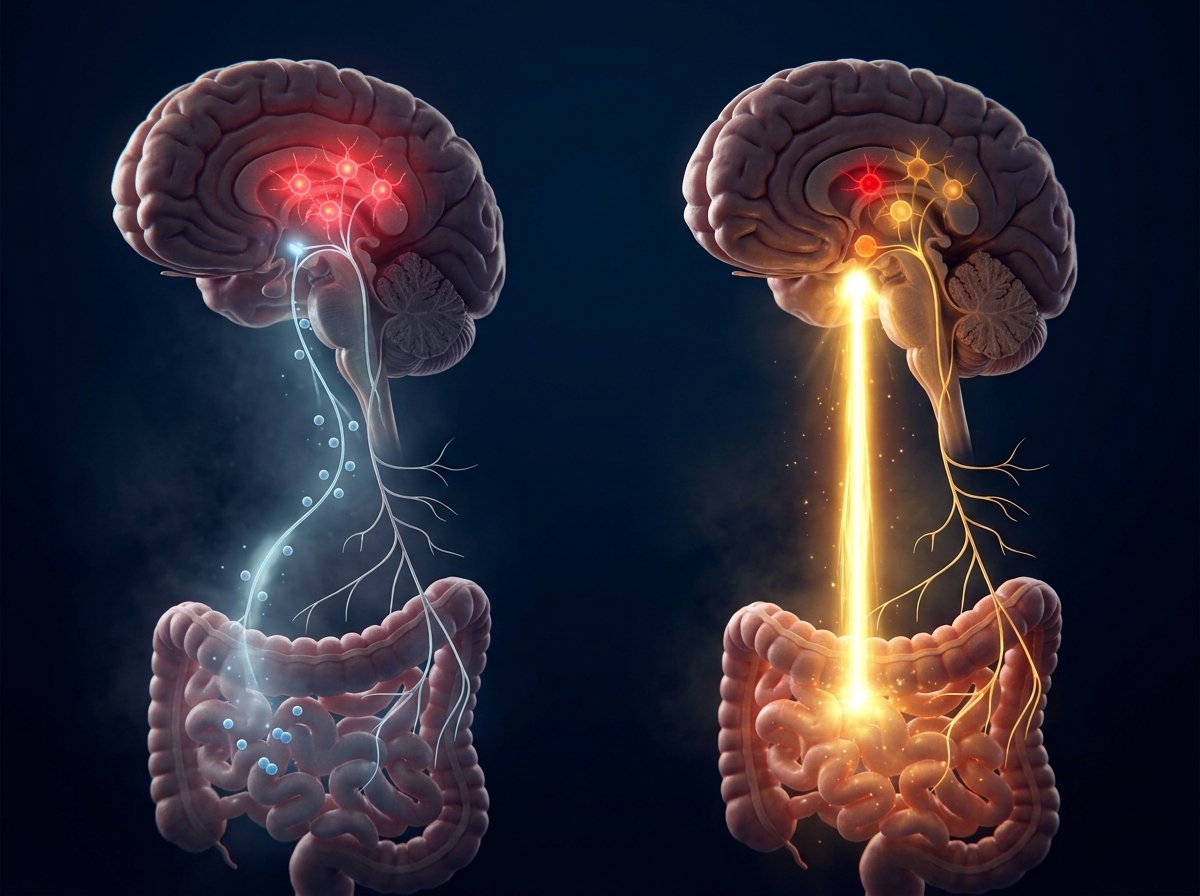
Glucose powerfully and directly suppressed AgRP neurons, producing a strong, sustained reduction in hunger-related brain signaling. The pathway was robust and the effect was large — exactly what you would expect from a sugar that the brain recognizes as a meaningful energy signal.
This is consistent with decades of evidence that the brain monitors blood glucose levels closely as a proxy for overall energy status.
Fructose Barely Makes A Dent
Fructose told a very different story.
When fructose was administered, it did eventually reach the same AgRP neurons — but through a much more indirect and far weaker route. Fructose first triggered the release of a gut hormone called PYY (peptide YY) in the intestine. That hormone then traveled through the vagus nerve to eventually reach the brain and produce a modest reduction in AgRP neuron activity.
When researchers experimentally disrupted this PYY-vagus nerve pathway, fructose lost its ability to affect hunger neurons at all — confirming that this indirect route is the only meaningful signal fructose sends to the brain.
The result: same calories consumed, dramatically weaker hunger suppression. Fructose leaves the brain’s hunger system substantially more active than glucose does, even when the two sugars have delivered identical amounts of energy.
Why High-Fructose Corn Syrup Is Particularly Problematic
The most practically significant finding in the study involves high-fructose corn syrup (HFCS) — the sweetener found in the vast majority of sodas, sweetened beverages, baked goods, condiments, and processed foods across the modern food supply.
HFCS is a blend of fructose and glucose. In the study, HFCS suppressed AgRP neuron activity more strongly than fructose alone — which makes sense, since it contains glucose as well as fructose. But the key finding was behavioral:
The mice showed a clear preference for HFCS over other sugars.
The researchers believe this preference is directly linked to the degree of AgRP neuron suppression each sugar triggers. Because HFCS’s glucose component produces stronger hunger suppression while the fructose component keeps a baseline of hunger-promoting activity running, the combination may create a particularly compelling drive to consume — seeking out both the satisfaction signal and the continued mild hunger simultaneously.
This may help explain why foods and beverages containing HFCS can be so difficult to stop eating or drinking even after consuming substantial calories.
Challenging A Fundamental Assumption About Calories And Hunger
The study’s implications go beyond just fructose and glucose. They challenge something more foundational about how we have long understood the relationship between calories and hunger.
The prevailing assumption has been that AgRP hunger neurons primarily track calorie intake — that what matters to the brain’s satiety system is how much energy has been delivered, regardless of where it came from. Under this model, a calorie of fructose and a calorie of glucose should suppress hunger equally, because they provide equal energy.
The new research shows this is wrong. AgRP neurons can distinguish between different sugars and respond to them through separate biological pathways with dramatically different magnitudes of effect. The brain is not simply counting calories — it’s evaluating specific molecular signals from the gut and responding differently depending on the type of nutrient it detects.
“This work adds to our growing understanding of how modern diets, especially those high in fructose or high-fructose corn syrup, interact with the neural systems involved in appetite,” said senior author Dr. Amber Alhadeff of the Monell Chemical Senses Center.
What This Means For How We Think About Sugar
The distinction between fructose and glucose effects on appetite matters enormously in the context of modern food consumption patterns.
Fructose consumption has increased dramatically since the widespread introduction of HFCS in the 1970s and 1980s. Today, fructose from HFCS and other sources is found in:
- Soft drinks and sweetened beverages
- Packaged snack foods and cookies
- Condiments including ketchup and salad dressings
- Breakfast cereals and granola bars
- Fruit juices and flavored drinks
All of these products deliver substantial fructose calories while producing a weaker brain hunger signal than an equivalent amount of glucose would. The practical consequence is that the brain’s hunger-suppression system is only partially engaged — leaving a persistent low-level hunger signal running that may drive continued eating and drinking beyond actual energy needs.
This is not about willpower or discipline. It’s about how specific molecules interact with specific neural circuits in ways that evolved for a food environment very different from the one we now inhabit.
The Bottom Line
Fructose doesn’t satisfy hunger the way glucose does — not because of the calories it provides, but because of the specific and weaker signal it sends to the brain’s hunger-regulating neurons.
And high-fructose corn syrup, the sweetener in the majority of the modern processed food supply, may combine the partial satisfaction of glucose with the persistent hunger-promoting effect of fructose in a way that makes overconsumption a predictable biological outcome rather than a personal failing.
The research is still in animal models, and human studies will be needed to confirm these mechanisms directly in people. But the findings, published in one of neuroscience’s most respected journals, provide the clearest mechanistic explanation yet for something many people have experienced but never had a biological reason for: why you can drink an entire soda and still feel like you haven’t quite had enough. 🧠🍬
Source: Monell Chemical Senses Center / Neuron — June 2026
Journal Reference: Aaron D. McKnight, Alan de Araujo, Fang-Yu Hsu, Alexandra G. Vargas-Elvira, et al. Attenuated hypothalamic response to fructose via a dedicated gut-brain pathway. Neuron, 2026.
DOI: 10.1016/j.neuron.2026.05.013