







Most people think about vitamin C when they feel a cold coming on. It’s the supplement you grab at the pharmacy, the extra orange juice you squeeze when you’re run down. Immune support. That’s the story most of us know.
But a large new study from Japan just added a chapter to that story — and it’s one that anyone concerned about brain aging should read carefully.
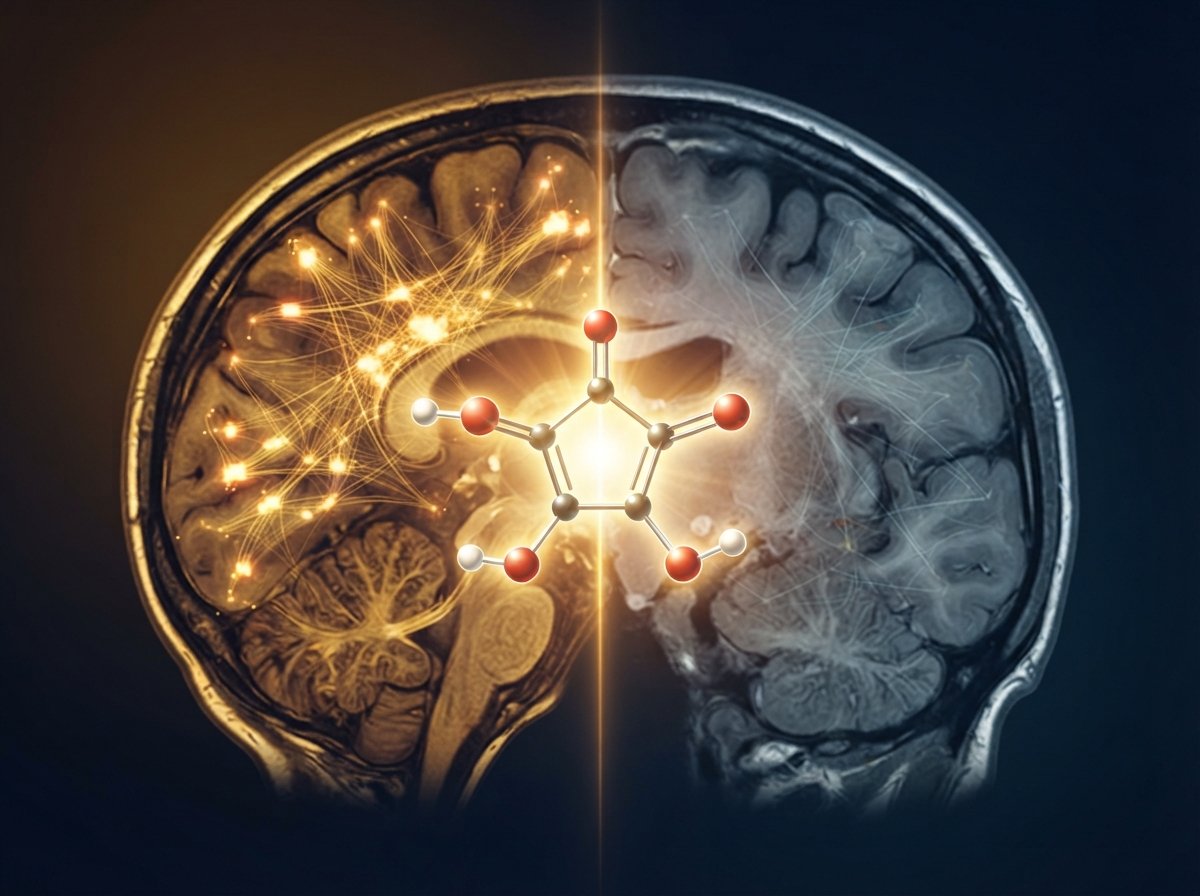
In a study of more than 2,000 older adults in Japan, people with lower levels of vitamin C in their blood tended to have less gray matter and weaker connections within an important brain network involved in memory and attention.
The research, led by Haruka Nagaya and colleagues at Hirosaki University and published in PLOS One, represents one of the largest investigations to date directly linking measured blood levels of vitamin C to actual brain structure — not self-reported diet, not questionnaire data, but MRI scans and blood samples from over two thousand real people.
What The Researchers Actually Measured
To understand why this study stands out, it helps to understand what the researchers did — and why it’s more rigorous than most nutrition-brain research.
The team analyzed MRI brain scans and plasma vitamin C levels from 2,044 Japanese adults over the age of 64, drawn from a large community-based health cohort in the Hirosaki region of Japan.
They measured two specific things:
- Gray matter volume — the density of the brain tissue containing neurons and their connections, which tends to decline with age and is reduced further in conditions like Alzheimer’s disease
- Default mode network connectivity — the strength of connections between regions of the brain that work together during memory retrieval, self-reflection, future thinking, and sustained attention
“Vitamin C is a vital antioxidant, and its concentration in the brain — in cerebrospinal fluid — is more than twice as high as in the blood,” said Dr. Tomohiro Shintaku, corresponding author of the study.
After controlling for age, sex, physical activity, education level, and health conditions including high blood pressure, the association was clear and consistent:
- Lower plasma vitamin C → lower gray matter volume
- Lower plasma vitamin C → weaker connectivity within the default mode network
Why The Default Mode Network Matters
The default mode network (DMN) is one of the most important large-scale brain systems identified in modern neuroscience. It’s a collection of brain regions that work in concert when you’re not focused on the external world — during:
- Autobiographical memory — recalling personal experiences
- Future thinking and planning — imagining future events
- Self-referential processing — reflecting on your own thoughts and identity
- Attention regulation — sustaining focus when it matters
The DMN is one of the first brain networks to show disruption in Alzheimer’s disease and other forms of cognitive decline. Researchers have identified it as a critical early biomarker — changes in DMN connectivity often appear before any obvious cognitive symptoms in people who later develop dementia.
Finding that lower vitamin C levels are associated with weaker DMN connectivity in healthy older adults is therefore not a trivial observation.
How Vitamin C Might Protect The Brain
The study shows association — not cause and effect. But there are biologically plausible reasons why vitamin C might support brain health, and they go well beyond its immune function.
As a powerful antioxidant:
- The brain is particularly vulnerable to oxidative damage because it consumes an enormous amount of oxygen relative to its size
- Vitamin C neutralizes free radicals — reactive molecules that damage neurons, mitochondria, and the protective structures around nerve fibers
- Chronically low vitamin C may allow oxidative damage to accumulate in brain tissue over years and decades
In collagen and tissue support:
- Vitamin C is essential for collagen synthesis — the structural protein that maintains the integrity of blood vessels, including the tiny capillaries supplying the brain with oxygen and nutrients
- Poor vascular health is a major driver of both gray matter loss and cognitive decline
In neurotransmitter production:
- Vitamin C is a required cofactor for the synthesis of dopamine and norepinephrine — neurotransmitters involved in attention, motivation, and cognitive function
- Deficiency may subtly impair these systems over time
Vitamin C is best known for supporting immune function, but it also acts as a powerful antioxidant and plays important roles in protecting nerve cells from oxidative stress.
What This Study Can And Cannot Tell Us
Intellectual honesty requires being clear about the limitations here.
The findings do not confirm any cause-and-effect relationship between vitamin C levels and brain health, and further research is needed to explore the biological mechanisms behind the observed statistical associations.
This study is cross-sectional — it measured vitamin C and brain structure at a single point in time. That means it cannot tell us whether low vitamin C caused the gray matter reduction, whether people with less gray matter for other reasons eat less vitamin C-rich food, or whether some third factor explains both.
The study also focused on older Japanese adults — a population with specific dietary patterns and genetic backgrounds. The researchers want to see whether they can replicate their findings in longitudinal studies that track people over several years, and in more diverse groups.
What it does tell us: in a large, well-controlled study, the relationship between vitamin C status and brain structural health was real, consistent, and statistically significant after accounting for major confounders.
Practical Steps: Getting Enough Vitamin C Daily
Vitamin C cannot be stored in the body — it must be replenished daily through food. The good news is that this is genuinely straightforward with a varied diet.
Richest food sources of vitamin C:
- Bell peppers (especially red) — one medium pepper provides over 150mg
- Citrus fruits — oranges, grapefruit, lemons
- Strawberries — one cup provides approximately 85mg
- Broccoli — one cup cooked provides approximately 100mg
- Brussels sprouts — one cup provides approximately 75mg
- Kiwi fruit — one kiwi provides approximately 65mg
- Tomatoes — fresh or cooked
Recommended daily intake:
- Adults: 65–90mg per day (US RDA)
- Upper tolerable limit: 2,000mg per day
- Most adults can easily meet their needs through a diet rich in fruits and vegetables
Key considerations:
- Vitamin C is destroyed by heat and prolonged cooking — raw or lightly cooked vegetables preserve more
- Smokers need approximately 35mg more per day than non-smokers due to increased oxidative stress
- Older adults may absorb vitamin C less efficiently and may benefit from consistent dietary attention
Key Takeaways
- A study of 2,044 older Japanese adults found lower blood vitamin C was associated with less gray matter and weaker default mode network connectivity
- The default mode network is critical for memory, attention, and self-reflection — and is disrupted early in Alzheimer’s disease
- Vitamin C’s antioxidant, vascular, and neurotransmitter-supporting roles provide biological plausibility for brain protection
- This study shows association, not causation — clinical trials are needed to confirm a protective effect
- Getting adequate vitamin C daily through a varied diet rich in fruits and vegetables is a safe, evidence-supported nutritional goal for all adults
When To See A Healthcare Professional
Speak with your doctor or dietitian if:
- You suspect you may not be getting adequate vitamin C through diet
- You experience unexplained fatigue, poor wound healing, or joint pain (possible signs of deficiency)
- You are considering high-dose vitamin C supplementation
- You or a family member are experiencing memory concerns or signs of cognitive change
References:
Nagaya H, Shintaku T, et al. Vitamin C levels in blood plasma linked with brain connectivity and volume in older adults. PLOS One, 2026.
DOI: 10.1371/journal.pone.0348504
⚠️ Medical Disclaimer: This article is for informational purposes only and does not constitute medical advice. Always consult a qualified healthcare professional before making changes to your diet or supplement regimen.
Have you thought about vitamin C as anything more than an immune booster? Share your thoughts below — we’d love to hear from you.