









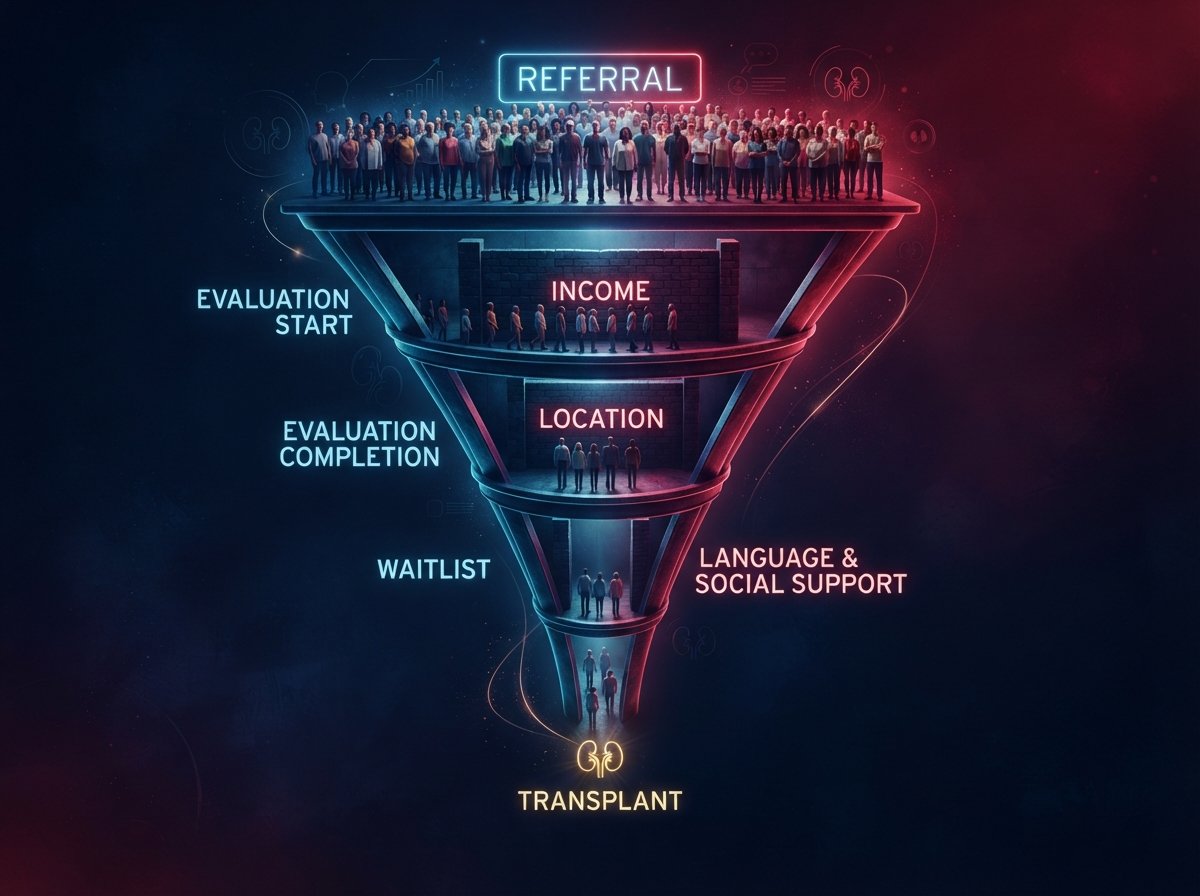
Getting referred for a kidney transplant feels like a turning point. Like a door finally opening after years of kidney disease, dialysis, and declining health.
For nearly half of all referred patients in the United States, that door never leads anywhere. New research just revealed the scale of this quiet crisis — and identified the factors that determine who gets through and who doesn’t.
The answer has little to do with medical eligibility. It has a great deal to do with where you live, how much money you make, whether you’re married, and which hospital you happen to be referred to.
The Largest Study Of Its Kind
Published in the Journal of the American Society of Nephrology, the study was led by Dr. Conor Donnelly, a resident and PhD student at NYU Grossman School of Medicine. The team analyzed data from 720,348 patients referred for kidney transplantation between 2014 and 2025, drawn from Epic Cosmos — a massive electronic health record database covering more than 300 million patients across over 1,850 hospitals, including more than a third of all US transplant centers.
Each patient was tracked through four distinct stages of the transplant pathway:
- Referral — being sent to a transplant center for consideration
- Evaluation — undergoing the comprehensive medical assessment required before listing
- Waitlist — being formally added to the national kidney transplant waitlist
- Transplant — receiving a donor organ
The findings at each stage were deeply sobering.
What The Numbers Actually Show
48% of referred patients never started the evaluation process at all.
Nearly half. Gone from the system before they filled out a single form, before they attended a single appointment, before they made any medical progress at all.
Of those who did begin, many still didn’t finish. Only 19% of all referred patients — fewer than one in five — ultimately made it onto the transplant waitlist.
“Our findings suggest that a substantial proportion of people who need a new kidney fall out of the process long before they reach the waitlist, let alone make it to the operating room,” said Dr. Donnelly. “Which transplant center you go to, where you live, and even whether you are married all appear to influence your chances of moving forward to the waitlist for a new kidney.”
The Barriers That Decide Who Advances
Statistical modeling revealed a clear and troubling picture of who was least likely to progress through each stage of the transplant process.
Social and demographic barriers:
- Being unmarried — patients without a spouse or partner were significantly less likely to advance. The researchers suggest this reflects the practical reality that transplant evaluation requires repeated appointments, transportation, and logistical coordination that is far harder to manage alone
- Lower income — financial barriers affect both the ability to navigate a complex system and the practical costs of repeated testing and travel
- Speaking Spanish as a primary language — language barriers created measurable disadvantages in navigating an English-dominant healthcare system
- Older age — older patients were less likely to be fully evaluated or waitlisted, likely reflecting both clinical decisions and practical challenges
Geographic barriers:
- Living in rural communities — patients in rural areas faced reduced access to transplant centers and fewer resources to support the evaluation process
- Being treated at smaller transplant centers — smaller programs had lower rates of patient advancement, potentially reflecting resource limitations or greater selectivity in candidate acceptance
- Being in the Southern United States — patients at transplant centers in the South showed lower rates of progression, even after controlling for other factors
Medical factors:
- Severe obesity — patients with higher BMI were less likely to complete evaluation and reach the waitlist, consistent with known clinical thresholds at many transplant programs
Why The Evaluation Process Itself Is A Barrier
To understand why so many patients fall away, it’s essential to understand what the kidney transplant evaluation actually involves.
After receiving a referral, patients must complete an extensive medical workup to assess their overall suitability for surgery. This typically includes:
- Blood tests and tissue typing for donor compatibility
- Cardiac evaluation — stress tests, echocardiograms, cardiac catheterization in some cases
- Chest imaging and pulmonary function testing
- Cancer screenings — mammograms, colonoscopies, depending on age and history
- Psychosocial assessment — evaluating mental health, social support, and ability to adhere to post-transplant medication regimens
This process may require multiple separate appointments spread across several weeks or months — all while the patient continues to attend dialysis sessions three times per week.
For someone living in a rural area, without a partner to help organize appointments, with limited income and transportation options, in a language other than English — this process presents a formidable series of compounding obstacles.
Smaller transplant centers, the study also found, may be more selective in pursuing candidates to evaluation, potentially reflecting both resource constraints and the availability of donor organs in their region.
What The Research Team Recommends
The findings are not just a description of a problem — they point toward specific opportunities for intervention.
“These results demonstrate that finding ways to reduce barriers to both evaluation and waitlisting could help expand much-needed access to kidney transplantation,” said study co-senior author Allan B. Massie, PhD. “Providing patients with better education and support to help them navigate the complex and sometimes grueling process would be a good start.”
Practical interventions that could help include:
- Patient navigation programs — dedicated staff who guide patients through the evaluation process, track their progress, and proactively address barriers as they arise
- Telehealth evaluation components — reducing the number of in-person visits required, particularly for patients in rural areas
- Language support services — interpreter services and translated materials integrated throughout the evaluation pathway
- Transportation assistance — coordinated support for patients who cannot drive or lack reliable access to transportation
- Social support assessment — identifying patients who are isolated early in the process and connecting them with community support resources before barriers become insurmountable
The Bigger Picture: Health Equity In Organ Transplantation
This study is the largest and most detailed examination to date of where patients leave the kidney transplant pathway before reaching the waitlist. But the implications extend beyond kidneys.
Co-senior author Dr. Michal A. Mankowski noted that future research will apply a similar analytical framework to other organ transplant pathways — liver, heart, lung — where pre-waitlist dropout may be equally significant but less well understood.
The kidney transplant system in the United States has long been scrutinized for disparities in who receives organs once on the waitlist. This research shifts the lens to an earlier and perhaps more correctable point in the process: who gets to the waitlist in the first place.
Key Takeaways
- Nearly half of all referred kidney transplant patients never begin the evaluation process
- Only 19% of referred patients ultimately reach the transplant waitlist
- Marital status, income, language, geography, age, and transplant center all independently influence who advances
- The evaluation process itself — complex, multi-visit, and conducted during dialysis — creates disproportionate barriers for the most vulnerable patients
- Navigation support, telehealth, language access, and transportation assistance are actionable interventions that could close this gap
When To Seek Help Navigating The Transplant Process
If you or someone you love has been referred for kidney transplant evaluation:
- Ask your transplant center what patient navigation or social work support is available
- Request a patient advocate or case manager if the process feels overwhelming
- Inquire about telehealth options for evaluation appointments to reduce travel burden
- Ask about transportation assistance programs through the transplant center or local kidney disease organizations
- Contact the American Kidney Fund or the National Kidney Foundation for patient support resources
The system has gaps. But knowing they exist — and asking for help navigating them — can make the difference between falling through and moving forward. 💙
⚠️ Medical Disclaimer: This article is for informational purposes only and does not constitute medical advice. Always consult with your nephrologist or transplant team about your individual medical situation and eligibility.
Have you or someone you know experienced barriers in the kidney transplant process? We’d love to hear your story in the comments — your experience could help others know what to expect and how to advocate for themselves.
Source: NYU Langone Health / NYU Grossman School of Medicine — July 1, 2026
Journal Reference: Conor B. Donnelly, Suhani S. Patel, Syed Ali Husain, et al. Evaluating Barriers to Kidney Transplantation in the United States. Journal of the American Society of Nephrology, 2026.
DOI: 10.1681/ASN.0000001162