






Most of the technology that defines modern life runs on light and electricity.
Fiber optic cables carry your internet data as pulses of light. Processors in your phone and laptop manipulate electrons. Even wireless communication — WiFi, 5G, Bluetooth — works by sending electromagnetic waves through the air.
But light has limits. It can’t travel through ocean water. It can’t pass through the kind of dense biological tissue that surrounds the heart and brain. And in some of the most extreme environments on earth and in space, electromagnetic signals fail entirely.
Sound doesn’t have these problems. It travels through mediums that completely block light. It penetrates biological tissue with ease. It carries information through ocean depths where electromagnetic signals die within meters.
Harnessing sound at the quantum level — precisely controlling individual sound-like particles the way lasers control individual photons of light — has been one of the most tantalizing and difficult goals in modern physics.
Scientists at McGill University just took a major step toward that goal. And what they found in the process suggests that our current understanding of how energy moves through advanced materials needs to be fundamentally revised.
What Are Phonons And Why Do They Matter?
Before understanding the discovery, it helps to understand what phonons actually are.
When atoms vibrate — which they do constantly at any temperature above absolute zero — those vibrations don’t just occur randomly and independently. They propagate through the material as waves, similar to how a wave travels through water when you drop a stone.
Phonons are the quantum mechanical description of these vibrations — the particle-like packets of vibrational energy that carry sound through solid materials. The word comes from the Greek phone, meaning sound, combined with the quantum physics suffix -on used for particles.
Like photons (particles of light), phonons can carry information. Like photons, they can be manipulated, controlled, and — in principle — used to build devices that process and transmit information.
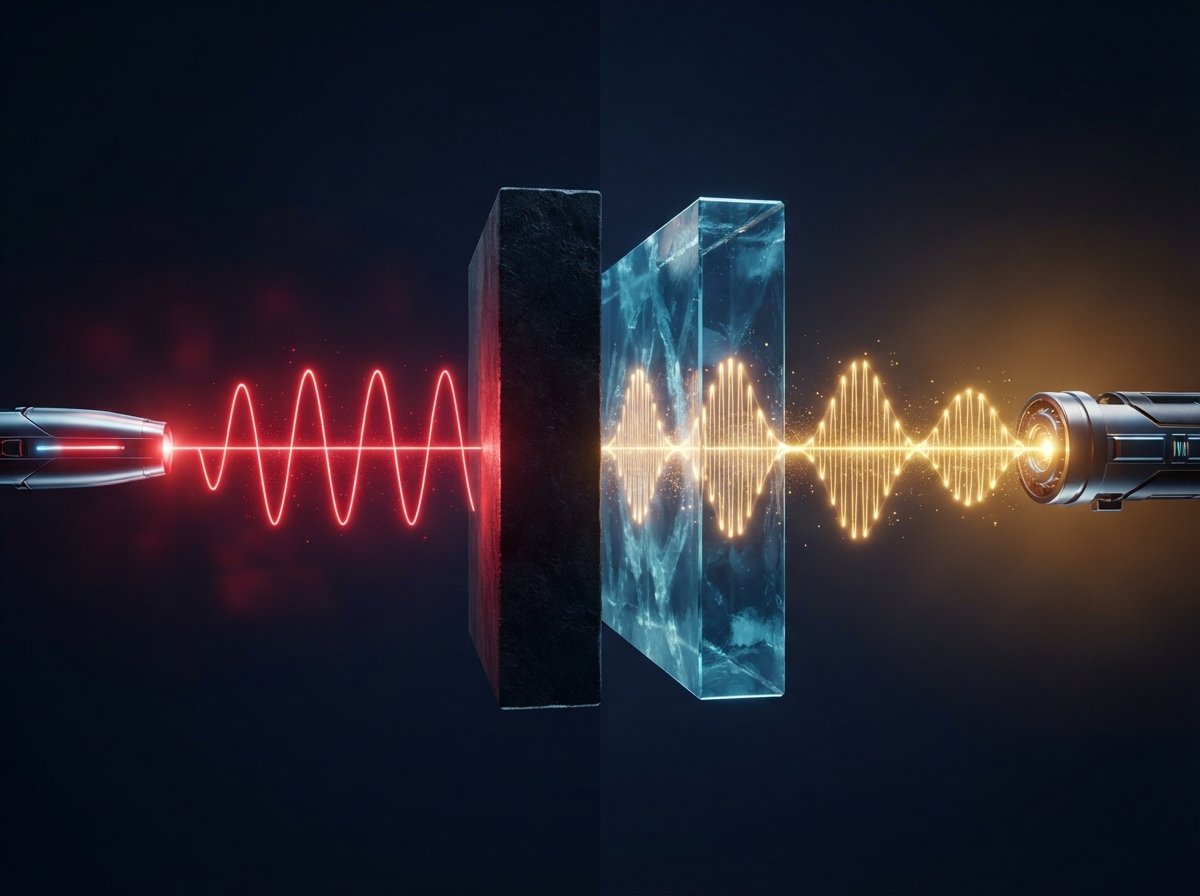
A phonon laser would do for sound what an optical laser does for light: produce a coherent, precisely controlled beam of phonons — all at the same frequency, all moving in the same direction, all perfectly synchronized. The applications would be enormous:
- Medical imaging — ultrasound already uses sound waves in medicine, but quantum phonon control could enable far more precise diagnostics and treatment
- Secure communications — phonon-based signals could travel through environments where light-based signals fail entirely
- Quantum sensing — phonon sensors could detect gravitational waves, measure forces, and monitor biological systems with unprecedented sensitivity
- Materials science — precisely controlled phonons could probe the structure of materials at atomic scales
The challenge is that generating phonons in a controlled, quantum-level way has proven extraordinarily difficult. Until now.
The McGill Experiment: Pushing Electrons To Supersonic Speed
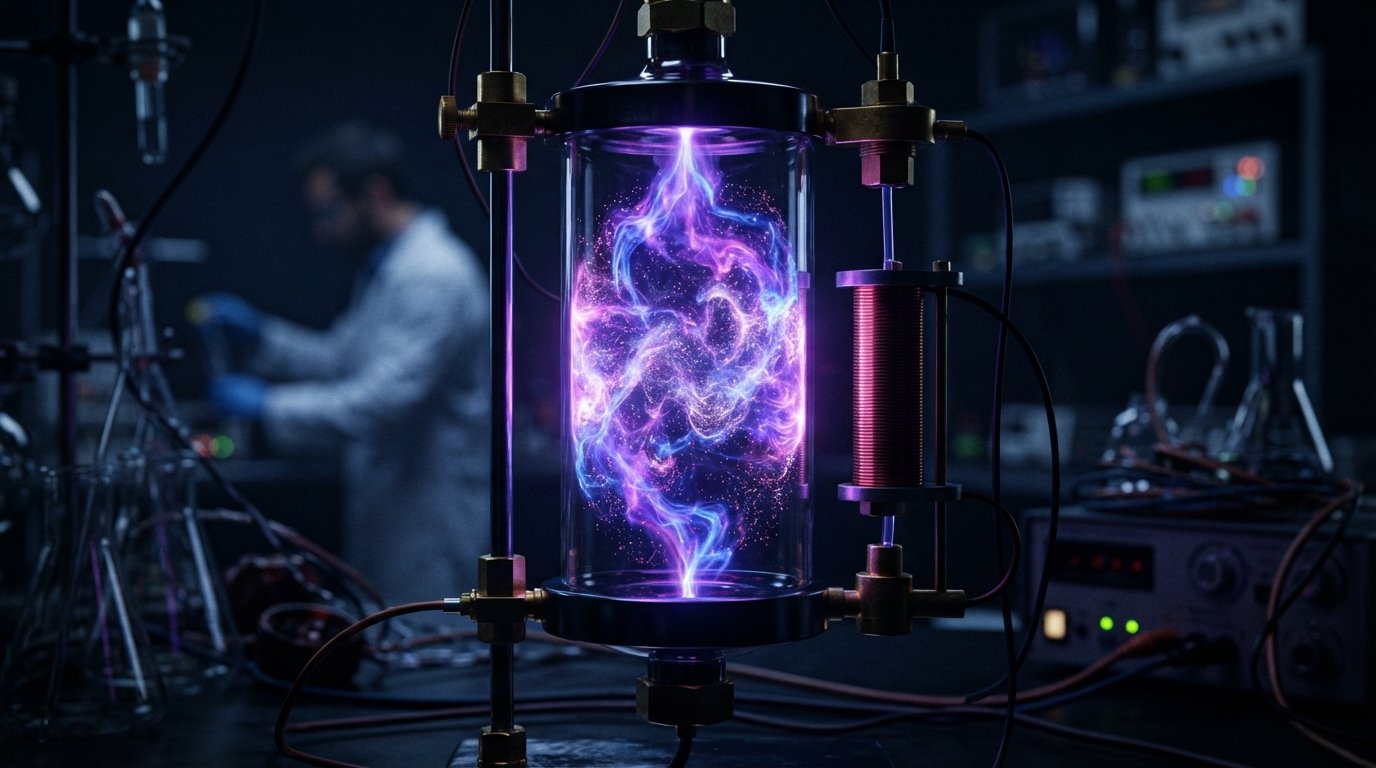
The research team, led by Associate Professor Michael Hilke at McGill University’s Department of Physics and working with the National Research Council of Canada and Princeton University, built their quantum device using a two-dimensional crystal — a material so thin it is only a few atoms deep.
Within this ultra-thin material, electrons are confined to a channel barely wide enough to accommodate them. When an electrical current pushes electrons through this narrow channel at very high speeds — and at temperatures ranging from approximately 10 milliKelvin to 3.9 Kelvin, just barely above absolute zero — something remarkable happens.
The electrons accelerate to supersonic speeds relative to the material — faster than sound travels through the crystal. When they do, they release their excess energy as bursts of phonons — precisely the kind of controlled phonon generation that is the prerequisite for a phonon laser.
“Modern communication is largely based on light, including electromagnetic waves and electrical currents,” said Hilke. “In a medium such as oceans, sound can travel, whereas light and electrical currents cannot. In the human body, sound waves can also be a useful tool.”
The Finding That Broke Current Theory
What makes this discovery particularly significant for physics — beyond the applied technology potential — is what the device revealed about the limits of existing theoretical understanding.
At the extreme temperatures of the experiment, existing theoretical models make a clear prediction: no phonon emission should occur unless electrons are moving collectively at or above the speed of sound in the material. Below that threshold, the models predict silence.
The McGill device not only confirmed phonon emission above the sound barrier — it showed that the phonon signal was far stronger and more complex than theories predicted, persisting and intensifying in ways the current models cannot fully explain.
“Earlier work had observed related effects as electron speeds approached the sound barrier,” Hilke explained. “Our study goes further by pushing the system well beyond that point and showing that existing theories need to be reassessed by considering that electrons can be very hot even if the host crystal is close to absolute zero temperature.”
The key insight: even when the crystal itself is chilled to near absolute zero, the electrons moving through it can retain significant thermal energy — they can be “hot” while the surrounding lattice remains “cold.” This decoupling of electron temperature from lattice temperature creates phonon emission behaviors that existing theory doesn’t predict.
That gap between prediction and observation is precisely where new physics hides — and where new theories are born.
What Comes Next
The research team is already planning the next phase of experiments, including rebuilding the device using graphene — a single-atom-thick layer of carbon atoms arranged in a hexagonal lattice that has shown extraordinary electronic properties in previous research.
Graphene’s exceptional electron mobility could allow the device to operate at even higher speeds and potentially at less extreme temperatures, moving phonon laser technology closer to practical applications outside of specialized cryogenic laboratory environments.
Beyond phonon lasers, Hilke sees the broader significance of the work as fundamental to understanding energy transport in advanced electronic materials.
“Phonons are hard to generate and harness in a controlled way, so we are exploring new regimes,” he said. “At a broad level, this is about how electrical current and energy moves and is converted inside advanced electronic materials.”
Understanding those mechanisms — how energy flows, converts, and dissipates at the quantum level in modern materials — is central to the development of future generations of computing, communications, and sensing technology.
The Bottom Line
We live in a world built on controlling light and electricity. The next generation of technology may be built on controlling sound — at the quantum level, one phonon at a time.
The McGill device is not a phonon laser yet. But it has demonstrated, for the first time, that precisely controlled quantum phonon generation in this regime is achievable — and that the physics governing it is richer and more surprising than current theory can fully account for.
Sound may carry information through ocean depths, human tissue, and environments that stop light entirely. Learning to harness it at the quantum level could open a new chapter in communications, medicine, and sensing that is only beginning to be written. ⚛️🔊
Source: McGill University / National Research Council of Canada / Princeton University — July 1, 2026
Journal Reference: Z. T. Wang, M. Hilke, N. Fong, D. G. Austing, S. A. Studenikin, K. W. West, L. N. Pfeiffer. Resonant Magnetophonon Emission by Supersonic Electrons in Ultrahigh-Mobility Two-Dimensional Systems. Physical Review Letters, 2026; 136 (14).
DOI: 10.1103/m1nb-j1h6