







Most of us watch bees and see buzzing chaos. A tiny creature darting unpredictably between flowers, seemingly at random, guided by nothing more than scent and instinct.
A remarkable new study from the University of Freiburg just proved that picture couldn’t be further from the truth.
Published in Current Biology, the research reveals that individual honey bees don’t wander at all. Each one follows its own highly specific, personally developed flight route — and repeats that route with a level of spatial precision that genuinely surprised the scientists studying it.
How They Tracked Bees Through The Sky
The challenge with studying bee navigation has always been a practical one. Bees are tiny, fast, and move through complex three-dimensional space. Tracking them accurately in a natural outdoor environment has historically been nearly impossible.
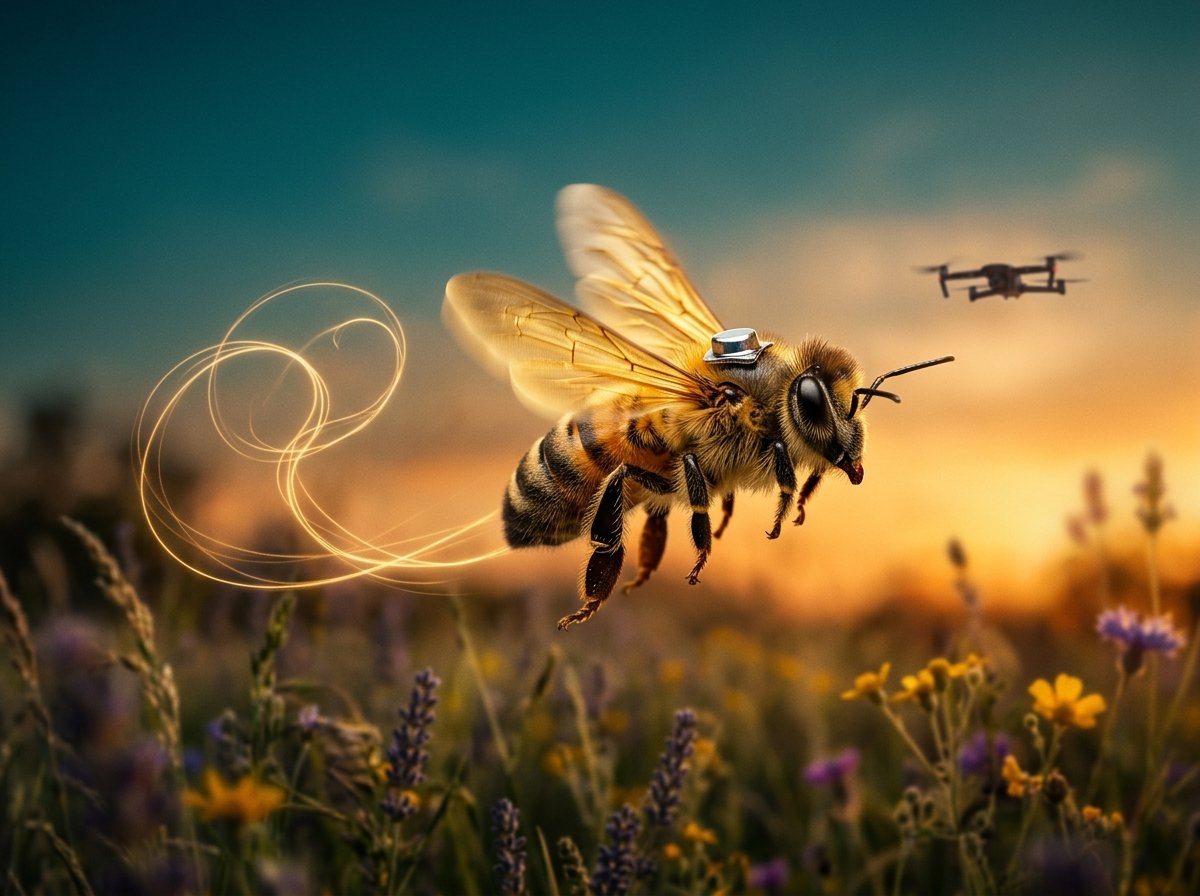
The University of Freiburg team, led by neurobiologist and behavioral biologist Prof. Dr. Andrew Straw, solved this problem in a genuinely clever way. They attached tiny reflective markers — small enough not to interfere with flight — to individual honey bees. A drone equipped with a specialized computer vision system called Fast Lock-On (FLO) Tracking could then identify the reflected light signature of a single marked bee and follow it continuously through the air, recording its exact 3D position in real time.
The Spin Of Alien Worlds Just Revealed A Stunning Hidden Secret About How Planets Are Born
The researchers used this system to track bees traveling between their hive and a food source about 120 meters away in a real agricultural landscape near Kaiserstuhl, Germany — an area that included hedges, a cornfield, and a tree positioned directly between the hive and the food, preventing any straight-line route.
In total, they recorded 255 individual flight paths across multiple bees and multiple trips.
What The Data Revealed
When the researchers analyzed those 255 flight paths, a clear pattern emerged immediately.
Every bee had its own route. Not a shared general direction, not a loose preference for one side of the field over another — a distinct, individual, personally developed flight path that each bee had clearly committed to memory and was actively recreating on every trip.
More striking still was the precision with which they recreated it. Individual bees repeated their own routes so consistently that they often flew within just a few centimeters of where they had flown on previous journeys. Not within a few meters. Within centimeters — in open air, across 120 meters of varied landscape, with no physical guide to follow.
“Individual bees repeated their individual flight paths nearly exactly on several flights. They often fly just a few centimeters away from their previous paths,” said Straw.
Landmarks Are The Key
The data also revealed something important about how bees achieve this precision — and where it breaks down.
The most consistent, tightly clustered flight paths occurred near the prominent tree standing between the hive and food source. Near that single landmark, the bees’ routes were at their most precise, converging and maintaining centimeter-level consistency.
Over the cornfield, where the landscape was visually uniform and offered few distinct reference points, the paths showed more variation. The bees were still following personal routes — but without strong visual anchors to correct against, small errors accumulated.
“Our results suggest that visual landmarks aid the bees’ navigation and increase the precision of their flight paths,” Straw explained. “In contrast, the bees’ uncertainty increases in visually monotonous environments.”
This has a direct implication for agricultural landscapes. As modern farming increasingly creates vast uniform monocultures — fields of identical crops stretching in every direction — it may be inadvertently degrading the navigational precision bees depend on, with potential consequences for pollination efficiency.
The Waggle Dance Mystery Solved
One of the most surprising and scientifically significant findings in this study concerns the famous waggle dance.
Honey bees use the waggle dance to communicate the direction and distance of food sources to other members of the colony. It’s one of the most celebrated examples of animal communication in all of biology. But scientists have long noted a puzzling limitation: the directional information encoded in the dance can be off by as much as 30 degrees for food sources around 100 meters away.
For years, this imprecision was assumed to reflect a genuine limitation in bee navigation — as if the bee’s own internal sense of direction was simply not that accurate.
This study directly challenges that interpretation. The bees themselves, when flying routes they know, deviate from their personal paths by only a few degrees even at their most variable. Their actual navigation is far more accurate than their dance suggests.
“Our research has shown that individual bees navigate much more accurately to destinations they are familiar with,” said Straw. “Our results allow us to conclude that the inaccuracy of the waggle dance is not due to the bees’ limited navigational abilities. Rather, individual animals are spatially much more accurately oriented than their dance communication would suggest.”
In other words, the bee knows exactly where it’s going. The dance is the imprecise part — not the navigator performing it.
What This Means Beyond The Hive
Honey bees pollinate a significant portion of the world’s food supply. Understanding how they navigate, where their precision comes from, and what environmental conditions support or undermine it has real practical consequences for agriculture, conservation, and efforts to protect pollinator populations under pressure from habitat loss and climate change.
This research also opens a door to a more profound appreciation of what is happening inside the mind of a creature that weighs less than a tenth of a gram. Each bee is building a detailed, accurate, personalized mental map of its environment — and flying that map with a precision that would impress any GPS engineer.
The bee darting past your window isn’t wandering. It knows exactly where it’s going, it’s been there before, and it’s flying the same invisible path it always flies. 🐝🌿
Source: University of Freiburg / Current Biology — June 14, 2026
Journal Reference: Rachael Stentiford, Michael J.M. Harrap, Victor V. Titov, Stephan Lochner, Andrew D. Straw. Precise, individualized foraging flights in honeybees revealed by multicopter drone-based tracking. Current Biology, 2026; 36 (5): 1320.
DOI: 10.1016/j.cub.2026.01.045