







Every planet that has ever existed carries a secret. It’s not written in its atmosphere, its moons, or its distance from its star. It’s written in something far more fundamental — the speed at which it spins.
A new study from Northwestern University, published in The Astronomical Journal, just proved that planetary rotation isn’t a random leftover quirk of cosmic formation. It’s a fossil record. A direct signature of how a world came to be, preserved in its spin for billions of years.
And astronomers just learned how to read it.
The Largest Survey Of Its Kind
Using the W. M. Keck Observatory on Maunakea, Hawaii, a team led by researcher Dino Chih-Chun Hsu from Northwestern’s Center for Interdisciplinary Exploration and Research in Astrophysics deployed a specialized instrument called the Keck Planet Imager and Characterizer (KPIC). This instrument can isolate light coming directly from planets orbiting distant stars — an extraordinarily difficult technical challenge.
As a planet rotates, features in its atmosphere cause subtle broadening in the light spectrum it emits. By measuring these tiny changes, astronomers can calculate exactly how fast the world is spinning. It’s like reading a planet’s pulse from light-years away.
The team used KPIC to measure the spins of 32 giant planets and brown dwarf companions in other star systems. Combined with previously published spin measurements, they assembled a dataset covering 97 objects in total — the largest survey of exoplanet rotation ever conducted.
The Result Nobody Fully Expected
The assumption going into this research was straightforward: more massive objects should spin faster. More mass means more angular momentum during formation, which translates to faster rotation. It’s a principle that broadly holds in our own Solar System, where Jupiter and Saturn both complete full rotations in roughly 10 hours.
But when the Keck data came back, something didn’t add up.
Giant planets — far less massive than brown dwarfs — were rotating faster. Not just slightly faster, but dramatically so. In the HR 8799 star system, one of the clearest examples, a gas giant roughly 7 times the mass of Jupiter was spinning six times faster than a brown dwarf companion approximately 24 times Jupiter’s mass. A significantly smaller world dramatically outspinning a vastly heavier neighbor.
Mass alone clearly doesn’t determine spin. Something else is at work.
The Magnetic Field Connection
The research team believes the key lies in magnetic fields and the specific process through which different types of objects form.
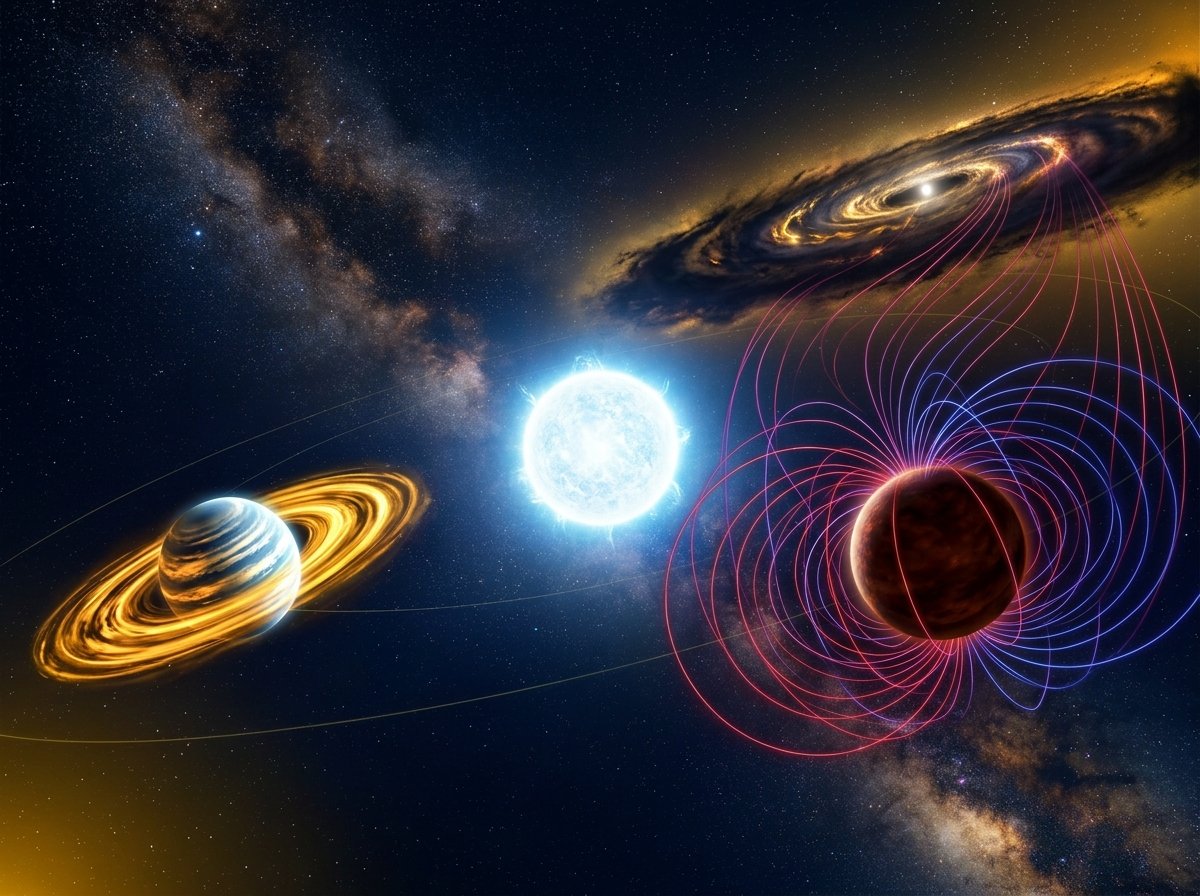
When a young planet or brown dwarf is still coalescing, it’s embedded in a swirling disk of gas and dust. The magnetic field of the forming object interacts with this disk — and that interaction creates drag, effectively acting as a brake on its rotation. The stronger the magnetic field, the more rotational energy gets stripped away during those critical early millions of years.
Brown dwarfs, being far more massive, develop significantly stronger magnetic fields during formation. Those fields interacted intensely with the surrounding disk material and robbed the brown dwarfs of much of their original spin. Giant planets, forming through a different process with generally weaker magnetic coupling to their disks, held onto more of their rotational energy.
The result, hundreds of millions of years later, is that smaller giant planets are spinning faster than their far more massive brown dwarf neighbors — a counterintuitive outcome that directly fingerprints the different physical processes involved in their creation.
“Spin is a fossil record of how a planet formed,” said Hsu. “By measuring how quickly these worlds rotate, we can start to piece together the physical processes that shaped them tens to hundreds of millions of years ago. Our results suggest that both the planet’s mass and the ratio between the planet’s mass and its star’s mass influence how fast the planet ultimately spins.”
Why This Matters Beyond Distant Star Systems
The implications of this research extend far beyond the alien worlds being studied.
The way angular momentum is distributed across a planetary system shapes its entire architecture — the spacing of planets, their sizes, their orbits, and ultimately whether conditions for complexity ever arise. Even Earth’s own rotation and magnetic field are products of how the spin budget was divided during our Solar System’s formation.
By studying these distant systems, astronomers are essentially looking at alternative outcomes — different versions of planetary formation that reveal which physical forces were most important in determining what kinds of worlds end up where, and why.
Co-author Jason Wang of Northwestern University explained what comes next:
“With HISPEC we will be able to drastically increase the number of planets that we can measure spins of, and in particular, we can study planets closer to our own Jupiter in nature to see if our own Jupiter is typical.”
HISPEC — the High-resolution Infrared Spectrograph for Exoplanet Characterization — is scheduled to begin operations at Keck Observatory in 2027, and will offer better sensitivity, higher spectral resolution, and wider wavelength coverage than any instrument currently available for this type of measurement.
The Bottom Line
The universe, it turns out, writes its history into everything — including the invisible spin of worlds orbiting stars too distant to see with the naked eye. Every rotation is a clue. Every planet that has ever formed carries within its spin a record of the magnetic forces, disk interactions, and formation processes that gave it life.
Astronomers are only just beginning to learn how to read that record. And what they find may ultimately tell us as much about our own origins as it does about the alien worlds they’re measuring. 🌌
Source: Universe Today / Northwestern University CIERA — June 13, 2026
Journal Reference: Chih-Chun Hsu, Jason J. Wang, Jerry W. Xuan, et al. Distinct Rotational Evolution of Giant Planets and Brown Dwarf Companions. The Astronomical Journal, 2026; 171 (4): 224.
DOI: 10.3847/1538-3881/ae434b