







Ancient brainstem neurons act as a built-in focus filter, blocking distractions. Silencing them in mice caused ADHD-like distractibility that reversed instantly. This discovery could transform ADHD treatments. Your brain’s attention engine is older than you think! 🧠
Imagine trying to focus in a noisy room, yet your brain effortlessly tunes out distractions. Scientists have just uncovered the hidden mechanism that makes this possible — and it’s been hiding in an ancient part of the brain for hundreds of millions of years.
This breakthrough from Johns Hopkins University reveals a tiny group of neurons that function as a built-in focus filter. These cells help the brain ignore irrelevant information and zero in on what truly matters.
The End of Old Assumptions About Attention
For years, experts believed advanced attention control came mainly from the prefrontal cortex — the newer, highly developed part of the human brain. But many animals, from fish to birds, show impressive focus without it. How?
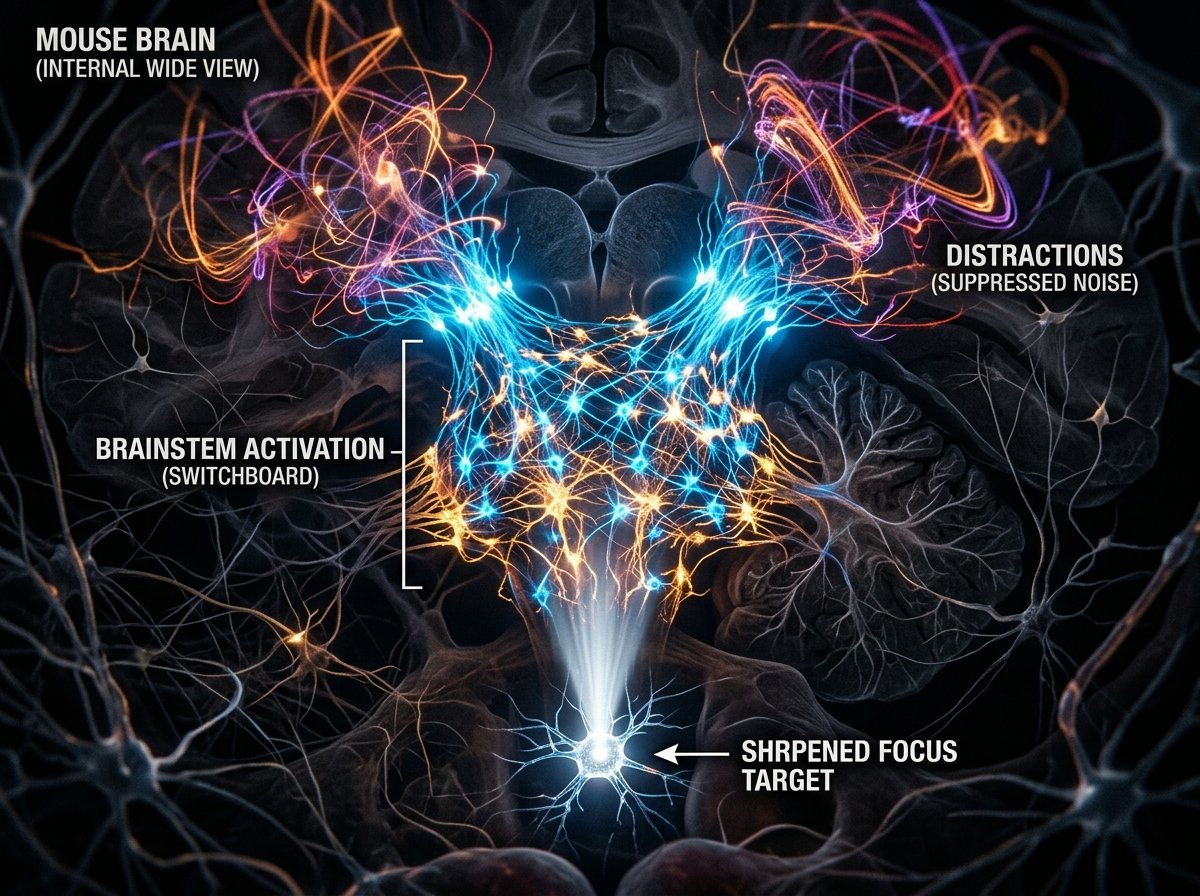
Researchers discovered the answer lies in the brainstem — an evolutionarily ancient region shared across all vertebrates, including humans.
Brainstem Neurons Act as a Powerful Focus Filter
These specialized inhibitory neurons act like an “attention engine.” They evaluate competing signals and direct focus toward the most important information while suppressing distractions.
In clever experiments, mice performed visual attention tasks successfully — until scientists temporarily switched off these neurons. The animals suddenly became hyper-distractible, struggling even with faint distractions, mirroring ADHD symptoms. Reactivating the cells restored normal focus the very next day.
Why This Discovery Is Revolutionary
Lead researcher Shreesh Mysore notes this matches classic ADHD challenges. The system isn’t just for basic survival — it’s a sophisticated selection mechanism refined over evolutionary time.
Potential Hope for ADHD and Beyond
This finding opens exciting possibilities for more targeted treatments. Future research will explore whether these neurons function differently in people with ADHD or autism, potentially leading to precise therapies that enhance this natural focus filter.
The next time you successfully tune out distractions, thank your ancient brainstem neurons — a remarkable evolutionary gift still working hard inside your head.
Source & Reference: Johns Hopkins University. “Scientists discover ancient brain cells that help block distractions.” ScienceDaily. June 24, 2026. Journal Reference: Ninad B. Kothari et al. Evolutionarily old brainstem neurons are required for the control of selective spatial attention. Nature Communications, 2026. DOI: 10.1038/s41467-026-72340-9