






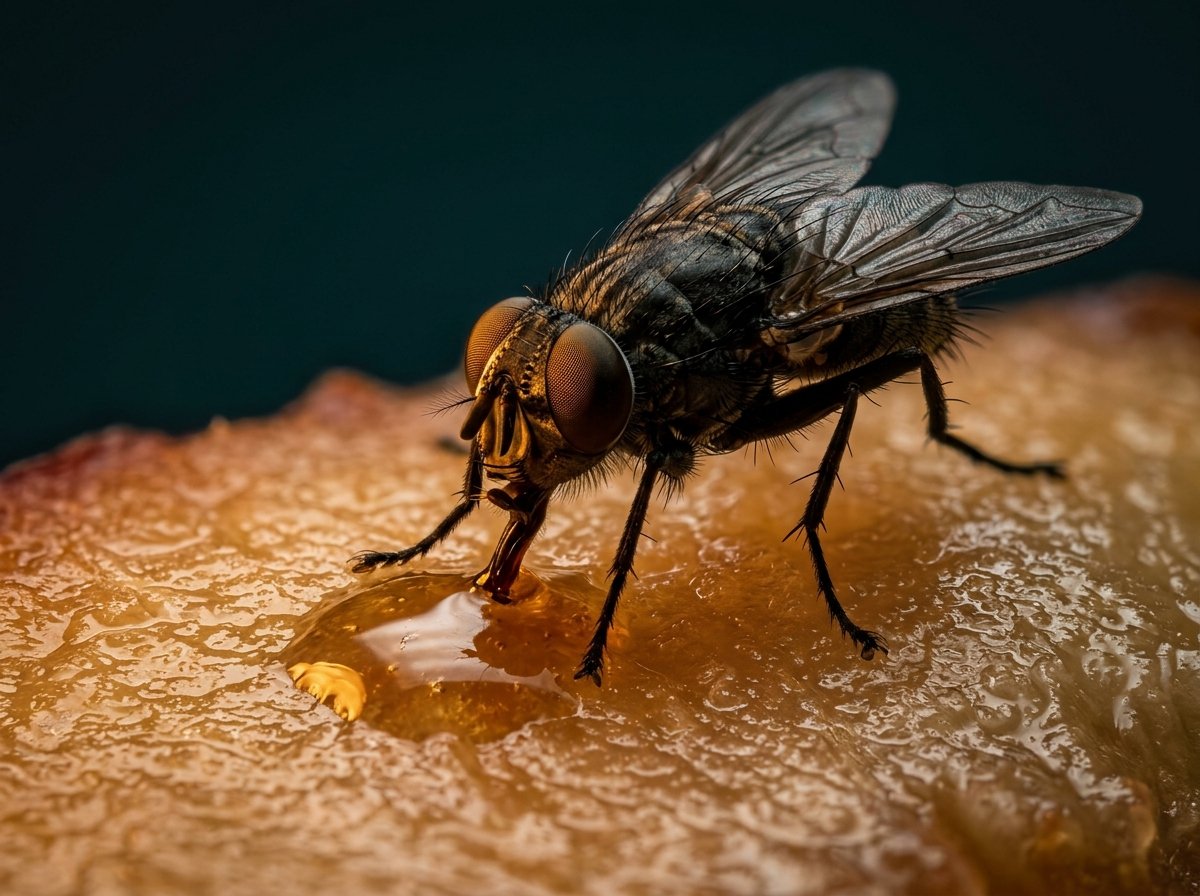
Most of us know flies are unpleasant dinner guests. But the biology behind what actually happens when a housefly lands on your food is far more extraordinary — and far more unsettling — than most people realise.
The housefly (Musca domestica) belongs to an exceptionally rare group: the 0.1% of animal species that practices external digestion. Rather than eating food and processing it internally, the fly secretes digestive enzymes directly onto its meal, partially breaks it down outside its body, and then sucks up the liquefied result through its proboscis — a sponge-like, straw-shaped mouthpart.
This isn’t just a quirky biological trick. It has real consequences for food safety. The enzymes the fly deposits are drawn from its saliva and include amylases, lipases, and proteases — compounds capable of breaking down every major nutrient group. That saliva can also carry pathogens the fly picked up from its previous feeding site, which may have been rotting matter, animal waste, or decaying organic material.
Japan’s Secret Bird: How DNA and Song Revealed a Species Hidden in Plain Sight
Scientists have described this vividly: once a fly has begun external digestion on your food, the process cannot be reversed. The food is chemically altered from the moment of landing. As one entomologist put it, it truly is easier to recover food from the jaws of a lion — at least the lion hasn’t liquefied it yet.
It lands for less than a second. You wave it away. You think nothing happened.
But science tells a very different story — and once you understand housefly external digestion, you will never look at a fly on your plate the same way again.
The Statistic That Changes How You See Every Fly
Here is a number worth sitting with: 99.9% of animal species digest their food internally. Food goes in, enzymes process it inside the gut, nutrients are absorbed. It’s the system we know because it’s the system almost everything uses — including us.
The housefly belongs to the rare and remarkable 0.1%. These species don’t wait for food to enter their body before digestion begins. They bring the digestion to the food. Outside the body. On your plate.
What External Digestion Actually Means
When a housefly lands on a food source, it doesn’t bite, chew, or swallow. It can’t — it has no teeth and its mouthparts are not built for solid food.
Instead, it does something far stranger. The fly regurgitates a mixture of saliva and digestive enzymes directly onto the food. This fluid rapidly breaks down solid organic matter, dissolving it into a liquid the fly can then ingest.
The food is being digested. Externally. Before a single molecule has entered the fly’s body.
The Proboscis — Nature’s Most Unsettling Straw
Once the enzymes have done their work, the fly feeds using its proboscis — a sponge-tipped, straw-like mouthpart uniquely adapted for consuming fluid and semi-fluid material. The fly uses the labellum in its mouthpart to quality-test food before feeding, then applies a solvent fluid to dissolve it into a liquid it can suck up through the proboscis.
The proboscis is not a simple tube. It is a sophisticated feeding organ — dabbing, tasting, and drawing up liquefied food in a process that takes just seconds.
The Enzymes Doing the Work
The saliva a housefly deposits is biochemically complex. It contains enzymes and peptidases targeting different macronutrients — amylases for carbohydrates, lipases and esterases for lipids, and proteases for proteins.
In other words, the fly is simultaneously breaking down every major nutrient class in your food — before it has consumed a single drop.
Why You Can’t Take the Food Back
This is where the biology becomes genuinely striking — and where the lion comparison earns its place.
When a predator takes food in its jaws, the food is physically seized. Remove it quickly enough and, biologically speaking, it is largely intact. Digestion hasn’t begun.
But with a housefly, digestion begins the instant it lands. Enzymes alter the food’s molecular structure on contact. Liquefied food, premixed with saliva, is taken up by the pharynx and processed further internally — but the chemical transformation of that food has already occurred outside the body.
There is no moment of recovery. There is no “quick enough.” The food has already been changed at a chemical level before you even noticed the fly was there.
It is, without exaggeration, harder to recover food from a housefly than from the jaws of a lion. The lion hasn’t liquefied it yet.
What Else the Fly Leaves Behind
The enzymes are only part of the story.
When a fly lands on food, it can also retch viruses and bacteria from its crop — pathogens previously picked up from other food sources, such as wounds, saliva, mucus, or excrement.
The feeding history of a single housefly may include rotting organic matter, animal waste, and decomposing material — all of which can contribute bacteria to the salivary deposit it leaves on your meal.
Research has linked houseflies to the transmission of Salmonella, E. coli, and Helicobacter pylori, among others. Studies show that houseflies carry Salmonella typhi and these microorganisms can survive in the fly’s body for extended periods.
The fly doesn’t need to stay long. A fraction of a second of contact is enough.
The Bigger Picture — Why This Biology Exists
External digestion is not a flaw in the housefly’s design. It is an elegant evolutionary solution to a specific problem: how to extract nutrients from solid food when you have no teeth, no grinding mouthparts, and a body built for liquid intake.
The housefly is not alone in this strategy. Spiders inject digestive enzymes into prey. Starfish evert their stomachs outside their bodies to digest shellfish. Some predatory insects use extra-oral digestion to consume prey far larger than themselves.
What makes the housefly unusual is the sheer proximity of this process to human food — and the speed and invisibility with which it occurs.
The Takeaway — A New Respect for the Humble Housefly
The housefly is one of the most studied insects on Earth, and for good reason. Its external digestion system is a masterclass in biological efficiency — and a genuine public health consideration.
Understanding what actually happens when a fly lands on your food is not about panic. It’s about perspective. This tiny, ordinary insect carries out one of the most extraordinary feeding strategies in the animal kingdom — and it does so on your kitchen counter, in milliseconds, completely invisibly.
The 0.1% is always more interesting than it looks.
Sources:
- Salama, M.S. et al. A deep insight into the sialome of the house fly, Musca domestica. PMC, 2025. DOI: 10.1038/s41598-025-XXXXX
- Harun, Y. The Miracle of the Fly. Ta-Ha Publishers, 2002.
- Stoffolano, J.G. & Haselton, A.T. The adult Dipteran crop: a unique and overlooked organ. Annual Review of Entomology, 2013.
- AskNature.org. Food Digested Externally — Biological Strategy. Biomimicry Institute, 2016.
- Nayduch, D. & Joyner, C. Houseflies and the pathogens they carry. Journal of Medical Entomology, 2013.
- ScienceAlert. Why House Fly Barf Is an Overlooked Potential Vector of Disease. 2022.
⚠️ This article is for informational and educational purposes only. It does not constitute medical or health advice. Consult a qualified professional for food safety concerns.