







One of the most striking facts in all of biology is hiding in plain sight. In humans, a single egg cell is approximately 10 million times the volume of a sperm cell. Ten million times. That’s not a modest difference or a subtle biological asymmetry — it’s one of the most extreme size discrepancies found anywhere in the natural world, and it exists across virtually every sexually reproducing animal species on earth.
The question of why evolution produced such a dramatic size difference has fascinated biologists since Charles Darwin’s time. Northwestern Engineering researchers just provided the most rigorous mathematical answer yet — and the explanation is an ancient evolutionary arms race driven by competition and limited resources.
The World Before Eggs And Sperm
To understand how eggs and sperm came to be, you have to go back to a time before either existed.
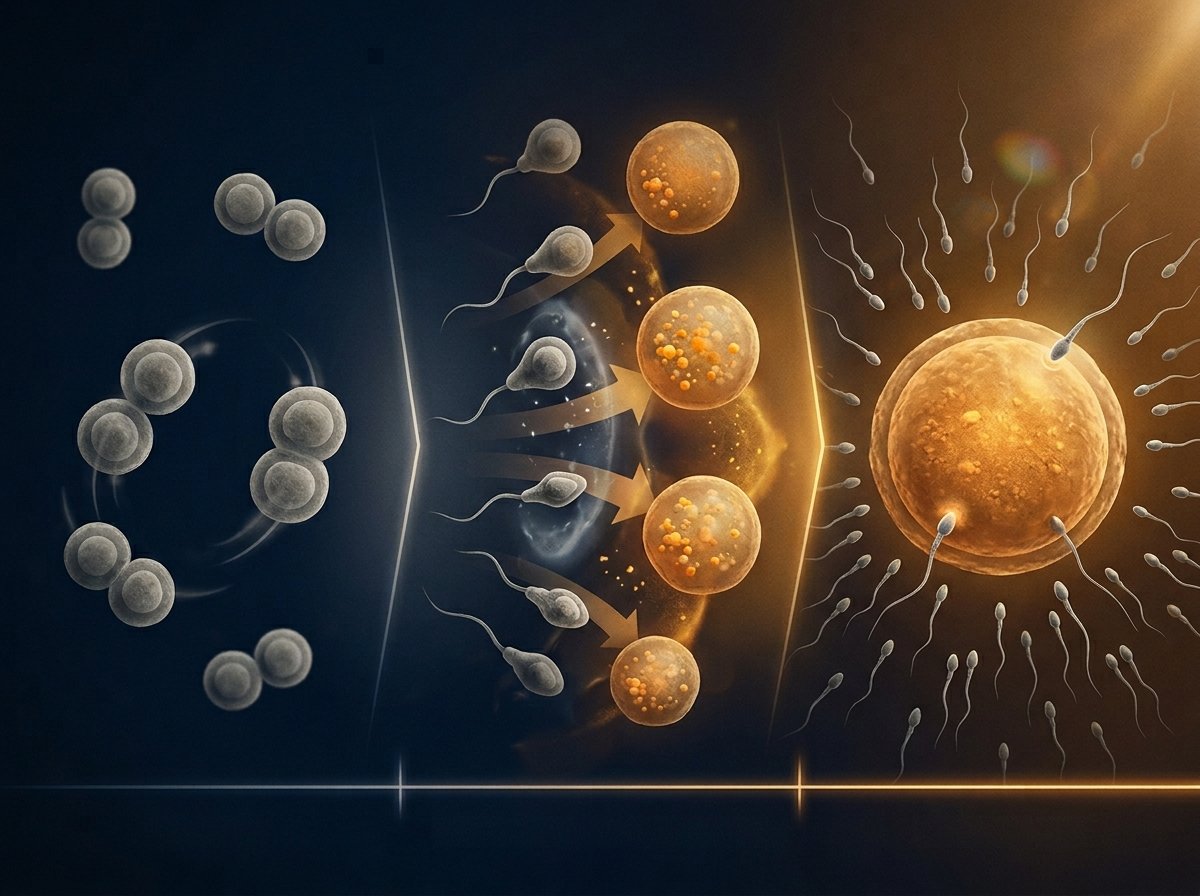
Early in the history of life on earth, organisms that reproduced sexually did so using gametes — reproductive cells — that were roughly equal in size. Scientists call this state isogamy: same-sized gametes, no distinction between male and female, no eggs or sperm. Some species still exist in this state today — certain types of algae and fungi reproduce using symmetrical mating types, offering a living window into what early sexual reproduction may have looked like.
Scientists Finally Solved Why Mosquitoes Bite You And Ignore Everyone Else At The Same Party
But at some point in evolutionary history, that symmetry broke. Gametes began diverging in size, eventually producing the extreme difference we see today. The question that has driven evolutionary biologists for generations is: what caused that break, and why did it lead to such an extreme outcome?
The Mathematical Model
Published in the Journal of Theoretical Biology, the study was led by Daniel Abrams, professor of engineering sciences and applied mathematics at Northwestern’s McCormick School of Engineering, with first author Joseph Johnson, a PhD candidate in Abrams’s laboratory.
Rather than studying living species — which can only reveal the end state of evolutionary processes, not the intermediate steps — the team built a mathematical model of early gamete evolution. The model started from the isogamous state and applied principles of competition and natural selection to ask: what would happen to gamete sizes over evolutionary time in a world with limited resources?
The model focused on external fertilization — the reproductive strategy used by many early organisms, where gametes are released into the environment and must find each other to merge. In this setting, gametes were competing not just to fertilize successfully, but to survive long enough to do so.
The Arms Race That Changed Everything
Two competing pressures created the evolutionary arms race at the heart of the model.
On one side: bigger gametes were better survivors. A larger gamete could carry more nutrients, giving a potential zygote — the fertilized cell that would develop into a new organism — a stronger head start. In an environment where survival was uncertain, that nutritional advantage translated directly into reproductive success.
On the other side: producing larger gametes was expensive. Every resource invested in making a large gamete was a resource the parent organism couldn’t use for something else. Organisms that produced many small, cheap gametes could compensate for each individual gamete’s lower survival odds through sheer numbers.
“Organisms either needed to produce the biggest gametes with the most provisions or the smallest gametes to use the least resources,” said Abrams.
Neither approach was inherently superior. What the model showed was that the middle ground — medium-sized gametes — was inherently unstable. Competition pushed gametes toward one extreme or the other, because a gamete that was slightly bigger than average had a survival edge over average-sized ones, pushing selection toward larger sizes in one lineage; while organisms that could make slightly smaller, more numerous gametes had a competitive advantage in terms of quantity, pushing selection toward smaller sizes in another.
“Early in evolution when sexual reproduction emerged, gametes were symmetrical. But this is where that symmetry breaks,” Abrams explained. “We end up with some organisms specializing in large gametes and others specializing in small gametes.”
The Inevitable Outcome
Run this selection pressure long enough, over sufficient evolutionary time, and the outcome is essentially what we see today. One lineage of organisms becomes specialists in large, nutrient-rich gametes — eggs. Another becomes specialists in small, numerous, resource-efficient gametes — sperm. And biological sex, as we understand it, emerges from this simple competitive dynamic.
“We believe this size difference is almost inevitable, based on plausible assumptions about how sexual reproduction works and how natural selection works,” Abrams said.
The word “inevitable” is striking, and it’s worth pausing on. The model suggests that given the basic rules of competition, limited resources, and natural selection, the evolution of dramatically different gamete sizes wasn’t a random accident or a quirk of evolutionary history specific to certain lineages. It was the mathematically predictable outcome of these fundamental pressures operating over time.
The Remaining Mysteries
The mathematical model doesn’t resolve every question in this area of evolutionary biology. One puzzle that persists is why isogamous species still exist at all. If anisogamy — different-sized gametes — is the mathematically stable end state of sexual reproduction under competition, why haven’t all isogamous species been outcompeted by anisogamous ones?
Abrams acknowledges this as an open question that the current model doesn’t fully resolve. Some isogamous species may occupy ecological niches where the competitive pressures that drive anisogamy are less intense, or they may benefit from other evolutionary trade-offs that make equal-sized gametes advantageous in their specific circumstances.
“There have been different theories about how anisogamy emerged, going all the way back to Charles Darwin,” Abrams noted. “Issues in evolutionary biology are very hard to test because we can only study species that are around today. We can’t see what they looked like billions of years ago. Using mathematical models can yield new insight and understanding.”
Why This Matters
Understanding the evolutionary origin of gamete size differences isn’t just satisfying intellectual history. It connects to fundamental questions about why biological sexes exist, why males and females have such different reproductive strategies across the animal kingdom, and why the investment costs of reproduction are distributed so differently between sexes in most species.
The 10-million-fold size difference between a human egg and a human sperm isn’t an accident. It’s the mathematical endpoint of a competition that began billions of years ago, driven by the same basic forces — resource scarcity, survival advantage, and the relentless logic of natural selection — that shape every other feature of living organisms.
Evolution, it turns out, was always going to arrive here. 🧬
Source: Northwestern University / Journal of Theoretical Biology — March 18, 2021
Journal Reference: Joseph D. Johnson, Nathan L. White, Alain Kangabire, Daniel M. Abrams. A dynamical model for the origin of anisogamy. Journal of Theoretical Biology, 2021; 521: 110669.
DOI: 10.1016/j.jtbi.2021.110669