







If you’re over 65 and exercising to stay healthy, you’re probably doing something right. But a new six-month study suggests that what type of exercise you do may matter far more than most people — or most fitness advice — acknowledges.
Researchers at the University of the Sunshine Coast just published findings that challenge a common assumption about aging and exercise: that any regular physical activity is roughly equally beneficial for body composition.
The study, published in the journal Maturitas, found a clear and clinically significant difference between exercise intensities in healthy adults in their seventies — and the result has direct implications for how we should think about fitness after 65.
Why Body Composition Matters More Than Weight As You Age
Before getting into the research, it’s worth understanding why muscle mass preservation is such a critical issue for older adults — and why it’s not the same thing as simply “not gaining weight.”
As we age, the body naturally loses muscle through a process called sarcopenia. After 65, this loss accelerates. Even in people who are not gaining body weight overall, the proportion of lean muscle typically declines while fat mass stays the same or increases — a shift in body composition that:
- Reduces strength and functional capacity — making everyday activities harder
- Increases fall risk — a leading cause of injury and hospitalization in older adults
- Slows metabolism — contributing to further fat accumulation
- Raises risk of chronic disease — including type 2 diabetes, cardiovascular disease, and metabolic syndrome
- Reduces independence — one of the most feared consequences of aging
This is why the goal for older adults isn’t just losing fat — it’s losing fat while protecting the muscle that keeps them strong, mobile, and independent.
The Study: Six Months, Three Intensities, One Clear Winner
The University of the Sunshine Coast research team recruited more than 120 healthy older adults from the Greater Brisbane region. Participants averaged 72 years of age and had a BMI of approximately 26 kg/m² — within the normal range for adults over 65.
For six months, participants completed three supervised gym sessions per week assigned to one of three exercise intensity groups:
- Low-intensity training — gentle exercise with minimal cardiovascular demand
- Moderate-intensity training — sustained aerobic exercise at a comfortable but elevated effort level
- High-intensity interval training (HIIT) — repeated short bursts of very demanding exercise alternated with easier recovery periods
Body composition was measured before and after the six-month period, with researchers specifically tracking changes in fat mass and lean muscle mass separately — not just overall weight.
What The Results Actually Showed
All three exercise intensities produced some degree of fat loss. On that measure, any exercise was better than no exercise — consistent with decades of research showing that regular physical activity reduces body fat regardless of intensity.
But lean muscle mass told a completely different story.
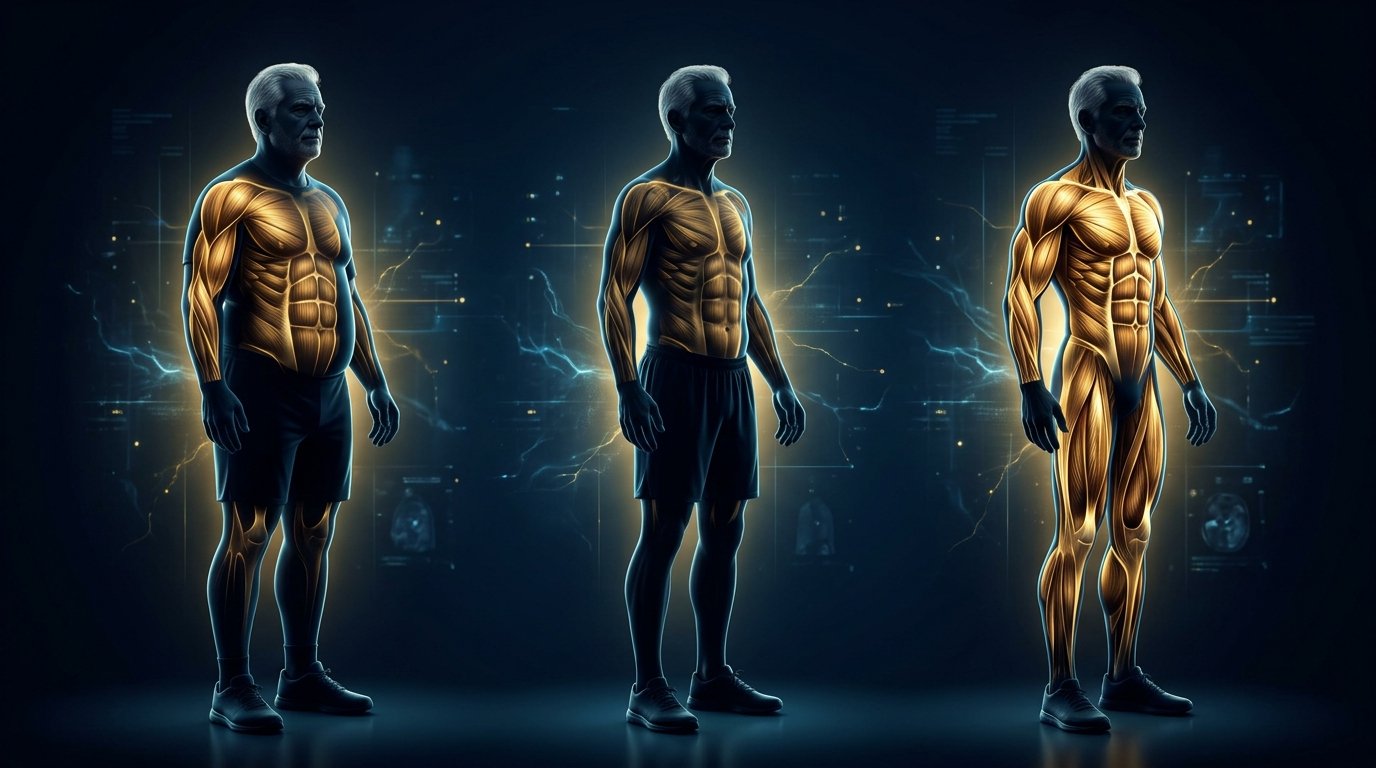
- HIIT — reduced fat mass AND preserved lean muscle throughout the six months
- Moderate intensity — reduced fat mass but caused a small but measurable decline in lean muscle
- Low intensity — results require further analysis before firm conclusions can be drawn
The key finding: only HIIT achieved the dual outcome that matters most for aging bodies — losing fat while keeping muscle.
“We found that high, medium and low intensity exercises all led to modest fat loss but only HIIT retained lean muscle,” said lead author Dr. Grace Rose, exercise physiologist at the University of the Sunshine Coast.
The moderate training group’s muscle loss was described as small — but small losses compounded over months and years of otherwise “healthy” exercise could add up to meaningful functional decline over time.
Both high and moderate intensity training also showed improvements in abdominal fat — the fat stored around the middle of the body that is most closely linked to cardiovascular and metabolic disease risk.
Why HIIT Protects Muscle When Other Exercise Doesn’t
The biological explanation for why HIIT preserves lean muscle while moderate exercise does not comes down to the nature of the stimulus the two approaches deliver to the body.
“HIIT likely works better because it puts more stress on the muscles, giving the body a stronger signal to keep muscle tissue rather than lose it,” explained Associate Professor Mia Schaumberg, study co-author and UniSC Associate Professor of Physiology.
During HIIT, the muscles are pushed to work at very high intensity — near maximum effort — during each short interval. This creates a significant mechanical and metabolic demand on muscle fibers that triggers the body’s muscle-preservation response. The body interprets this intense stress as a signal that strong muscles are necessary, and actively works to maintain them.
Moderate intensity exercise, by contrast, is sustained at a level that challenges the cardiovascular system effectively — great for heart health and fat burning — but does not generate the same intensity of muscular stress that triggers strong preservation signals. The body, in the absence of that signal, may allow gradual muscle breakdown to occur alongside fat loss.
In practical terms: it’s not about working out longer. It’s about working out harder — at least some of the time.
What HIIT Looks Like For Adults In Their Seventies
An important clarification: HIIT for older adults is not the same as HIIT for athletes.
In this study, high-intensity intervals were defined as exercise where breathing is heavy and conversation becomes difficult — not extreme athletic performance. The participants were healthy adults in their 70s, average BMI, no special athletic background.
Practically speaking, HIIT appropriate for older adults might look like:
- Short bursts of brisk uphill walking alternated with recovery at flat pace
- Cycling at high resistance for 30-60 seconds followed by easy cycling
- Stationary bike or rowing machine intervals
- Supervised gym-based circuit training with recovery periods between stations
The key elements are:
- Short bursts of high effort — not sustained maximum intensity
- Recovery periods between each burst
- Three sessions per week — consistent with the study protocol
- Supervised initially — particularly important for those new to higher intensity exercise
Important Cautions Before You Start
The research team and exercise physiologists consistently emphasize one critical point: older adults should not begin HIIT without medical clearance and ideally professional guidance.
All participants in this study were described as healthy older adults with no significant health conditions that would contraindicate higher intensity exercise. People with cardiovascular disease, uncontrolled hypertension, joint problems, or other health conditions may face different risk profiles that need to be assessed individually.
Consulting with a doctor before changing exercise intensity — and ideally working with an accredited exercise physiologist or qualified trainer experienced with older populations — is the recommended first step.
The Bottom Line
HIIT for older adults may be one of the most important exercise recommendations to emerge from recent aging research. While any regular exercise is better than none — and moderate activity does reduce fat and improve health — only higher intensity interval training appears to simultaneously address both sides of the body composition challenge after 65: losing fat while keeping the muscle that maintains strength, mobility, and independence.
For the millions of older adults currently doing moderate exercise faithfully in the belief that they’re doing everything right, this study is worth discussing with a healthcare provider or exercise professional. Not to abandon what they’re doing — but to consider whether adding structured higher intensity intervals could deliver meaningfully better outcomes for their long-term physical health. 💪
Source: University of the Sunshine Coast — June 28, 2026
Journal Reference: Grace Rose, Emily Hume, Daniel Blackmore, Jules Mitchell, Samuel Belford, Tina Skinner, Maryam Ziaei, Stephan Riek, Perry Bartlett, Mia Schaumberg. Exercise intensity influences body composition: a 6-month comparison of high-intensity interval, moderate- and low-intensity training among healthy older adults. Maturitas, 2025; 203: 108763.
DOI: 10.1016/j.maturitas.2025.108763