






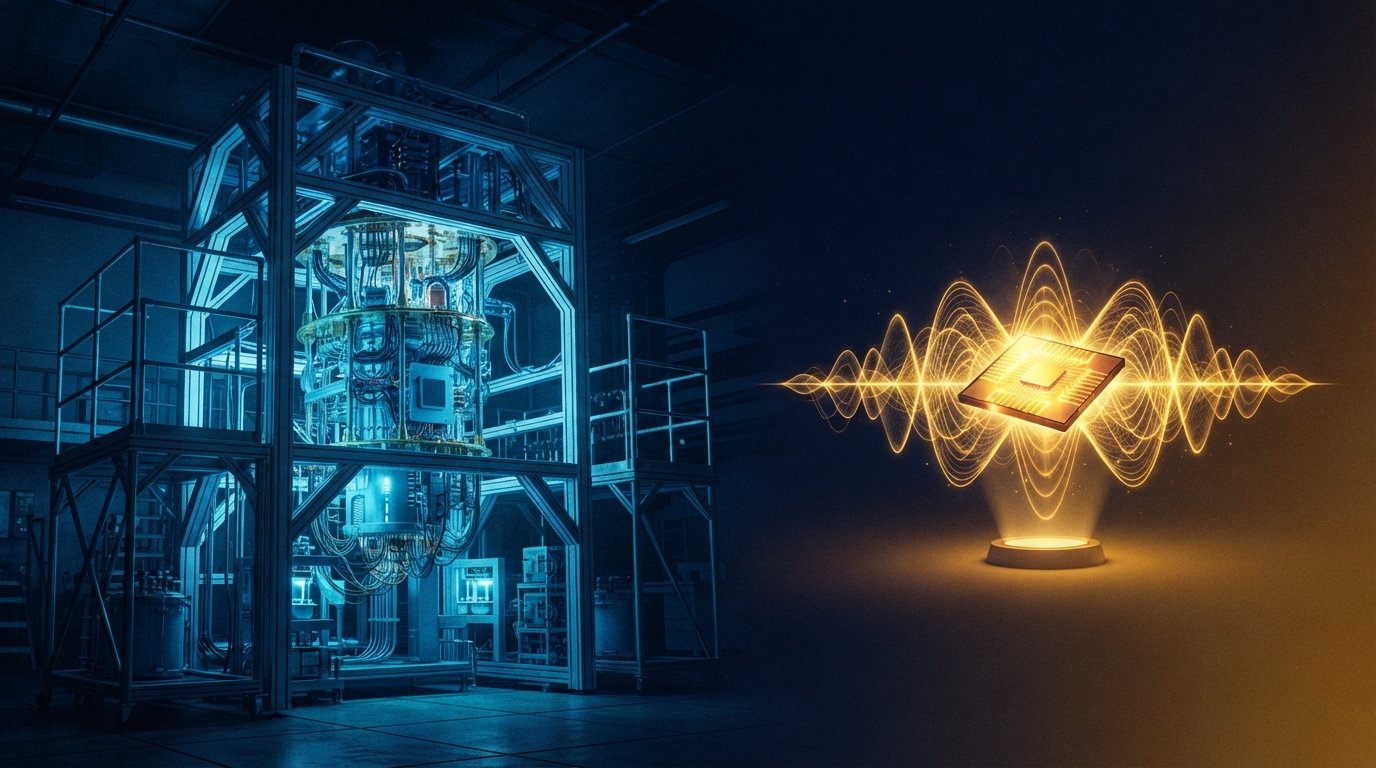
Quantum computers today are enormous. Room-sized refrigeration systems, miles of wiring, and complex infrastructure are required just to keep a handful of qubits stable enough to compute anything useful.
A new discovery from an international team of physicists led by Andrii Chumak at the University of Vienna suggests that future quantum computers might be dramatically smaller — potentially no larger than a 1-cent coin.
The breakthrough centers on magnons — tiny waves in magnetization that had long been considered too short-lived to be practically useful. Published in Science Advances, the new research changes that picture entirely.
What Are Magnons?
Magnons are waves that move through solid magnetic materials, much like ripples spreading across a pond after a stone is dropped in. Instead of water, the “ripple” here is a wave in the magnetic orientation of atoms within the material.
Unlike photons — particles of light that can travel through empty space or fiber optic cables — magnons can only travel inside solid magnetic materials. This has one major advantage: their wavelengths can shrink down to the nanometer scale, meaning magnonic circuits could, in principle, be built onto chips no larger than those already used in today’s smartphones.
That compactness makes magnons an attractive building block for quantum technology. The problem has always been how briefly they last.
The Problem: Magnons Disappeared Too Quickly
For quantum information to be useful, it needs to persist long enough to be measured, processed, and transferred. This window is called the lifetime — the period during which a quantum carrier can reliably hold information.
Until now, magnon lifetimes were limited to a few hundred nanoseconds at best. That’s a fraction of a millionth of a second — far too brief for any practical quantum computation. Magnons would appear and vanish before they could be meaningfully used.
This short lifetime has been the central obstacle preventing magnons from becoming genuine building blocks for hybrid quantum systems and quantum sensing technology, despite their theoretical promise.
The Breakthrough: 100 Times Longer
The Vienna-led team, working with collaborators from the University of Colorado Colorado Springs and institutions in Germany, the United States, and Ukraine, achieved something remarkable: they extended magnon lifetimes to up to 18 microseconds.
That is nearly 100 times longer than any value previously observed.
At that timescale, magnons stop behaving like fleeting, lossy signals and start behaving like reliable, long-lived carriers of quantum information — comparable in performance to the superconducting qubits currently used in the world’s leading quantum processors.
“With lifetimes of 18 microseconds, magnons transform from lossy intermediate links into robust quantum memories and low-loss communication links on a chip,” the researchers explained.
How They Did It: Two Key Techniques
The breakthrough resulted from combining two specific approaches.
First, instead of using conventional, uniform magnons, the team generated short-wavelength magnons. These are naturally less sensitive to tiny surface defects in the crystal material — defects that had been quietly cutting magnon lifetimes short in earlier experiments.
Second, the researchers used ultra-pure spheres of yttrium iron garnet, a specialized magnetic crystal material, cooled to an extraordinarily low temperature of just 30 millikelvin — a fraction of a degree above absolute zero. At that temperature, thermal noise that would otherwise disrupt the fragile magnon waves is almost entirely eliminated.
Combining these two techniques — short-wavelength magnons plus an ultra-pure, ultra-cold crystal — produced the dramatic extension in lifetime the team observed.
The Most Important Discovery: It’s Materials, Not Physics
Perhaps the most consequential finding in this research isn’t the 18-microsecond number itself — it’s what the researchers discovered about why magnons had been so short-lived in the first place.
The team found that magnon lifetime is not fundamentally limited by the laws of physics. Instead, it is primarily governed by the purity and quality of the material the magnons travel through.
This distinction matters enormously for the future of the technology. If magnon lifetime were capped by an unavoidable physical law, researchers would be stuck working within that hard limit indefinitely. Because the limitation instead comes down to material quality, there is a clear and achievable path to further improvement through better manufacturing — purer crystals, fewer defects, more precise fabrication — rather than requiring entirely new physics breakthroughs.
What This Could Mean For The Future
The implications of stable, long-lived magnons extend across several areas of quantum technology:
- Coin-sized quantum computers — because magnon wavelengths can shrink to the nanometer scale, magnonic circuits could be built onto chips as small as those in today’s smartphones
- Robust on-chip quantum memory — long-lived magnons could store quantum information directly on a chip rather than requiring bulky external systems
- Universal “quantum buses” — magnons could potentially serve as a communication link connecting hundreds of qubits, or as translators between otherwise incompatible quantum technologies in hybrid architectures
- Quantum metrology — magnons could improve the precision of quantum-based sensing and measurement systems
The vision researchers are working toward is a fundamentally different scale of quantum hardware — moving away from room-sized cryogenic systems toward genuinely compact, potentially chip-integrated quantum devices.
What Comes Next
This is a foundational physics result, not a finished product. Turning an 18-microsecond magnon lifetime into an actual working, coin-sized quantum computer will require substantial additional engineering — including scaling up magnon-based systems, integrating them with existing quantum architectures, and further improving material purity to push lifetimes even longer.
The research was based on experimental work conducted by Rostyslav Serha as part of his doctoral thesis, with contributions from Kaitlin McAllister, supported by the Vienna Doctoral School in Physics.
The Bottom Line
For years, magnons were viewed as a quantum computing curiosity — theoretically interesting, but practically too fleeting to matter. A hundredfold increase in lifetime, combined with the discovery that the remaining limitation is a solvable materials problem rather than an unbreakable law of physics, changes that story entirely.
The path toward genuinely compact quantum computers — potentially the size of the coin in your pocket — just became measurably shorter. ⚛️🧲
Source: University of Vienna / Science Advances — July 2026
Journal Reference: Rostyslav Serha, Kaitlin McAllister, Andrii Chumak, et al. Published in Science Advances, 2026.