





For over a century, scientists believed that spontaneous problem-solving — the sudden mental leap of combining separate pieces of information into a working solution — belonged almost exclusively to large-brained animals. A new study from the University of Oulu just challenged that assumption in a striking way.
What The Researchers Actually Did
Published in the journal Science, the study was led by Akshaye Bhambore, a doctoral researcher at the University of Oulu, working alongside teams from the University of Helsinki and the University of Turku in Finland.
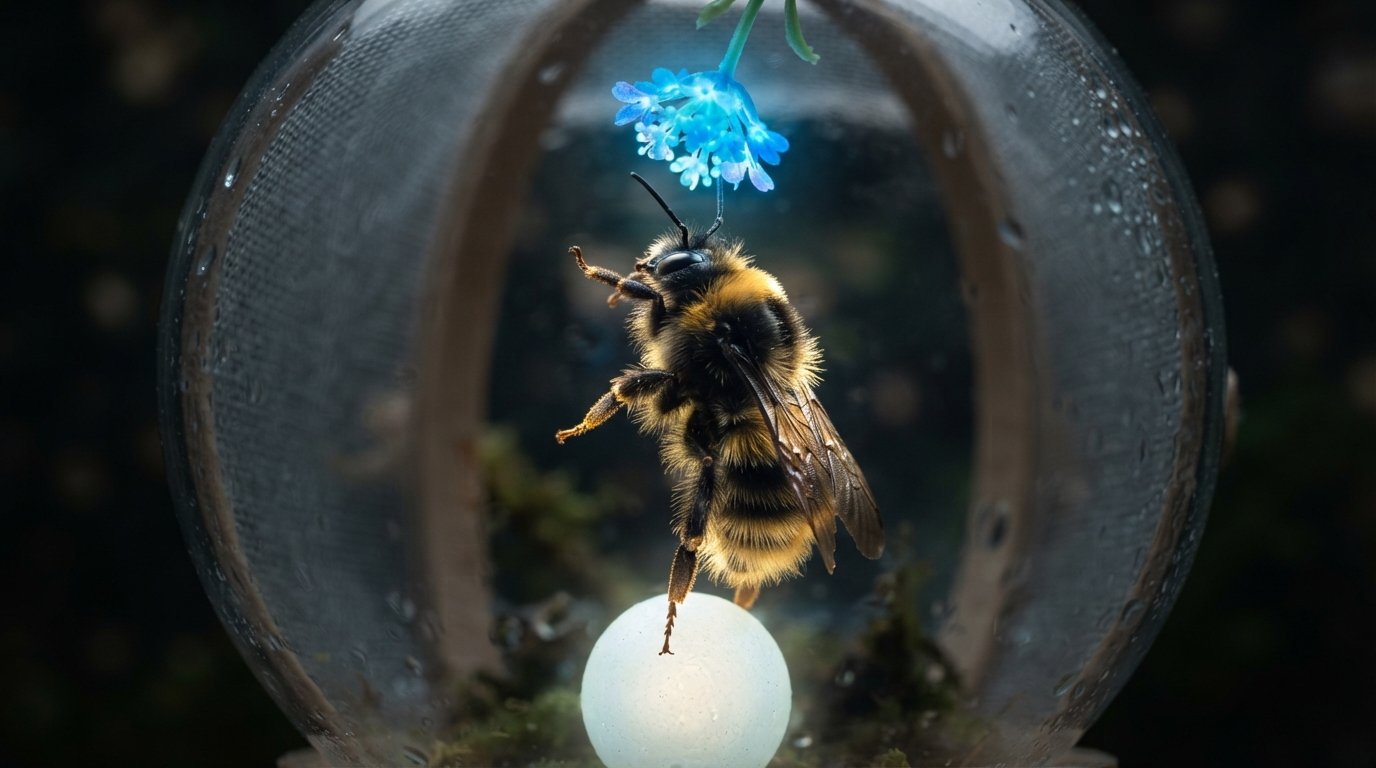
The team trained bumble bees (Bombus terrestris) to recognize a blue artificial flower as a reliable source of reward. Then came the real test. Researchers moved the flower to the ceiling of a clear, enclosed arena, placing it completely out of reach.
To access the reward, a bee had to:
- Push a small ball across the arena floor
- Position the ball directly beneath the flower
- Climb onto the ball
- Reach up to contact the flower
Crucially, the bees had never been trained on this specific sequence. Some worked it out entirely on their own.
No Surgery, No Daily Pills — Just One Shot That Regenerated An Arthritic Joint In Under Two Months
Why This Echoes A Century-Old Chimpanzee Experiment
More than 100 years ago, psychologist Wolfgang Kohler ran now-famous experiments showing chimpanzees could stack boxes to reach a banana hanging out of reach. Those studies became a foundational demonstration of animal insight.
“This is essentially an insect version of the classic test,” Bhambore said. The research team also noted that the bees’ movements during successful attempts looked goal-directed rather than random, suggesting the behavior was not purely accidental.
What Outside Experts Are Saying
James Nieh, a professor of ecology, behavior, and evolution at the University of California San Diego who was not involved in the study, pointed out that bees do not normally move objects to build platforms — this is not natural bumble bee behavior, which makes the finding more notable.
Senior author Olli Loukola, a behavioral ecologist who has studied bumble bees for over a decade, said the results suggest insects may belong in the same scientific conversation that has, until now, been reserved mostly for vertebrates.
What Remains Uncertain
To be transparent about the limits of this research: not every bee solved the task, and scientists are still studying how consistent this ability is across individuals and species. This is one study, and should be treated as part of a growing body of evidence rather than a final answer.
Key Takeaways
- Bumble bees solved a novel puzzle involving moving a ball to reach a reward, without being trained on that exact solution.
- The task closely mirrors the classic chimpanzee box-stacking experiments used to study insight.
- Experts say this challenges the long-standing assumption that spontaneous problem-solving requires a large brain.
- More research is needed to determine how widespread this ability is among bees and other insects.
A Note On The Science: This article summarizes findings from a peer-reviewed study for general educational purposes. It is not a substitute for reading the original research.
What do you think? Could other small-brained creatures be hiding abilities we simply haven’t tested for yet? Share your thoughts below.
Source: University of Oulu / Science journal — June 2026
Journal Reference: Akshaye A. Bhambore, et al. Spontaneous problem-solving in bumble bees. Science, 392, 1046–1049, 2026.
DOI: 10.1126/science.ady1618
Slug: bumble-bees-problem-solving-2026