






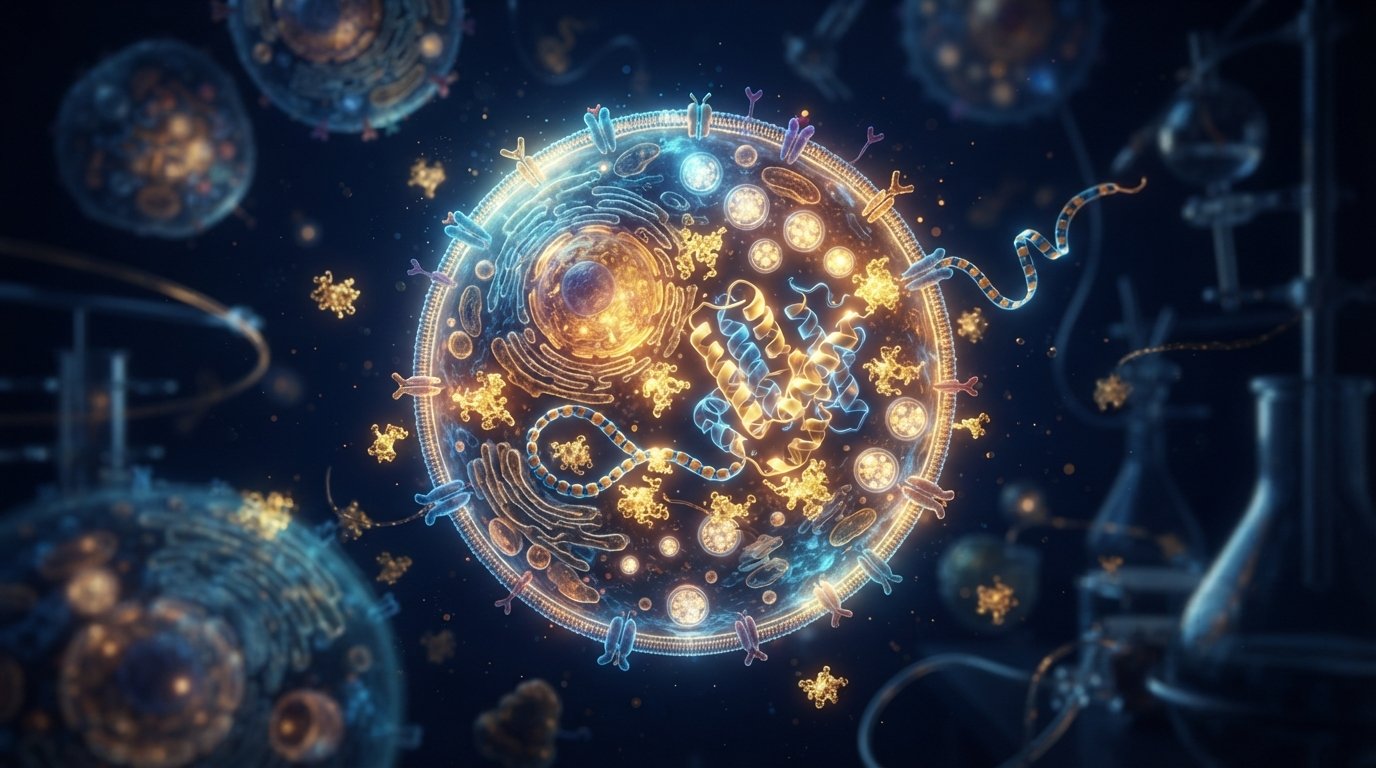
Proteins inside our cells only work if they fold into the right three-dimensional shape — much like a piece of paper only becomes a crane if it’s folded correctly. As prediabetes progresses toward full diabetes, this folding process inside insulin-producing cells can start to fail, and the resulting buildup of damaged, misfolded proteins places serious stress on the pancreas.
A new study from Sanford Burnham Prebys Medical Discovery Institute and the University of Michigan, published June 1, 2026 in the Proceedings of the National Academy of Sciences, digs into exactly how beta cells manage this folding process — and what goes wrong when it fails.
Why Insulin-Producing Beta Cells Get Overwhelmed
Beta cells in the pancreas constantly monitor blood sugar and ramp up insulin production whenever glucose rises. As diabetes progresses, though, these cells increasingly struggle to keep up with demand.
A Tiny Universe In A Bottle Reveals Clues To The Origins Of Life
Earlier research had already tied this decline to misfolding of proinsulin, the raw precursor protein cells convert into insulin. Scientists knew that misfolded proinsulin builds up during diabetes and stresses beta cells, but it wasn’t clear which other proteins help manage that folding process, or how they coordinate with each other.
Senior author Randal J. Kaufman, PhD, a professor at Sanford Burnham Prebys, explained that the team already knew a chaperone protein called BiP, along with several cochaperone partners, was central to preventing proinsulin misfolding. Their goal was to figure out how those partner proteins actually work together to fold proinsulin correctly and clear out any mistakes.
Tracking a Key Protein Inside Beta Cells
To study BiP’s interactions up close, researchers engineered mice so that BiP in their beta cells carried an added molecular tag — three copies of a short amino acid sequence that let scientists track and isolate the protein during experiments.
That tracking pointed to one cochaperone in particular as especially important: p58IPK.
When the team genetically removed p58IPK from two different cell lines, misfolded proinsulin piled up at much higher levels. Mice bred without p58IPK showed the same pattern — their beta cells produced smaller amounts of both proinsulin and finished insulin.
BiP and p58IPK Have To Work Together
Researchers then restored p58IPK in one of the modified cell lines, which improved the cells’ ability to fold and export proinsulin while cutting down on misfolded buildup. But that fix only worked if BiP was also present — p58IPK couldn’t do the job alone.
The team also tested the reverse: boosting BiP levels in cells that lacked p58IPK. That only produced modest improvements. Folding and export of proinsulin improved far more when both proteins were present together at normal levels.
Lead author Insook Jang, PhD, summed up the finding with a sports analogy, comparing BiP working alone to a single tennis player attempting a doubles match — the folding system needs both partners to function properly.
The researchers also identified several additional proteins that help fold and transport proinsulin or flag misfolded copies for cleanup, though more work is needed to pin down exactly how each one affects insulin production and disease progression. Kaufman noted that these findings highlight how vulnerable proinsulin folding is to the same cellular stresses already linked to beta cell failure in type 2 diabetes.
A Potential New Diabetes Treatment Strategy
Most current diabetes medications don’t target this protein-folding process at all. Instead, they work by helping tissues absorb more glucose or prompting the pancreas to release more insulin — managing symptoms rather than protecting the cells themselves.
No existing therapy is designed specifically to improve proinsulin folding as a way to preserve beta cell health. That’s what makes this research notable: it opens the door to treatments that intervene earlier, before beta cells are damaged beyond repair, by strengthening the folding machinery itself rather than just compensating for its failure.
Why This Research Matters
Diabetes treatment today largely focuses on managing blood sugar after the underlying cell damage has already begun. This research suggests a different angle — protecting the insulin-producing machinery itself before it breaks down.
If future therapies can boost the coordinated activity of BiP and its partner proteins, it could offer a way to intervene early in prediabetes or early type 2 diabetes, potentially slowing or preventing the loss of insulin-producing capacity that drives the disease forward.
Key Takeaways
- Insulin-producing beta cells rely on a chaperone protein, BiP, working together with a partner protein, p58IPK, to fold proinsulin correctly
- Removing p58IPK caused misfolded proinsulin to build up and reduced both proinsulin and insulin production in cells and mice
- BiP alone, or p58IPK alone, couldn’t fix the folding process — both proteins were needed together for real improvement
- No current diabetes drugs target this folding process directly, pointing to a potential new treatment strategy
- The findings suggest that strengthening beta cells’ protein-folding machinery could help protect the pancreas earlier in the course of diabetes
Source: Sanford Burnham Prebys — July 28, 2026
Journal Reference: Insook Jang, Alec Duffey, Pamela Itkin-Ansari, Peter Arvan, Randal J. Kaufman. Coordinated expression and assembly of BiP, p58IPK, and ER chaperone complexes maximize proinsulin folding in pancreatic β cells. Proceedings of the National Academy of Sciences, 2026; 123 (23).
DOI: 10.1073/pnas.2533617123