









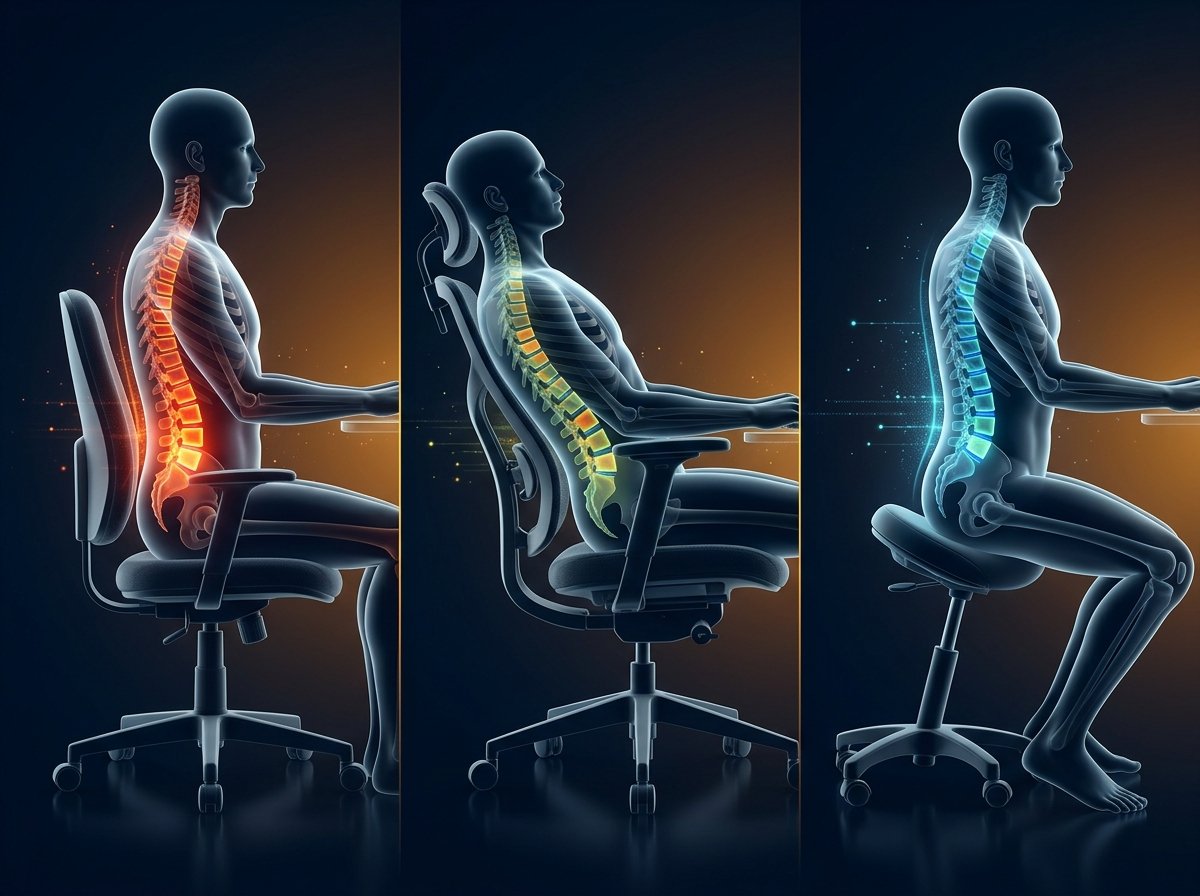
If you work at a desk, you’ve probably been told to sit up straight more times than you can count. Shoulders back. Feet flat on the floor. Ninety degrees at the hips, ninety degrees at the knees, screen at eye level. It’s the posture advice that gets repeated in every ergonomics training session, printed on every workplace wellness poster, and drilled into office workers from the first day on the job.
There’s just one problem. The science behind it is far more complicated — and far more interesting — than that single instruction suggests.
A comprehensive literature review published in the Journal of Bodywork and Movement Therapies examined decades of research on prolonged sitting, sitting posture, and active seating solutions. What emerged from that review challenges many of the assumptions that most desk workers — and many employers — have been operating under for years.
The Real Problem With Sitting Isn’t Your Posture — It’s Staying Still
The first and most important finding from the research is this: no single sitting posture is safe when maintained for too long.
Prolonged static sitting — holding any position without movement for extended periods — consistently produces measurable negative effects on the body regardless of how “correct” the position appears. Spinal disc pressure increases and stays elevated. Trunk muscles that support the spine progressively reduce their activity as the body settles into a passive position. Blood flow to the lower limbs restricts. Tissue compression at the seat interface builds steadily, contributing to discomfort that compounds over hours and accumulates over years.
The Spin Of Alien Worlds Just Revealed A Stunning Hidden Secret About How Planets Are Born
The popular image of perfect upright posture — back straight, spine in neutral, everything at 90 degrees — turns out to create its own set of problems when maintained rigidly throughout a working day. High levels of sustained trunk muscle activity in a rigid upright position contribute to muscle fatigue. Lumbar disc pressure in this position is measurably higher than in several alternatives.
What The Research Actually Recommends
The review compared the four main working postures recognized in ANSI/HFES 100-2007 ergonomic standards: upright sitting, reclined sitting, declined sitting, and standing.
Reclined sitting — leaning back between 100 and 120 degrees — consistently showed lower spinal disc pressure than upright sitting. It reduced the compressive load on lumbar structures, decreased trunk muscle fatigue, and was associated with less discomfort over extended periods. Yet most workplace chairs and setups continue to be designed around the upright position as the default, with many actively discouraging reclined postures as appearing unprofessional or lazy.
Declined sitting — where the seat tilts forward slightly — showed benefits for maintaining lumbar lordosis, the natural inward curve of the lower spine that tends to flatten during prolonged sitting. Forward-tilted seats encourage a more natural spinal curve and can reduce disc pressure at certain lumbar levels. However, the research also noted trade-offs, including increased pressure at the front of the seat and greater demands on leg muscles to maintain stability.
Standing desks have become enormously popular as a response to the risks of prolonged sitting, and the research does support their value — when used correctly. Breaking up seated time with periods of standing reduces the cumulative effects of static sitting and can lower the overall health risks associated with sedentary work.
But prolonged standing carries its own documented risks. Research consistently shows that standing for extended periods increases lower limb discomfort, raises varicose vein risk, and produces its own form of musculoskeletal strain — particularly in the lower back and feet. Standing all day is not the answer to sitting all day. The evidence supports variety, not substitution.
Active Sitting: What The Evidence Shows
Perhaps the most interesting section of the review covers active seating — chairs and sitting surfaces designed to encourage continuous movement rather than locking the user into any single position.
Active chairs work on a simple principle: instead of supporting a fixed posture, they accommodate and encourage small, ongoing postural adjustments throughout the working day. Research on active sitting shows increased leg muscle activation compared to traditional chairs, improved postural variety, and better maintenance of spinal curvature over time.
The distinction between dynamic chairs and active chairs is worth understanding. Dynamic chairs require constant motion — think rocking chairs or certain balance-disc designs where the user is perpetually moving. Active chairs are designed so the sitter initiates movement, with the chair mechanism accommodating that action. This distinction matters because pure dynamic designs can increase discomfort over time as the constant movement demand becomes fatiguing.
The research found that the most effective active seating designs are those that support two specific movement patterns: sustaining gradual, continuous postural variation across a range of positions while occasionally reaching neutral spinal alignment, and maintaining frequent low-level muscle activity in the legs and lower limbs throughout the day.
The Practical Takeaway
The research points toward a clear direction for desk workers. The goal is not to find the one perfect sitting position and hold it for eight hours. The goal is to create regular postural variety — changing positions frequently, incorporating standing periods, using seating that encourages natural movement, and treating the working day as something that requires deliberate postural management rather than a single static setup.
Practical steps supported by the evidence include using a chair that allows recline rather than locking into upright, incorporating a sit-stand desk for periodic position changes, choosing active seating options where appropriate, setting reminders to shift position every 30 to 45 minutes, and ensuring workstation setup allows comfortable movement rather than forcing a single rigid alignment.
Movement is the medicine. Not the chair, not the posture, not the angle — the movement. Every desk worker who understands that is already ahead of the research curve.
Source: Journal of Bodywork and Movement Therapies — 2024
Journal Reference: Steve Pearse, Michelle Léger, Wayne J. Albert, Michelle Cardoso. Active workstations: A literature review on workplace sitting. Journal of Bodywork and Movement Therapies, 2024.
DOI: 10.1016/j.jbmt.2024.01.001