









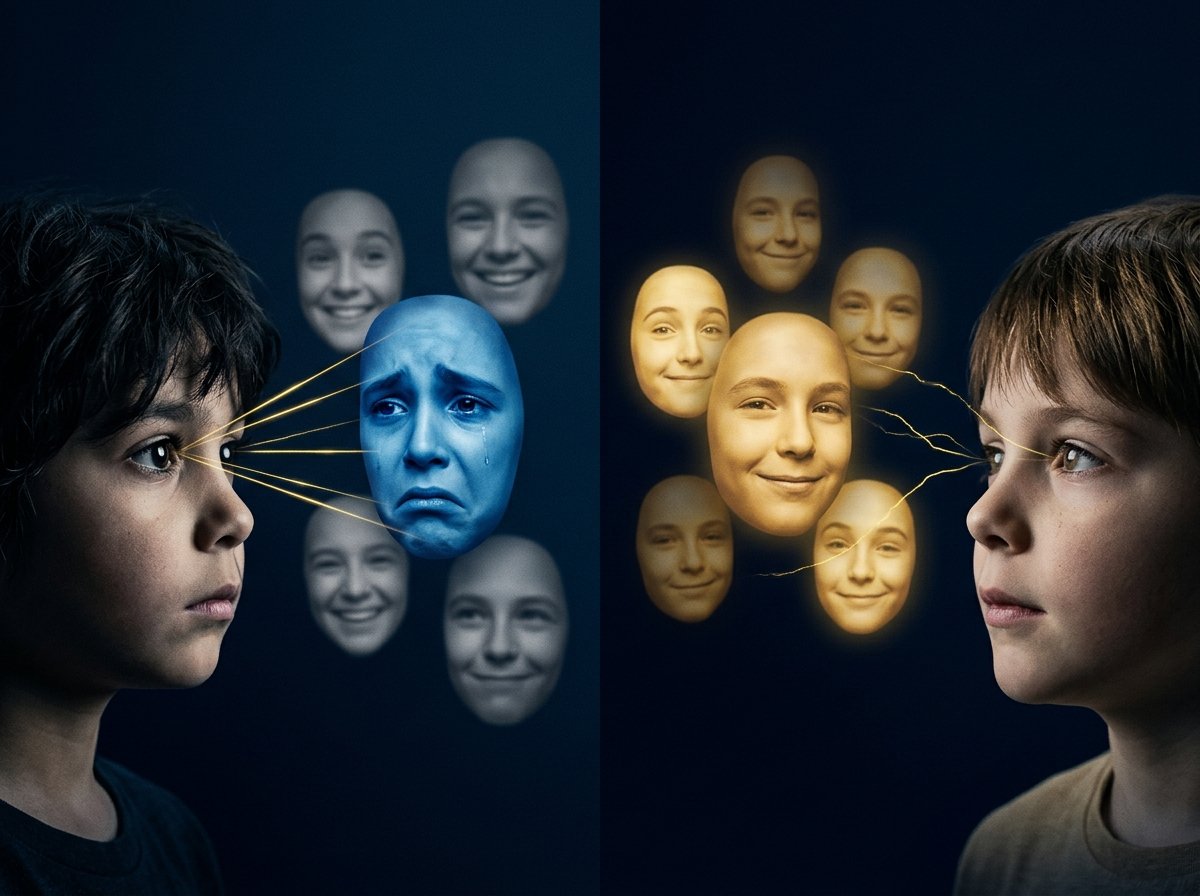
Depression in children is one of the hardest things to catch early. Children often can’t name what they’re feeling. They may not show the sadness that adults associate with depression — they may show irritability instead, or stomachaches, or a quiet withdrawal that gets mistaken for shyness or a difficult phase.
By the time a clinical diagnosis is made, the condition has often been silently building for a long time.
A new study from Binghamton University just found a clue that may be detectable far earlier than any of those behavioral signs — hidden in something as simple as where a child’s eyes go when they look at another person’s face.
The Study
Researchers at Binghamton University’s Mood Disorders Institute followed 242 children and their mothers for two years, conducting assessments every six months. Led by Brandon Gibb, SUNY distinguished professor of psychology and director of the institute, the team used eye-tracking technology to measure exactly where children directed their attention when shown pairs of faces — one neutral, one emotional.
The emotional faces showed happiness, sadness, or anger. The eye tracker recorded which face the child looked at first, how long they stayed focused on it, and how their attention patterns shifted over time as their depressive symptoms changed.
The central question was genuinely novel. Previous research had established that depression is linked to greater attention toward sad facial expressions. But those studies were mostly snapshots — they couldn’t tell researchers whether the attention bias caused depression, resulted from it, or both. This study examined the relationship across time, tracking how depressive symptoms and attention patterns mutually influenced each other over a two-year period.
“The real novel piece is that we looked at these transactional relations,” said lead author Kelly Gair, a PhD student at Binghamton. “Between attentional biases and depressive symptoms, we looked at the way that they were mutually predicting one another across the time points, which is especially novel and hasn’t been done before.”
Two Different Patterns, One Common Direction
The results split clearly based on family history — and what emerged in each group tells a meaningfully different story.
Among children whose mothers had a history of major depressive disorder, increasing depressive symptoms were associated with growing attention toward sad faces. As these children’s symptoms worsened, their gaze became increasingly drawn to sadness in the faces around them — and increasingly unable to pull away from it. Negative emotional information became more and more dominant in what they noticed about their social world.
The Spin Of Alien Worlds Just Revealed A Stunning Hidden Secret About How Planets Are Born
Researchers believe this pattern may reflect early emotional learning. Children of depressed mothers are exposed to more facial expressions of sadness in their daily home environment. When these children then experience depression themselves, those familiar expressions become even more salient — pulling attention toward sadness in a way that reinforces and deepens depressive thinking over time.
Among children whose mothers had no depression history — lower-risk children — the pattern was different. Their increasing depressive symptoms didn’t create a pull toward sadness. Instead, they caused a fading of attention toward happiness. These children were gradually losing their natural orientation toward positive emotional information, eroding a protective attentional buffer that had previously been helping to keep their mood stable.
“In our lower-risk children, what seems to be happening is that experiences of depression are eroding a protective factor, which is how much they pay attention to happy faces,” said Gibb.
Two different pathways. But both leading toward a mind increasingly disconnected from positive emotional experience.
Why Early Detection Matters So Much
The developmental window this study examines — childhood, before clinical depression takes hold — is precisely where early intervention has the greatest potential impact.
“Most of the vulnerabilities that we focus on are still developing during this time period,” Gibb said. “You can catch things as they’re developing, rather than only studying them once they’re already there and pretty stable.”
Eye-tracking offers something that questionnaires and clinical observations cannot: an objective, real-time measure of how a child’s attention is orienting emotionally, independent of what the child can articulate about their inner experience. For children who lack the words or self-awareness to describe what they’re feeling, that kind of objective measurement could prove invaluable in identifying risk early.
What Comes Next
The research team is continuing to follow these children into adolescence — the developmental period when depression rates climb sharply and when the attentional habits formed in childhood may start producing more significant and lasting consequences.
The key questions going forward are whether these attention patterns predict actual clinical depression diagnoses, and whether interventions targeting attentional biases directly — training high-risk children to redirect attention away from sadness, or helping lower-risk children rebuild natural attention toward happiness — can genuinely reduce the probability of depression developing.
The idea that something as simple as where a child’s eyes go when they see a smile or a frown might carry meaningful information about their mental health trajectory is both humbling and quietly hopeful. Not because it gives us all the answers — but because it gives us somewhere new to look.
Source: Binghamton University / Journal of Psychopathology and Clinical Science — June 16, 2026
Journal Reference: Kelly A. Gair, Leslie A. Brick, Brandon E. Gibb. Transactional relations between attentional biases for affective stimuli and depressive symptoms in offspring of mothers with and without major depressive disorder. Journal of Psychopathology and Clinical Science, 2026.
DOI: 10.1037/abn0001132