







Black holes are one of the most accepted and well-studied phenomena in all of astrophysics. When a massive star runs out of fuel, gravity wins — the star collapses, and a black hole forms. That’s the story. That’s been the story for decades.
A new theoretical study from Goethe University Frankfurt just proposed a genuinely different ending.
The Problem With Black Holes Nobody Likes To Talk About
Black holes are real. The evidence for their existence is overwhelming — gravitational wave detections, the shadow images captured by the Event Horizon Telescope, the behavior of stars orbiting the supermassive object at the center of our own galaxy. Nobody serious in astrophysics disputes that black holes exist.
But they come with a problem that has never been satisfactorily resolved. At the center of every black hole, current physics predicts a singularity — a point of infinite density where all the mass of the collapsing star is compressed into zero volume. At that extreme, the equations of General Relativity break down completely. The laws of physics as we know them stop working. What actually happens at a singularity remains genuinely unknown.
Black holes also hide everything behind their event horizons. Nothing — not matter, not light, not information — can escape once it crosses that boundary. This creates deep conceptual problems that physicists have wrestled with for half a century without resolution.
The Spin Of Alien Worlds Just Revealed A Stunning Hidden Secret About How Planets Are Born
Because of these unresolved issues, some researchers have long explored whether at least some objects we identify as black holes might actually be something else entirely.
Enter The Gravastar
One proposed alternative is called a gravastar — short for gravitational vacuum star. A gravastar would look almost identical to a black hole from the outside. It would be equally massive, equally dense, equally powerful in its gravitational effects. But it would contain no singularity and no event horizon. Instead, its interior would be filled with dark energy — the mysterious repulsive force that is currently driving the accelerating expansion of our own universe.
The idea has been around for roughly 25 years. The problem is that nobody could explain how a gravastar could actually form from a real collapsing star. It remained a mathematically interesting possibility without a physical mechanism to back it up.
Until now.
The First Dynamic Solution
Theoretical physicists Daniel Jampolski and Professor Luciano Rezzolla at Goethe University Frankfurt have published what they describe as the first dynamic solution to Einstein’s equations of General Relativity that explains how a gravastar could emerge from the collapse of an ordinary massive star.
Their proposal centers on something extraordinary happening at the moment of extreme collapse.
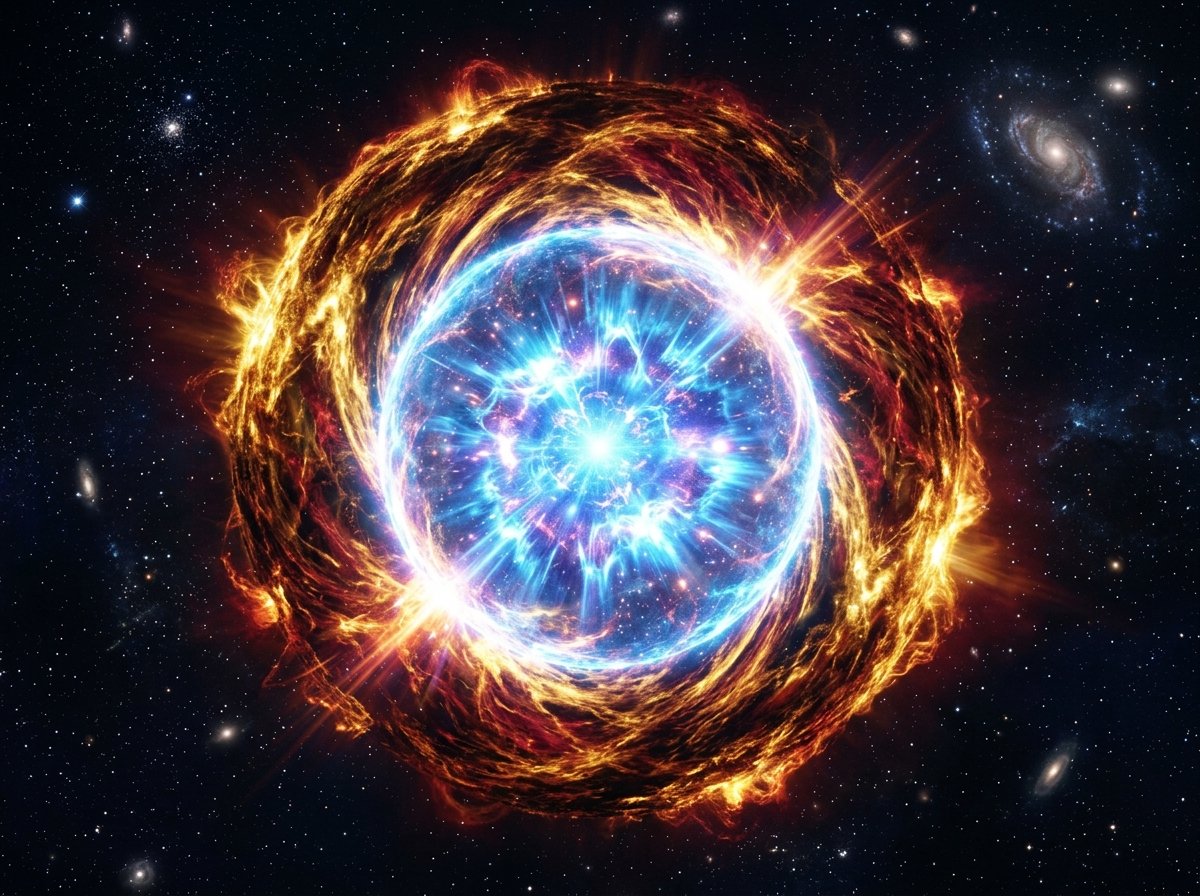
As the star compresses to near-infinite density, the conditions inside become so extreme that they trigger something new — a miniature Big Bang. A tiny new universe is born within the collapsing stellar matter. Just as dark energy drives the expansion of our own cosmos, it drives the expansion of this newborn miniature universe from the inside out.
That expanding inner universe pushes back against the crushing inward pull of gravity from the collapsing star. The two forces meet in opposition. And under the right conditions, they reach a stable equilibrium — creating a gravastar instead of a black hole.
“The Big Bang of the emerging universe can unfold once the star has already collapsed almost to the point of becoming a black hole,” said Jampolski, who developed the solution during his master’s thesis. “It is easier to imagine that the Big Bang occurs only at a very late stage, when matter has already been compressed to an extreme degree, thereby giving rise to new effects.”
What This Means — And Doesn’t Mean
Rezzolla is careful to frame the discovery appropriately. This is not a rejection of black holes.
“Looking for alternatives to black holes should not suggest a skepticism towards black holes, which still represent the most natural and simplest solution to the fate of gravitational collapse,” he said. “However, as scientists, it is essential to maintain an unbiased approach towards what we do not know and hence explore both the accepted wisdom and the more exotic interpretations. History teaches us that it is not unusual for the latter to become the former.”
In other words — black holes almost certainly exist and remain the most likely outcome of stellar collapse in most cases. But the possibility that some collapsed objects might be gravastars rather than black holes is now, for the first time, supported by a concrete physical mechanism derived from Einstein’s own equations.
The Deeper Implication
And then there is the thought that quietly sits behind all of this, almost too vast to fully absorb.
If a dying star can trigger the birth of a new universe within itself — if a miniature Big Bang can ignite inside collapsing stellar matter — then the same process that may be happening in distant star systems across the cosmos might be exactly how our own universe began.
We might be living inside what was once a dying star in some other cosmos. Our Big Bang, the moment of our universe’s birth, might have been triggered by exactly the kind of collapse that Jampolski and Rezzolla are now describing mathematically.
The universe creating universes. Death becoming birth. Physics folding back on itself in ways that are almost impossible to hold in the mind — but that the equations, at least for now, appear to allow.
Source: Goethe University Frankfurt — June 14, 2026
Journal Reference: Daniel Jampolski, Luciano Rezzolla. Formation of gravastars. Physical Review D, 2026; 113 (12).
DOI: 10.1103/c6lw-nx7k