






You’ve probably stood in a supermarket aisle at some point, staring at butter and margarine side by side, wondering whether the difference really matters.
It does. More than most people realize.
Butter and margarine may look almost identical — same golden color, similar texture, roughly the same fat content. But their molecular chemistry is so fundamentally different that choosing between them can completely change what happens in your recipe, your oven, and your body.
Rosemary Trout, Associate Clinical Professor of Culinary Arts and Food Science at Drexel University, just explained exactly why — and the chemistry is genuinely fascinating.
Scientists Built A Skin-Like AI Patch That Detects Heart Attacks In Milliseconds
What Butter And Margarine Actually Are
Both are emulsions — mixtures of tiny water droplets suspended in a continuous fat matrix. Both are at minimum 80% fat, with water content around 16%. On those broad numbers, they’re nearly identical.
But the similarity ends there.
Butter is made from animal cream. When cream is churned, fat globules rupture, the fat leaks out, and semi-solid grains form. Those grains are pressed together into the solid block you buy at the store. Cultured butters add lactic acid bacteria that ferment the natural lactose into flavor compounds — giving butter its characteristic tang and complexity.
Margarine starts as liquid plant-based oil and is made solid through a process called interesterification — a chemical rearrangement of fatty acids on the glycerol molecule that converts liquid oil into a solid without creating harmful trans fats. This gives margarine a longer shelf life and a more consistent, predictable melting point.
These different origins translate into different molecular structures — and those molecular differences change everything.
The Saturated vs Unsaturated Fat Difference
Butter’s fats are mainly saturated. Saturated fatty acids have no double bonds between their carbon atoms, which means they pack together neatly into straight chains. These orderly chains form compact crystals — and those crystals are what give butter its functional magic in the kitchen.
- Multiple crystal types with different melting points make butter firm when cold but allow it to soften gradually at room temperature
- Air trapping — when butter crystals are creamed with sugar, they trap air between the fat crystals, creating the lightness and lift that makes cakes and cookies tender
- Flaky layers — butter’s water content (around 16%) converts to steam in a hot oven, physically separating layers of pastry and dough
Margarine’s fats are mainly unsaturated, from blended plant oils. Unsaturated fatty acids have double bonds that create kinks and bends in the molecular chain — they can’t stack neatly. This irregular shape:
- Prevents the formation of the same air-trapping crystal structures butter creates
- Produces a more uniform but less complex melting behavior
- Results in different texture outcomes in baked goods — often denser and less flaky
Why Butter Browns And Margarine Doesn’t
This is the most practically important difference for home cooks — and the most chemically interesting.
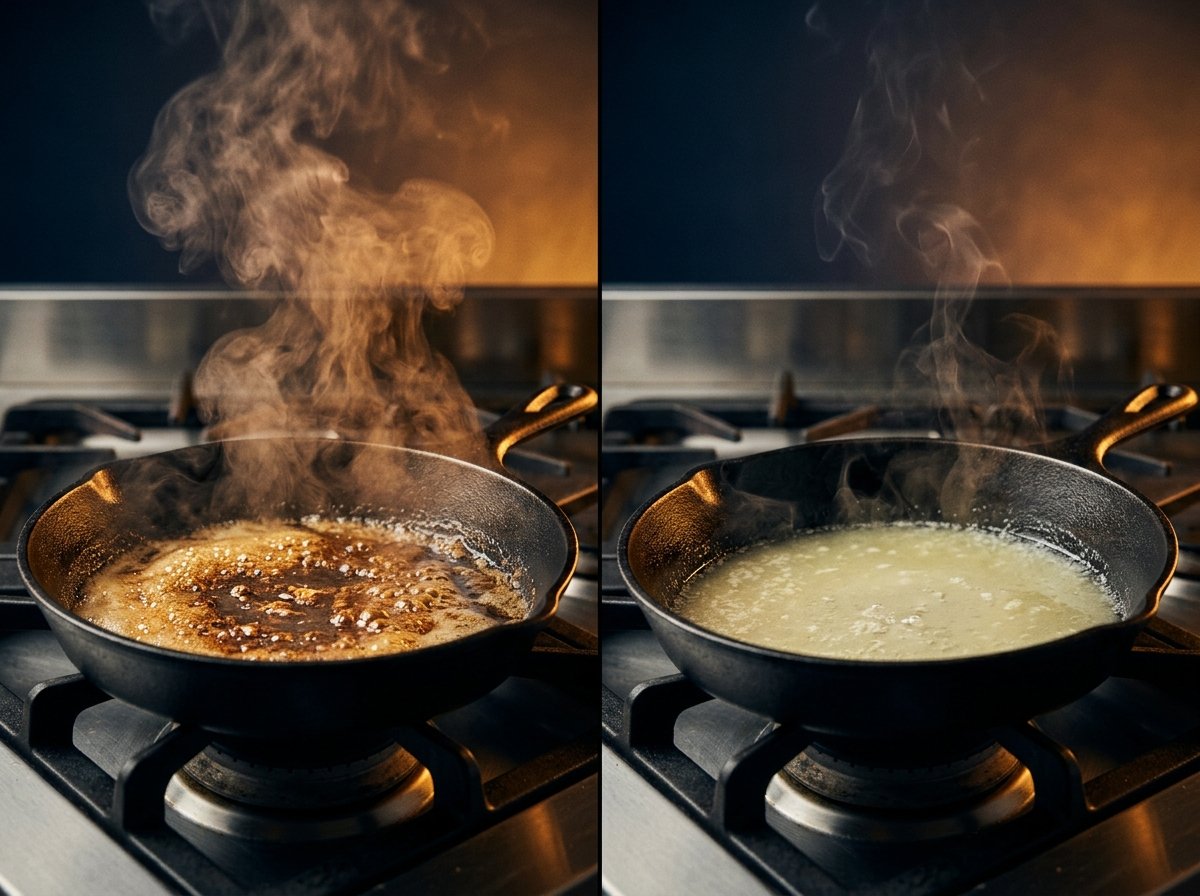
When you heat butter in a pan or oven, something remarkable happens. The proteins and lactose naturally present in butter undergo the Maillard reaction — a cascade of chemical events between amino acids and sugars that produces hundreds of new flavor compounds simultaneously. The result:
- Rich golden-brown color that margarine simply cannot match
- Nutty, toasty, caramelized aromas that develop progressively with heat
- The characteristic flavor complexity that makes brown butter one of the most celebrated techniques in cooking
Margarine contains no lactose — it’s made from plant oils, not dairy. Without lactose, the Maillard reaction cannot occur in the same way. Margarine can brown slightly through other mechanisms, but it never achieves the depth, richness, or aroma complexity of browned butter.
For recipes where browning and flavor are the point — finishing sauces, sautéed vegetables, beurre noisette, shortbread — margarine is simply a different product, not a straightforward substitute.
The Color Question
Here’s something most people don’t know: margarine is naturally colorless.
Butter gets its distinctive golden hue from beta-carotene — an orange plant pigment found in grass. Cows eat grass but don’t metabolize beta-carotene efficiently, so it passes into their milk and concentrated further into butter during churning. This is why grass-fed butter is typically a deeper, richer yellow than butter from grain-fed cows.
Margarine, derived from plant oils rather than cream, contains no beta-carotene and would be an unappealing white-grey color without intervention. Manufacturers add synthetic beta-carotene to mimic butter’s familiar yellow appearance — along with artificial flavor compounds like diacetyl and blends of whey components to replicate butter’s taste.
Where Margarine Has Genuine Advantages
Despite butter’s culinary superiority in many applications, margarine has real strengths worth acknowledging.
- Consistency — margarine’s controlled interesterification produces a very precise melting point, which can actually be an advantage in industrial baking where exact, repeatable results matter
- Shelf life — without dairy proteins and lactose, margarine is significantly more stable and lasts considerably longer
- Lower saturated fat — for people managing cardiovascular risk factors, margarine’s primarily unsaturated fat profile may be a relevant health consideration
- Not an ultraprocessed free pass — importantly, margarine is classified as an ultraprocessed food due to the industrial modification it undergoes, which is a separate health consideration from its saturated fat content
One critical caution: spreadable or squeeze-style margarines are not equivalent to stick margarine for baking. These products rely on higher ratios of water and air to stay soft — which means they’re significantly lower in fat. Using them in place of butter or stick margarine in recipes formulated for high-fat content will produce noticeably different, usually inferior results.
Which One Should You Choose?
The honest answer depends entirely on what you’re doing:
Choose butter when:
- Browning and flavor complexity matter — pastry, sauces, finishing dishes
- You want flaky, layered texture — croissants, pie crusts, puff pastry
- You’re following a recipe formulated specifically for butter
- You want a minimally processed, naturally occurring fat
Choose margarine when:
- Consistency and shelf life are priorities
- You have specific dietary reasons to limit saturated fat
- You need a dairy-free option
- You’re using stick margarine (not spread) in appropriate baking applications
Avoid spreads and soft margarines for baking entirely — their altered fat and water ratios will change your results in ways a recipe won’t account for.
The chemistry of butter vs margarine is not an abstract food science curiosity. It shows up every time you bake, cook, or spread something on your toast — in the color of your pastry, the flavor of your sauce, and the texture of your cake. Understanding it means making better choices for whatever you’re actually trying to achieve. 🧈🔬
Source: The Conversation / Drexel University — June 26, 2026
Original Author: Rosemary Trout, Associate Clinical Professor of Culinary Arts & Food Science, Drexel University