






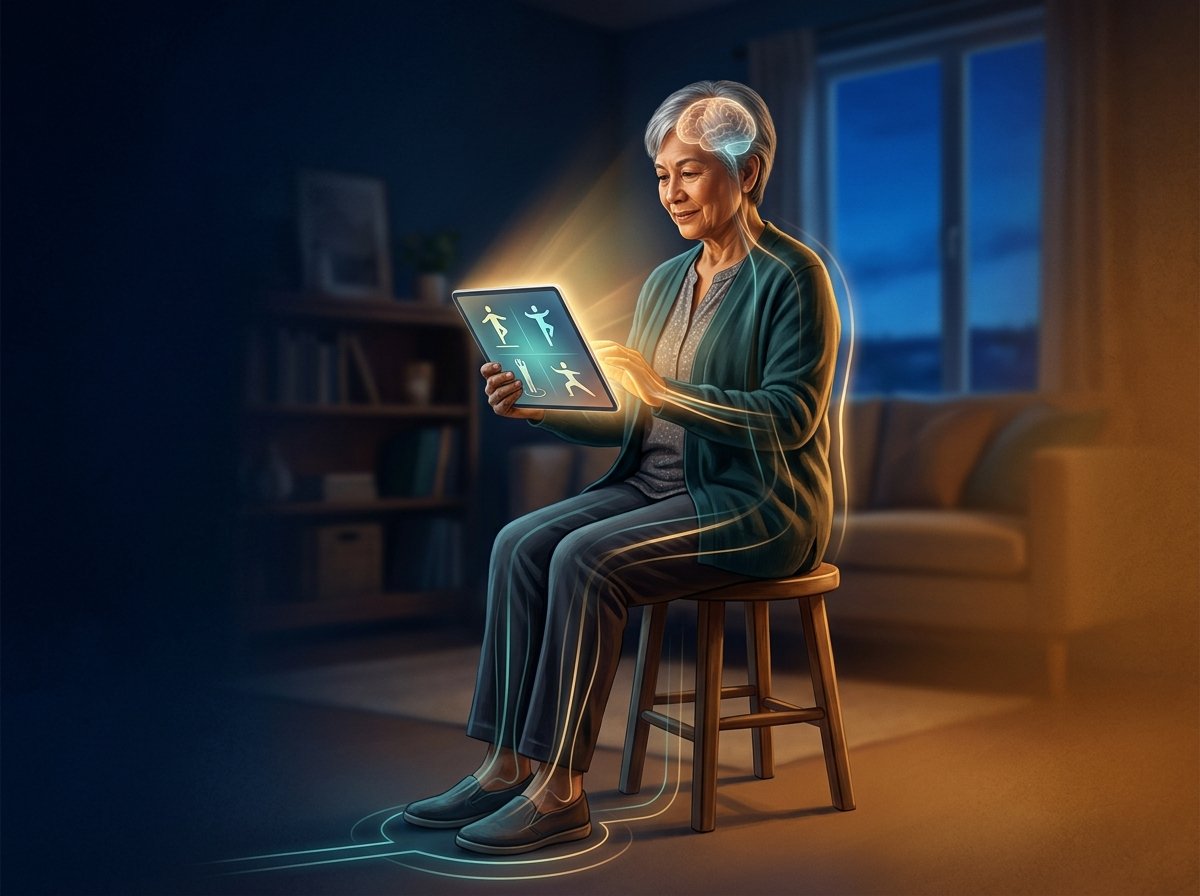


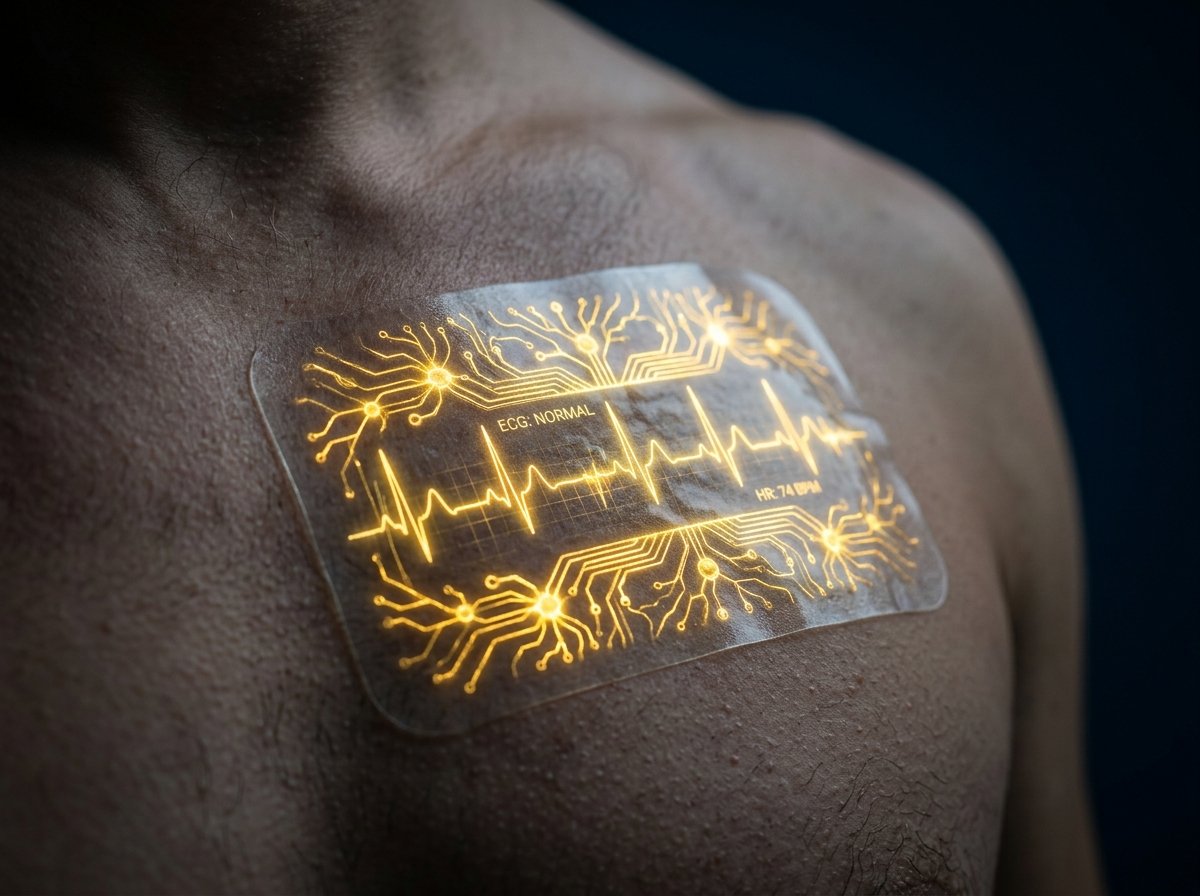
Imagine a doctor that never leaves your side. One that doesn’t need to send your health data to a distant server. One that analyzes your heart’s electrical activity, estimates your cardiac risk, and responds to a life-threatening arrhythmia — all in the time it takes you to blink.
That doctor now exists. It sticks to your skin. And it’s made of material that flexes with your body.
Researchers at the University of Chicago Pritzker School of Molecular Engineering, working with scientists at Argonne National Laboratory, just published something genuinely extraordinary in Nature Electronics — a flexible, brain-inspired computing patch that runs artificial intelligence directly on the body, without wireless transmission, without cloud servers, and without delay.
The Problem With Every Wearable You Own Right Now
Your smartwatch is impressive. It tracks your heart rate, your steps, your sleep. But here’s something most people don’t realize: the actual analysis doesn’t happen on your wrist.
The Tiny Creature That Digests Your Food Before You Even Get a Chance To
When your smartwatch detects something unusual, it sends raw data wirelessly to external servers, those servers run the analysis, and the results come back to your device. That round trip — however fast it feels — takes time.
In everyday wellness monitoring, that delay barely matters. But in medicine, it can mean everything.
Ventricular fibrillation is a cardiac emergency where the heart’s lower chambers fall into chaotic, uncoordinated electrical activity instead of beating rhythmically. It can be fatal within minutes. Researchers have proposed a more targeted treatment approach — tracking the electrical wavefronts causing the chaos and applying precise corrective pulses before the pattern spreads.
But these electrical wavefronts move through the heart extraordinarily fast. The analysis must be completed within milliseconds. No remote server can respond quickly enough.
“This is a situation where it’s not feasible to have remote computing,” said Professor Sihong Wang, associate professor of molecular engineering at UChicago PME and co-senior author of the study. “It just takes too long. But if you have a computing device that can do the analysis within the body, it could be possible.”
Building A Brain-Like Computer You Can Wear On Your Skin
The core challenge was engineering a computing device that could:
- Stretch and flex without breaking or losing performance
- Process AI calculations with enough complexity and precision for real medical use
- Work at body temperature using materials compatible with skin contact
- Scale to a large enough transistor network to run meaningful algorithms
Wang’s laboratory had spent years building toward this moment, developing stretchable transistor arrays and flexible displays. For this project, the goal was a full stretchable neuromorphic computing circuit — a large network of transistors that processes information the way the brain does.
The breakthrough came from choosing organic electrochemical transistors — components that work fundamentally differently from the silicon transistors in conventional computer chips.
Instead of relying purely on electrical current, these devices process information through both electrical signals and the movement of ions within a gel-like electrolyte layer. Because the electrolyte retains information over time, each transistor effectively has its own built-in memory — similar to the way brain synapses strengthen or weaken to store learned patterns.
This is what makes the system neuromorphic — it doesn’t just compute. It learns and remembers, hardware-level, like biological neural tissue.
The Manufacturing Breakthrough That Made It Possible
Building these transistors at scale on flexible materials presented serious engineering obstacles:
- The flexible substrate is sensitive to heat and solvents, making standard chip manufacturing methods completely unsuitable
- The gel electrolyte tends to flow like a liquid, allowing neighboring devices to merge and potentially short-circuit each other
- Scaling from a few transistors to a clinically useful network required entirely new fabrication approaches
The solution was a polymer gel that hardens into precise structures when exposed to ultraviolet light — the same general principle used in photolithography, the dominant patterning method in the microelectronics industry, but adapted entirely for flexible organic materials.
The result: the team can now fabricate up to 10,000 organic electrochemical transistors per square centimeter — a density sufficient to encode genuinely complex AI algorithms onto a patch that conforms to your skin.
“As computer scientists, we’re used to thinking of a neural network weight as just a number,” said Zixuan Zhao, a graduate student and co-first author. “In hardware, it’s a material — with variability, history, and physical limits. The challenge was to hold those constraints in mind and still compute with enough precision to matter.”
The Results: Near-Perfect Accuracy Under Real Conditions
The team put the device through two demanding tests — and the performance was exceptional.
Test 1 — Cardiac Wavefront Mapping:
Using cardiac data from a donated human heart, the stretchable array ran a pretrained algorithm designed to support ventricular fibrillation treatment. It needed to identify the location of dangerous electrical wavefronts in real time, at millisecond speed.
The patch achieved 99.6% accuracy — even when physically stretched to more than one and a half times its original length. Its performance didn’t degrade under the mechanical stress that any real-world wearable would face during everyday use.
Test 2 — Heart Attack Risk Prediction:
A neural network encoded within the array analyzed a combination of vital signs and personal health data — including cholesterol levels, blood sugar, maximum heart rate, and ECG measurements — to estimate a patient’s risk of heart attack.
Accuracy: 83.5%, all computed locally on the patch itself, with no data leaving the body.
What This Could Mean For The Future Of Medicine
Wang is clear about the bigger vision his team is building toward.
“The future that we’re trying to realize is to make wearable and implantable devices smarter,” he said. “It’s helping people have a personal, instantaneous doctor integrated into their devices.”
His team is now working to integrate the computing patch with stretchable wireless communication systems and more advanced sensors — creating a fully unified platform that can:
- Collect health data continuously through skin contact
- Analyze that data using on-body AI in real time
- Respond — potentially triggering corrective interventions automatically for emergencies like arrhythmias
- Communicate processed results wirelessly when needed, without the raw data delay of current systems
“Instead of sending data away to a remote server, we can begin making sense of it right where life is happening,” said Fangfang Xia, computer scientist at Argonne National Laboratory and co-senior author.
The applications extend well beyond cardiac monitoring. Neurological monitoring, metabolic disease management, surgical support, and continuous chronic disease tracking are all plausible future directions for this technology — anywhere that the delay between data collection and analysis currently creates clinical risk or limitation.
The Bottom Line
The gap between what wearable health technology promises and what it currently delivers has always come down to one fundamental constraint: the data has to leave your body to be understood.
This patch removes that constraint entirely.
A flexible, brain-inspired AI computing system that sticks to your skin, stretches with your body, processes medical-grade data in milliseconds, and achieves near-perfect accuracy in life-threatening cardiac scenarios — this is not a concept. It has been built, tested, and published.
The personal doctor that lives on your skin is no longer science fiction. 🩹🫀
Source: University of Chicago Pritzker School of Molecular Engineering / Argonne National Laboratory / Nature Electronics — May 20, 2026
Journal Reference: Songsong Li, Zixuan Zhao, Max Weires, et al. A large-scale stretchable neuromorphic circuit for on-body edge computing. Nature Electronics, 2026.
DOI: 10.1038/s41928-026-01639-8