





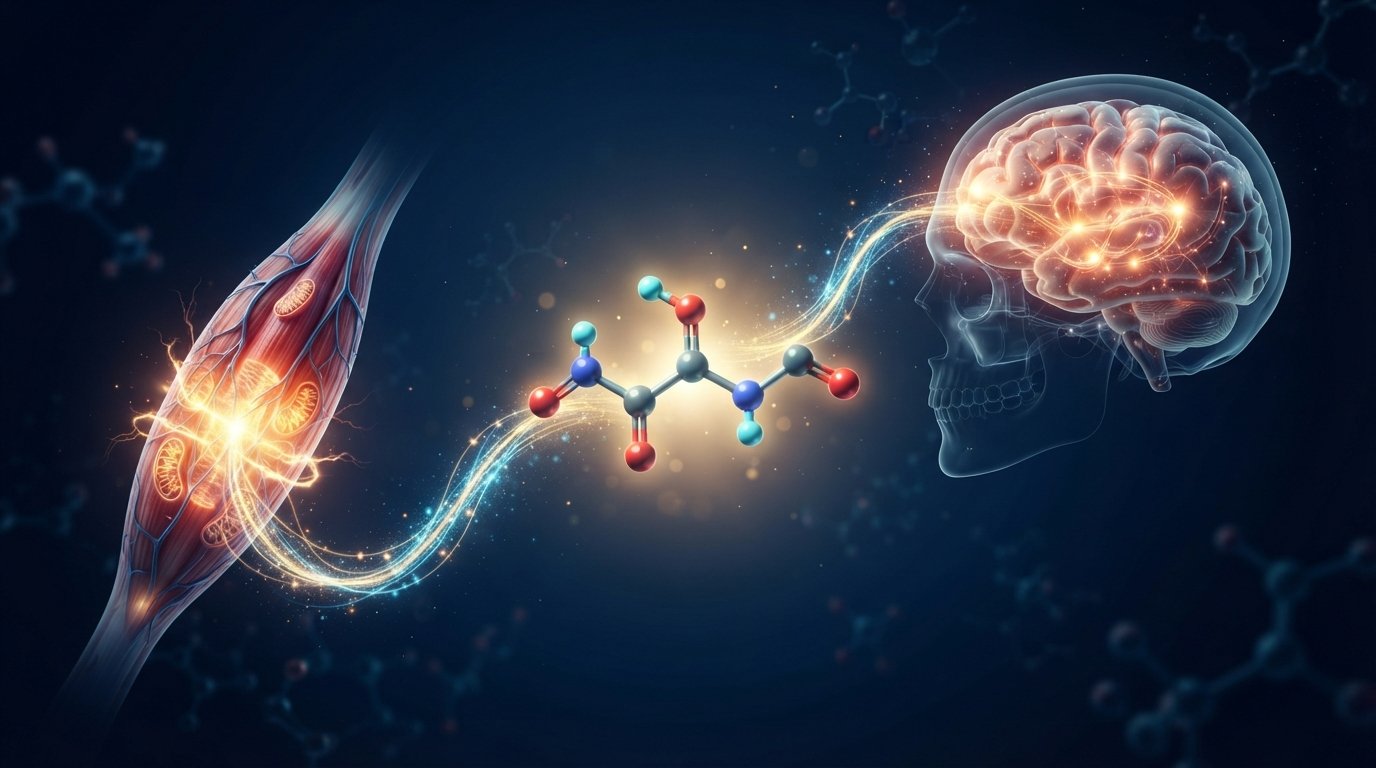
Creatine has built its reputation in gyms and sports science labs — one of the most extensively studied and widely used supplements for strength training and muscle growth. But muscles aren’t the only tissue that depends on creatine for energy.
The brain relies on the exact same cellular energy system. That overlap has led scientists to ask a genuinely interesting question: could a supplement best known for building muscle also help treat depression?
A new systematic review, published in the journal Brain Medicine and led by researchers at the University of Ottawa, set out to answer that question by examining every relevant clinical trial published to date. The results are honest, careful, and — appropriately — inconclusive.
Why Scientists Are Even Asking This Question
The biological rationale for investigating creatine and depression isn’t random speculation. It’s grounded in how the brain actually functions.
This Deep-Sea Giant Can Survive Five Years Without Eating — And Scientists Finally Know How
The brain consumes an enormous amount of energy relative to its size. Creatine plays a central role in helping cells regenerate adenosine triphosphate (ATP) — the molecule that powers nearly every cellular process in the body, including in neurons.
Previous research has identified changes in brain creatine metabolism among people with mood disorders, raising the possibility that disrupted energy production in brain cells could contribute to depression symptoms. Creatine may also influence dopamine and serotonin — two neurotransmitters that are the primary targets of most standard antidepressant medications.
These are plausible biological mechanisms. But as the researchers are careful to point out, plausibility is not proof.
What The Researchers Actually Did
Rather than running a new clinical trial, the team — led by Bassam Jeryous Fares, a medical student at the University of Ottawa — conducted a systematic review, analyzing previously published research to see what the existing evidence actually shows.
After reviewing the available literature, they identified six reports covering five randomized controlled trials — studies where neither participants nor researchers knew who was receiving creatine versus a placebo, the gold standard design for testing whether a treatment genuinely works.
These trials were conducted across five different countries: South Korea, the United States, Brazil, Israel, and India. Combined, they included 238 participants, with 126 receiving creatine and 112 receiving a placebo. The average participant age was 36, and the majority were women — two of the five trials enrolled women exclusively.
Four trials focused on major depressive disorder. One examined people experiencing depressive episodes related to bipolar disorder.
Because the studies differed significantly in design, dosing, and population, the researchers did not attempt to combine them into a single statistical result. Instead, they evaluated each trial individually — an important methodological choice that avoids overstating what mixed evidence can support.
The Two Trials That Showed Real Benefit
Two of the five trials — both drawn from the same broader study of women with major depressive disorder — reported meaningful improvements.
Creatine plus an antidepressant: In one trial, participants who took 5 grams of creatine daily alongside the antidepressant escitalopram experienced significantly greater reduction in depressive symptoms after 8 weeks compared to those receiving escitalopram plus a placebo. The effect size was large by standard statistical measures — a Cohen’s d of 1.13 on the Hamilton Depression Rating Scale — and remission rates were also higher in the creatine group.
Creatine plus therapy: A related study combined creatine with cognitive behavioral therapy (CBT) and found participants experienced greater reduction in depression scores than those receiving therapy plus a placebo.
Both findings point toward a possible role for creatine as an add-on treatment alongside existing evidence-based approaches — not as a standalone therapy.
The Three Trials That Found No Benefit
The remaining three trials told a very different story.
- One tested 5-gram and 10-gram daily doses in people whose depression had not responded to standard medication, and found no advantage over placebo
- Another involved adolescent girls receiving several different doses of creatine and also found no meaningful difference
- A third examined people with bipolar disorder experiencing depressive episodes and likewise found no improvement
This third study also revealed an important safety signal worth taking seriously.
A Notable Safety Concern
Two participants with bipolar disorder who received creatine in that trial developed hypomania or mania — a shift toward abnormally elevated mood, energy, or activity levels associated with bipolar disorder.
This finding suggests that creatine’s effects on the brain may vary significantly depending on a person’s underlying mental health condition. What might be neutral or beneficial for someone with major depressive disorder could potentially destabilize mood in someone with bipolar disorder — a distinction that matters enormously for anyone considering supplementation.
What The Researchers Actually Concluded
The tone of this review is notably careful and scientifically honest — refusing to oversell mixed results.
“The signal is interesting, but it is not a verdict,” said Fares. “Two trials pointed one way, and three pointed another. That is not the kind of evidence on which you change clinical practice. It is the kind that tells you the question is worth further exploration.”
Nicholas Fabiano, corresponding author and a psychiatry resident at the University of Ottawa, echoed this caution while highlighting one clearly positive finding: creatine’s safety profile.
“Creatine appears to be a safe intervention,” Fabiano said. “The adverse events we found were limited to mild gastrointestinal discomfort. We cannot yet reliably say that creatine helps with depressive symptoms or if the findings are generalizable to everyone.”
Important Limitations
The authors are transparent about the weaknesses in the current evidence base:
- Small participant numbers across all five trials
- Female-dominant study populations, with two trials including only women — limiting how well findings generalize to men
- Variable study quality — two trials were rated low risk of bias, while three raised concerns, primarily related to how participants were assigned to groups and how missing data was handled
- Short trial duration — none of the studies extended meaningfully beyond 8 weeks
An intriguing clue from animal research may help explain part of the pattern seen in human studies. Rodent studies have suggested creatine affects depression-like behavior differently in male versus female animals — which could help explain why trials involving more women showed clearer benefit than those with more balanced or male-only populations.
What Larger Future Studies Should Look At
The researchers call for several specific next steps:
- Larger trials with more participants across more diverse populations
- Longer trial durations, extending well beyond the current 8-week standard
- Combined interventions, specifically studying creatine alongside exercise, which independently affects both muscle and brain energy metabolism
- Dose-response studies, since the current evidence doesn’t clarify whether higher doses are more effective — and existing signals suggest they may not be
The Bottom Line
Creatine remains, for now, an intriguing possibility rather than a proven depression treatment. The evidence shows a genuine, biologically plausible signal — particularly in women, particularly when combined with existing treatments like therapy or antidepressants — but it falls well short of what would be needed to recommend it as standard care.
For a supplement best known for building muscle in the gym, the idea that it might also support brain health represents a genuinely interesting new research direction. Just not, yet, a green light to self-treat depression with a bottle of creatine powder instead of established care.
When To See A Healthcare Professional
If you are experiencing symptoms of depression — persistent low mood, loss of interest in activities, changes in sleep or appetite, or difficulty functioning in daily life — please reach out to a doctor, therapist, or mental health professional. Effective, evidence-based treatments already exist, and a professional can help determine what’s right for you.
If you are having thoughts of suicide or self-harm, please contact a crisis helpline in your country immediately, or go to your nearest emergency department.
⚠️ This is a sensitive topic. If you are personally struggling with depression or a mood disorder, please know that support is available and reaching out is a sign of strength, not weakness.
Source: University of Ottawa / Brain Medicine — June 30, 2026
Journal Reference: Bassam Jeryous Fares, Carl Zhou, Nicholas Fabiano, Stanley Wong. Creatine as a treatment for depression. Brain Medicine, 2026.
DOI: 10.61373/bm026l.0039