








As a physiotherapist, I tell clients constantly that exercise is one of the most powerful tools we have for healthy aging. Until recently, though, the exact biological reason exercise protects aging muscles so effectively wasn’t fully understood.
A new study from Duke-NUS Medical School, published in the Proceedings of the National Academy of Sciences, finally connects the dots — and identifies a specific gene that may explain why exercise works, and why it sometimes works better for some people than others.
Why Muscle Health Declines With Age
Healthy muscle does far more than move your body. It plays a central role in metabolism, blood sugar regulation, and overall physical function. Starting in middle age, muscle strength and function begin a gradual decline — increasing the risk of falls, fractures, and slower recovery from illness or injury.
Scientists Discovered Why Some Brains Resist Alzheimer’s Even When The Disease Is Already There
This decline isn’t just an individual health concern. As populations age worldwide, muscle loss increases demands on caregivers and healthcare systems alike. Preserving muscle function is central to maintaining independence and quality of life in later years.
At the center of muscle maintenance is a biological growth pathway called mTORC1, which regulates protein production and repair inside muscle cells. In aging muscle, this pathway can become overactive — pushing cells to focus on building new proteins while becoming less efficient at clearing away damaged ones.
Over time, these damaged proteins accumulate, placing cells under increasing stress. This buildup is a major contributor to the gradual strength loss associated with aging. Until now, scientists hadn’t fully understood what was driving this imbalance.
DEAF1: The Gene Behind The Imbalance
The Duke-NUS research team, working with collaborators from Singapore General Hospital and Cardiff University, identified a gene called DEAF1 as a key driver of this process.
According to the study, DEAF1 levels rise as muscles age. As DEAF1 increases, it pushes mTORC1 activity even higher, worsening the imbalance between building new proteins and clearing out damaged ones.
Under normal, younger conditions, DEAF1 is kept in check by a group of regulatory proteins called FOXOs. But FOXO activity naturally declines with age. Without that regulation, DEAF1 levels climb unchecked, pushing muscle cells further away from healthy repair and maintenance.
How Exercise Restores The Balance
This is where the most encouraging part of the research comes in.
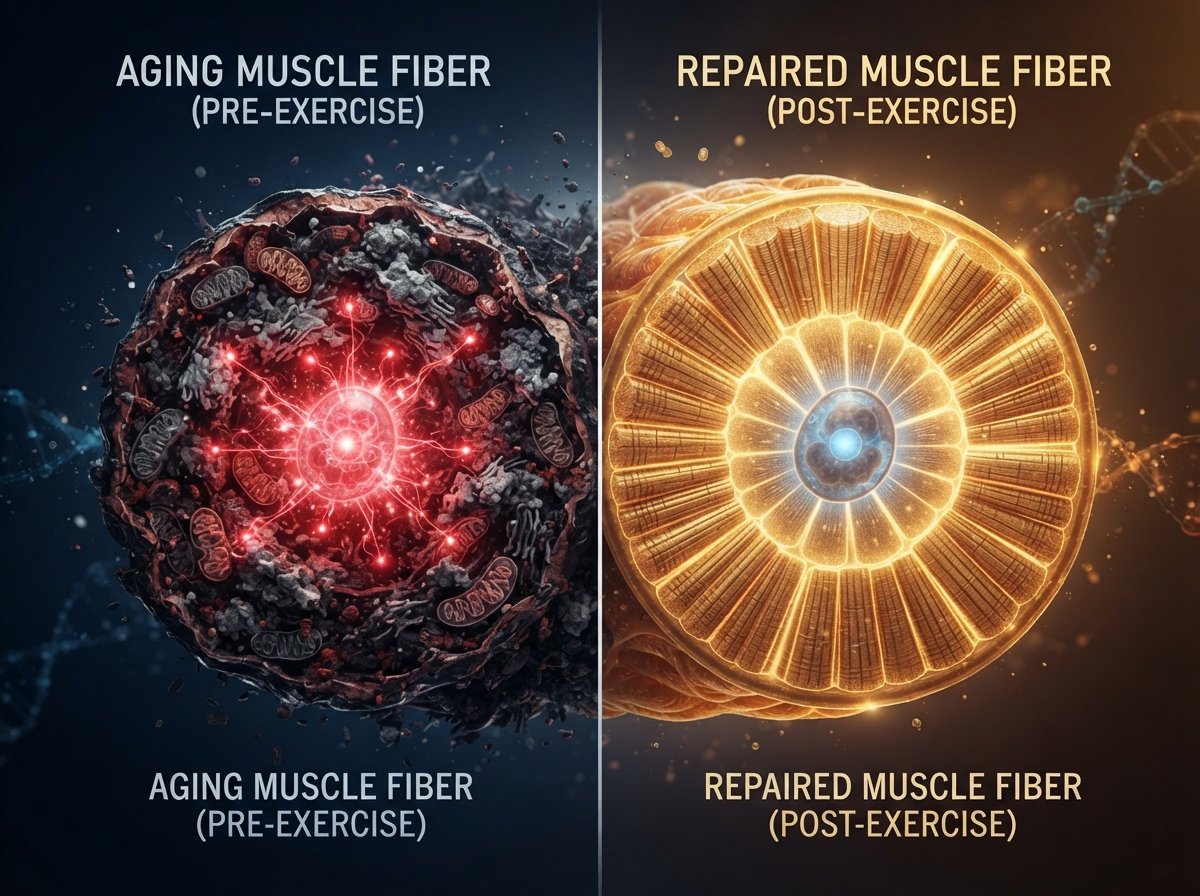
The team found that exercise can directly reverse this imbalance — as long as the underlying regulatory system is still responsive.
“Exercise can reverse this process, correcting the imbalance,” explained Assistant Professor Tang Hong-Wen, the study’s lead author. “Physical activity activates certain proteins which lower DEAF1 levels, bringing the growth pathway back into balance. This allows aging muscles to clear out damaged proteins, rebuild themselves properly, and help them stay stronger and more resilient.”
In practical terms, exercise appears to act as a biological reset button — pushing the mTORC1 pathway back toward its healthy, balanced state and restoring the muscle’s natural ability to clean up and repair itself.
Why Exercise Doesn’t Work Equally Well For Everyone
One particularly important finding from this research helps explain something physiotherapists observe clinically all the time: exercise benefits vary significantly between individuals.
The researchers found that in some older adults, DEAF1 levels become extremely high, or FOXO activity drops so significantly, that exercise alone may not be enough to fully restore the muscle’s repair capacity.
This may help explain why some older adults respond dramatically well to exercise programs, while others see more modest improvements despite similar effort — a difference that may come down to underlying molecular biology rather than simply effort or consistency.
Confirmed Across Two Species
To test their findings rigorously, researchers conducted experiments in both fruit flies and mice — two well-established models in aging research.
The results were consistent across both species:
- Raising DEAF1 levels caused muscles to weaken more rapidly
- Lowering DEAF1 levels restored healthier protein balance and improved muscle strength
This consistency across different organisms suggests that DEAF1 plays a conserved biological role in muscle aging — meaning the mechanism is likely fundamental to how muscle tissue ages across many species, strengthening confidence in its relevance.
Beyond Normal Aging: Broader Implications
The implications of this discovery may extend beyond typical age-related muscle decline.
DEAF1 also influences muscle stem cells — specialized cells responsible for helping muscle tissue repair and regenerate after injury. These stem cells naturally become less effective with age, and disruptions in DEAF1 regulation appear to make recovery even more difficult.
This has potential relevance for people recovering from surgery, illness, or chronic conditions such as cancer — situations where physical activity may be limited but muscle preservation is critical.
“Exercise tells muscles to ‘clean up and reset,'” said Priscillia Choy Sze Mun, the study’s first author. “Lowering DEAF1 helps older muscles regain strength and balance, almost like hitting the rewind button. With millions of older adults at risk of muscle decline, understanding DEAF1 could lead to new ways to protect muscles and improve quality of life.”
Professor Patrick Tan, Senior Vice-Dean for Research at Duke-NUS, added: “This study helps explain, at a molecular level, why aging muscles lose their ability to repair themselves and why exercise can restore that balance in some individuals.”
What This Means For You Right Now
It’s important to understand where this research stands: this is early-stage molecular research, confirmed in fruit flies and mice, not yet tested as a treatment in humans. There is no DEAF1-targeting therapy currently available.
What this research does confirm — with strong mechanistic evidence — is something physiotherapists already recommend based on decades of clinical evidence: regular physical activity is one of the most effective tools available for maintaining muscle health with age.
Evidence-based recommendations that align with this research include:
- Resistance training at least two to three times weekly, which directly stimulates the muscle repair pathways this study examined
- Progressive overload — gradually increasing exercise intensity over time to continue challenging muscle repair systems
- Consistency over intensity for older adults just beginning an exercise program, since the studies suggest even moderate activity activates these repair pathways
- Combining resistance and aerobic activity, which supports overall muscle and metabolic health together
- Patience with results — since this research suggests some people’s underlying biology may mean slower visible improvement, even with consistent effort
Key Takeaways
- Aging muscles lose the ability to properly balance building new proteins and clearing out damaged ones
- A gene called DEAF1 rises with age and worsens this imbalance by overactivating the mTORC1 growth pathway
- Exercise lowers DEAF1 levels, helping restore the muscle’s natural repair and maintenance balance
- This effect was confirmed in both fruit flies and mice
- In some older adults, DEAF1 levels or FOXO decline may be severe enough that exercise alone isn’t fully sufficient — helping explain individual variation in exercise response
- This is early-stage molecular research; no human treatment currently exists based on these findings
When To See A Healthcare Professional
Consider consulting a physiotherapist or physician if you experience:
- Noticeable loss of strength or difficulty with daily tasks like climbing stairs or carrying groceries
- Slow or incomplete recovery after illness, surgery, or injury
- Concerns about starting an exercise program safely, especially with existing health conditions
- Signs of significant muscle loss (sarcopenia), such as noticeable thinning of arms or legs
A physiotherapist can design an appropriate, individualized resistance training program to support healthy muscle aging.
⚠️ Medical Disclaimer: This article is for informational purposes only and is based on research conducted in fruit flies and mice. It does not constitute medical advice and should not be interpreted as a proven human treatment. Always consult a qualified healthcare professional, such as a physiotherapist or physician, before starting a new exercise program.
Have you noticed how your body responds differently to exercise as you’ve gotten older? Share your experience in the comments below.
Source: Duke-NUS Medical School — July 6, 2026
Journal Reference: Sze Mun Choy, Kah Yong Goh, Wen Xing Lee, et al. Exercise suppresses DEAF1 to normalize mTORC1 activity and reverse muscle aging. Proceedings of the National Academy of Sciences, 2025; 122 (48).
DOI: 10.1073/pnas.2508893122