







As a physiotherapist, one of the most common concerns I hear from older clients is a simple one: “Why do I feel weaker than I used to, even though I haven’t changed much?”
Age-related muscle loss, known clinically as sarcopenia, is one of the leading causes of frailty, falls, and loss of independence in older adults. Despite how common it is, treatment options remain limited — mostly resistance exercise and adequate protein intake.
A new study published in the journal Gut introduces a genuinely surprising possibility: a specific bacterium living in your intestines may play a direct role in how strong your muscles are — and its levels appear to decline naturally with age, right when sarcopenia risk increases.
The Gut-Muscle Connection Researchers Are Investigating
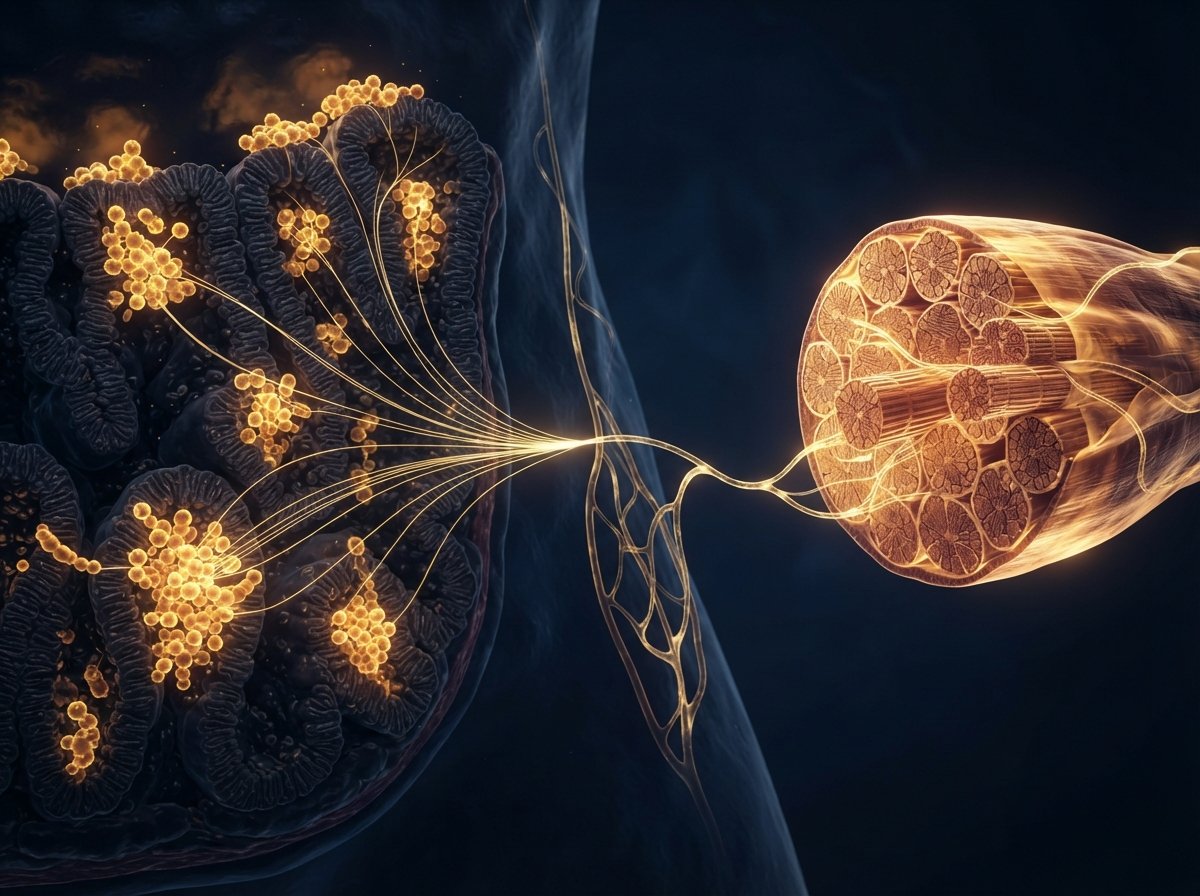
Scientists have known for years that gut bacteria influence far more than digestion. The gut microbiome affects metabolism, immune function, brain health, and cardiovascular disease risk. More recently, researchers have begun exploring what’s now called the gut-muscle axis — the idea that specific gut bacteria might directly influence muscle strength and performance.
Scientists Discovered Why Some Brains Resist Alzheimer’s Even When The Disease Is Already There
This new study, led by researchers in the Netherlands and Spain, set out to identify which bacteria, if any, are actually linked to measurable muscle strength in real people.
What The Researchers Did
The team analyzed stool samples from 90 healthy young adults (ages 18–25) and 33 older adults (65+), identifying which bacterial species were present in each person’s gut.
They then measured physical fitness using several standard clinical tests:
- Handgrip strength — a well-established marker of overall muscle strength and a key clinical indicator of frailty risk
- Leg press and bench press performance — measuring lower and upper body strength
- VO2 max — a measure of cardiorespiratory fitness during physical exertion
Of all the bacterial species detected, only one genus — Roseburia — showed a meaningful link to muscle strength. And within that genus, one species stood out clearly above the rest.
Roseburia Inulinivorans: The Standout Bacterium
The species Roseburia inulinivorans (R. inulinivorans) showed the strongest and most consistent association with muscle strength across both age groups.
In older adults:
- Those with detectable R. inulinivorans had 29% higher handgrip strength than those without it
- This strength difference occurred without a corresponding increase in cardiorespiratory fitness — suggesting the effect was specific to muscle function, not general fitness
In younger adults:
- Higher levels of R. inulinivorans were linked to both stronger handgrip and higher VO2 max
- Higher abundance was also positively linked to leg press and bench press strength
Interestingly, two related species — R. faecis and R. hominis — showed no meaningful connection to strength at all. This suggests that within the same bacterial genus, different species may play very different roles in the body.
Testing Cause And Effect In Mice
Finding an association in stool samples is one thing. Proving that a bacterium actually causes stronger muscles is a much bigger scientific claim — and this is where the research became genuinely compelling.
Researchers depleted the gut microbiomes of 32 mice using antibiotics, then divided them into four groups. Three groups received different Roseburia species once weekly for 8 weeks. One group received none, serving as the control.
The results for R. inulinivorans specifically:
- Grip strength increased by about 30% compared to control mice, measured after 4, 6, and 8 weeks of treatment
- Muscle fibers were larger, and mice had a significantly higher proportion of type II (“fast-twitch”) fibers in their calf muscle
Fast-twitch fibers are specifically responsible for powerful, explosive movements — the kind used in jumping, sprinting, and lifting heavy objects. Preserving these fibers is particularly important for fall prevention in older adults, since the ability to react quickly with strong, rapid muscle contractions helps prevent falls from becoming injuries.
Importantly, none of the Roseburia species improved how long the mice could run before becoming exhausted — meaning the effect appeared specific to muscle strength and fiber composition, not general endurance.
Why This Bacterium May Matter Most For Older Adults
Perhaps the most clinically relevant finding in this entire study is this: R. inulinivorans naturally declines with age.
In young adults, its relative abundance ranged up to 6.6% of gut bacteria. In older adults, that maximum dropped to just 1.3%.
This decline occurs during precisely the same life stage when sarcopenia becomes increasingly common — raising a genuinely important question for future research: is the natural loss of this bacterium with age one contributing factor to age-related muscle decline?
“Our findings provide robust evidence supporting a gut-muscle axis in which R. inulinivorans positively modulates muscle metabolism and muscle strength,” the researchers concluded, noting its potential as “a probiotic candidate for preserving muscle strength” in aging populations.
Important Limitations To Understand
As encouraging as these findings are, several important limitations mean this is not yet something you can act on directly.
- This is early-stage research. The human data shows association, not proof of causation. The mouse studies suggest a causal effect, but mice are not humans.
- None of the human Roseburia strains actually colonized the mouse gut during testing — an important technical limitation the researchers themselves acknowledge.
- Specific biological mechanisms remain unclear. The researchers did not directly test whether inflammation or nerve-muscle signaling pathways were involved.
- No commercially available R. inulinivorans probiotic currently exists for human use, and this study does not establish safe or effective dosing.
The researchers themselves are clear that “long-term studies are needed to determine whether changes in R. inulinivorans abundance cause changes in muscle function or occur as a result of them.”
What This Means For You Right Now
While a specific probiotic treatment isn’t available yet, this research reinforces several things physiotherapists already know matter for maintaining muscle strength as you age:
- Resistance training remains the most proven intervention for maintaining muscle mass and strength with age, according to research published in the Journal of Orthopaedic & Sports Physical Therapy
- Dietary fiber supports a healthy gut microbiome broadly, including potentially favorable conditions for beneficial bacteria like Roseburia species, which are known fiber fermenters
- Adequate protein intake continues to be essential for maintaining muscle mass, particularly in older adults whose protein needs are often higher than commonly assumed
- Regular physical activity supports overall metabolic health, which may in turn support a favorable gut environment
This study doesn’t replace those evidence-based strategies — but it does suggest gut health may be a meaningful, previously overlooked piece of the muscle-strength puzzle.
Key Takeaways
- A specific gut bacterium, R. inulinivorans, was linked to significantly greater muscle strength in both young and older adults
- Older adults with this bacterium had 29% higher handgrip strength than those without it
- Mouse studies suggest the bacterium may directly cause increased muscle fiber size and strength
- This bacterium’s abundance naturally declines with age — coinciding with rising rates of sarcopenia
- This is early-stage research; no approved probiotic treatment currently exists
- Resistance exercise, adequate protein, and dietary fiber remain the current evidence-based approaches for maintaining muscle strength with age
When To See A Healthcare Professional
Consider speaking with a doctor or physiotherapist if you notice:
- Noticeable weakness in grip strength or difficulty opening jars, carrying groceries, or rising from a chair
- Unexplained falls or a fear of falling
- Unintentional muscle loss or weight loss
- Difficulty maintaining balance or walking speed
A physiotherapist can assess muscle strength, recommend an appropriate resistance training program, and refer you for further evaluation if sarcopenia is suspected.
⚠️ Medical Disclaimer: This article is for informational purposes only and reflects early-stage research involving human observational data and mouse studies. It does not constitute medical advice and should not be interpreted as an endorsement of any probiotic product. Always consult a qualified healthcare professional, such as a physiotherapist or physician, before making changes to your health regimen.
Have you noticed changes in your grip strength or overall muscle strength as you’ve gotten older? Share your experience in the comments below.
Source: Gut Journal / Instituto de Salud Carlos III — July 2026
Journal Reference: Borja Martinez-Tellez, Milena Schönke, Artemiy Kovynev, et al. Roseburia inulinivorans increases muscle strength. Gut, 2026.
DOI: 10.1136/gutjnl-2025-336980