








For decades, one idea has been repeated so often in psychology and neuroscience that it became accepted wisdom: humans cannot truly multitask. What feels like doing two things at once, researchers argued, is actually the brain rapidly switching attention back and forth between tasks — creating a convincing illusion of simultaneity, but never genuine parallel processing.
New research from Georgetown University Medical Center challenges that long-held belief directly. Published in the Journal of Cognitive Neuroscience, the study reveals that with enough practice, the brain can physically reorganize itself to perform certain tasks simultaneously — not by switching between them, but through genuine, structural neural change.
The Long-Standing Bottleneck Theory
To understand why this discovery matters, it helps to understand the theory it challenges.
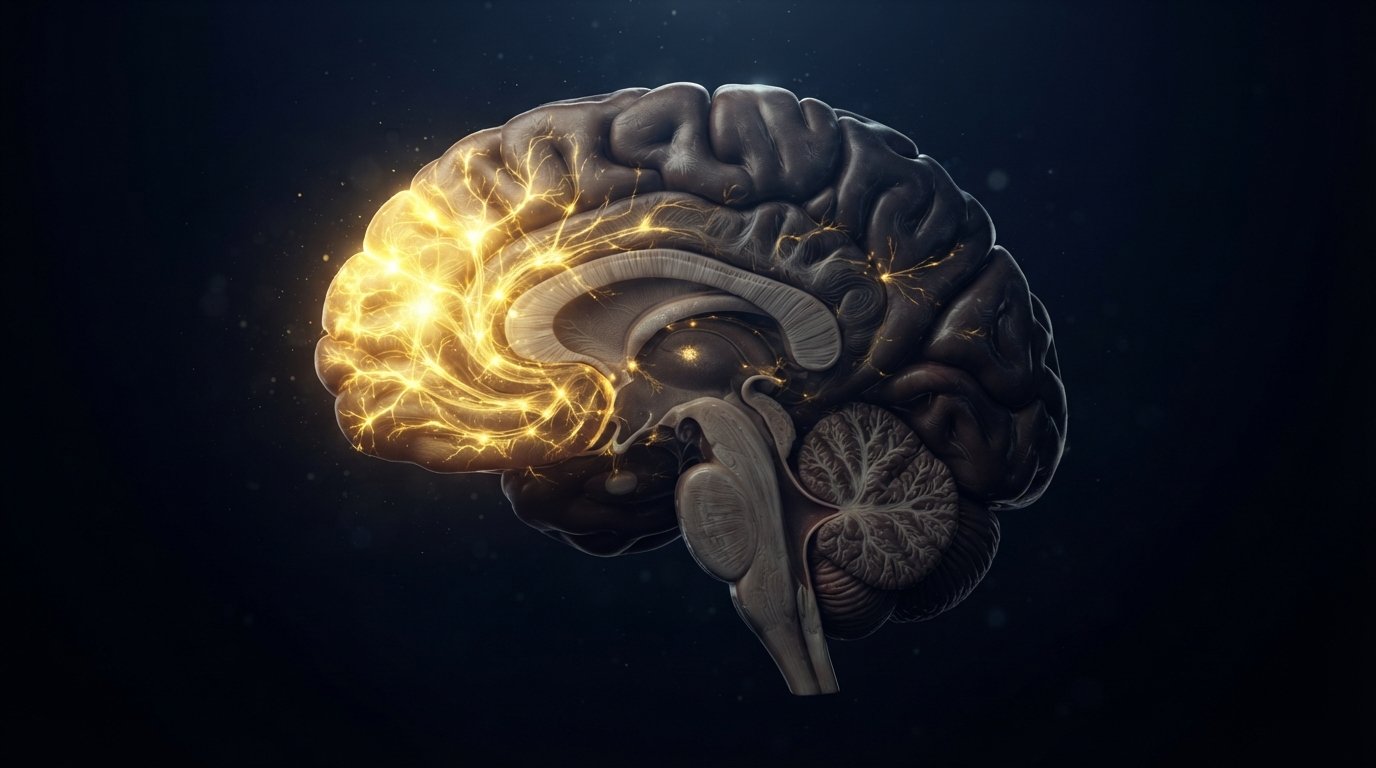
The human brain’s prefrontal cortex is responsible for executive functions — planning, reasoning, and conscious decision-making. Because this region generally handles demanding cognitive tasks one at a time, it has long been viewed as neuroscience’s primary explanation for why humans struggle to do two complex things simultaneously. This is often called the “frontal bottleneck.”
Under this model, when you feel like you’re multitasking, you’re actually asking your prefrontal cortex to rapidly toggle its attention between two tasks — never truly running both at once.
Why The Human Body Has So Many Design Flaws — And Why That’s Actually A Fascinating Story
“We have another stepping stone in our understanding of how the brain learns,” said senior author Maximilian Riesenhuber, PhD, professor of neuroscience at Georgetown University School of Medicine and co-director of the Center for Neuroengineering. “The encouraging part is that you really can learn to multitask. There is actually a way to remodel your brain architecture and use other parts of your brain.”
The Everyday Example That Inspired The Question
Riesenhuber points to something almost everyone has experienced directly: learning to drive.
Learning to drive initially demands intense, focused attention — every mirror check, every steering adjustment requires conscious effort. But years of experience allow many drivers to carry on a conversation, listen to music, or think through unrelated problems while still driving safely.
“The question is: how does your brain do that?” Riesenhuber asked.
Decades of neuroscience research have explored the early stages of skill learning in detail. But far less was understood about what happens after a skill becomes so well-practiced that it feels almost effortless — precisely the gap this new research set out to fill.
How The Study Was Designed
To investigate, the research team, led by first author Patrick Cox, PhD — who began the project as a graduate student in Riesenhuber’s lab and is now an assistant professor of psychology at Lehigh University — asked volunteers to sort morphed images of cars into two categories, based on subtle visual differences between them.
Participants completed more than 30,000 sorting trials over a period of 5 to 10 weeks, using a smartphone app designed like a simple game.
Crucially, the researchers scanned participants’ brains using both fMRI and EEG — both before training began and again after the practice period concluded. This longitudinal, before-and-after design is what makes the study particularly powerful.
“Previous studies have shown that parts of the temporal cortex can be activated by particular object categories in experienced observers — birds, cars, even Pokémon — but a limitation of all of those studies is that they only looked after people became experts,” Cox explained. “The strength of this study is that it is longitudinal; we measure before and after training, so we can see that extensive training essentially put a category-selective area in the temporal lobe that was not there before.”
The Brain Shift Researchers Observed
The results revealed a clear and measurable transformation.
Early in learning, the car-sorting task primarily activated the prefrontal cortex — consistent with the established “frontal bottleneck” theory, and consistent with how demanding a genuinely new task feels when you’re first learning it.
After weeks of practice, brain activity for the same exact task had shifted dramatically. It was now handled mainly by the temporal cortex — a brain region associated with memory and recognizing complex objects, rather than active conscious reasoning.
This finding has direct relevance to real-world expertise. “This has implications for critical real-world scenarios,” Cox noted, “like when a radiologist can accurately classify masses on an X-ray as benign or malignant fairly automatically, often without extensive deliberation, thanks to years of training.”
How This Rewiring Enables Genuine Multitasking
The researchers discovered something crucial about how this newly automated brain circuit actually functioned: information from the newly formed car-selective area in the temporal cortex could bypass the prefrontal cortex entirely, traveling directly to the brain regions responsible for producing a physical response.
“Experience remodels the brain to bypass that frontal bottleneck,” Riesenhuber explained. “The prefrontal cortex then stays free for whatever else you want to do, increasing your capacity.”
The team then tested whether this neural “offloading” actually translated into improved real-world multitasking ability — and it did. The more the car-sorting task moved out of the prefrontal cortex, the better participants performed a second task at the same time.
“What we show is that the circuitry actually changes so the brain can do two things at once,” Riesenhuber said. “This really is true multitasking.”
What This Means For Breaking Bad Habits
The findings also offer a genuinely useful insight into why certain habits and compulsive behaviors are so difficult to change through willpower alone.
Because well-learned behaviors migrate into brain circuits that operate with less conscious oversight, simply telling yourself to “think about something else” may not actually interrupt the underlying neural process driving the behavior.
“The first step to unlearning something is understanding where it is actually happening in the brain,” Riesenhuber said. “This shows why strategies like telling someone to think of something else don’t really help, because they don’t really have the behavior under conscious control.”
Implications For Artificial Intelligence
The research team also sees implications extending into artificial intelligence development.
Current AI systems often struggle with “catastrophic forgetting” — learning a new skill can disrupt or overwrite previously learned knowledge. Human brains, by contrast, appear to solve this problem elegantly: transferring a well-learned skill into a more automatic, dedicated brain region frees up the prefrontal cortex to tackle new challenges, while the original skill continues functioning independently in the background.
“Existing knowledge serves as the foundation for future learning,” according to Riesenhuber’s framing — a flexible architecture that today’s AI systems generally lack.
What’s Next
The team plans to investigate exactly which neural signals drive the transfer of learning from the prefrontal cortex to specialized regions like the temporal cortex, and to determine which types of tasks can eventually be performed genuinely in parallel.
Cox notes an important limit to this newfound multitasking capacity: it depends entirely on whether two tasks can be handled by fully separate neural circuits.
“We can walk and chew gum at the same time, but looking at our phones to text while driving will never be safe, because we take our eyes away from the road,” Cox explained. “It comes down to being able to train fully separate neural circuits for two tasks to become compatible.”
Key Takeaways
- Extensive practice physically reorganizes the brain, moving well-learned tasks from the prefrontal cortex into more automatic circuits in the temporal cortex
- This “offloading” frees the prefrontal cortex to handle additional tasks simultaneously — enabling genuine multitasking, not just rapid switching
- Participants who showed greater neural offloading performed better at a second task performed at the same time
- The findings help explain why habits are hard to break through conscious effort alone, since well-learned behaviors operate outside conscious control
- True multitasking is only possible when two tasks can be handled by genuinely separate neural circuits — not all task combinations qualify, particularly those requiring the same sensory resource (like vision)
Source: Georgetown University Medical Center — July 12, 2026
Journal Reference: Patrick H. Cox, Clara A. Scholl, Marissa L. Laws, Nelson E. Jaimes, Xiong Jiang, Maximilian Riesenhuber. Extensive Experience Remodels Neural Task Circuitry to Escape the Frontal Bottleneck and Increase Automaticity of Categorization. Journal of Cognitive Neuroscience, 2026.
DOI: 10.1162/JOCN_a_2618