








Gold has captivated humanity for thousands of years, prized not just for its beauty but for something almost magical: it simply never loses its shine. While silver darkens with time, iron rusts, and copper develops a green patina, gold jewelry excavated from ancient tombs can still gleam as brightly as the day it was made.
For generations, scientists assumed they understood why. New research from Tulane University, published in Physical Review Letters, reveals that the real explanation is far more sophisticated than anyone realized.
The Old Explanation Wasn’t The Whole Story
“People have generally thought gold doesn’t tarnish simply because it doesn’t interact strongly with oxygen,” explained Matthew Montemore, associate professor in Chemical Engineering at Tulane’s School of Science and Engineering.
This conventional explanation made intuitive sense. Oxygen is the culprit behind tarnishing and rusting in most metals — iron rusts, silver tarnishes, copper turns green — all through reactions with oxygen in the air. If gold simply didn’t react much with oxygen in the first place, that alone would explain its remarkable durability.
But Montemore and his research team discovered that gold’s resistance to tarnishing depends on more than just its underlying chemistry.
The Discovery: Gold’s Atoms Rearrange Themselves
Working with co-author Santu Biswas, a postdoctoral fellow in Tulane’s Department of Chemical & Biomolecular Engineering, Montemore used sophisticated computer simulations capable of predicting how atoms and electrons behave under different conditions.
The team specifically examined how oxygen molecules interact with two of the most common gold surface structures — the particular atomic arrangements found on the outermost layer of gold, where any reaction with the surrounding environment would actually take place.
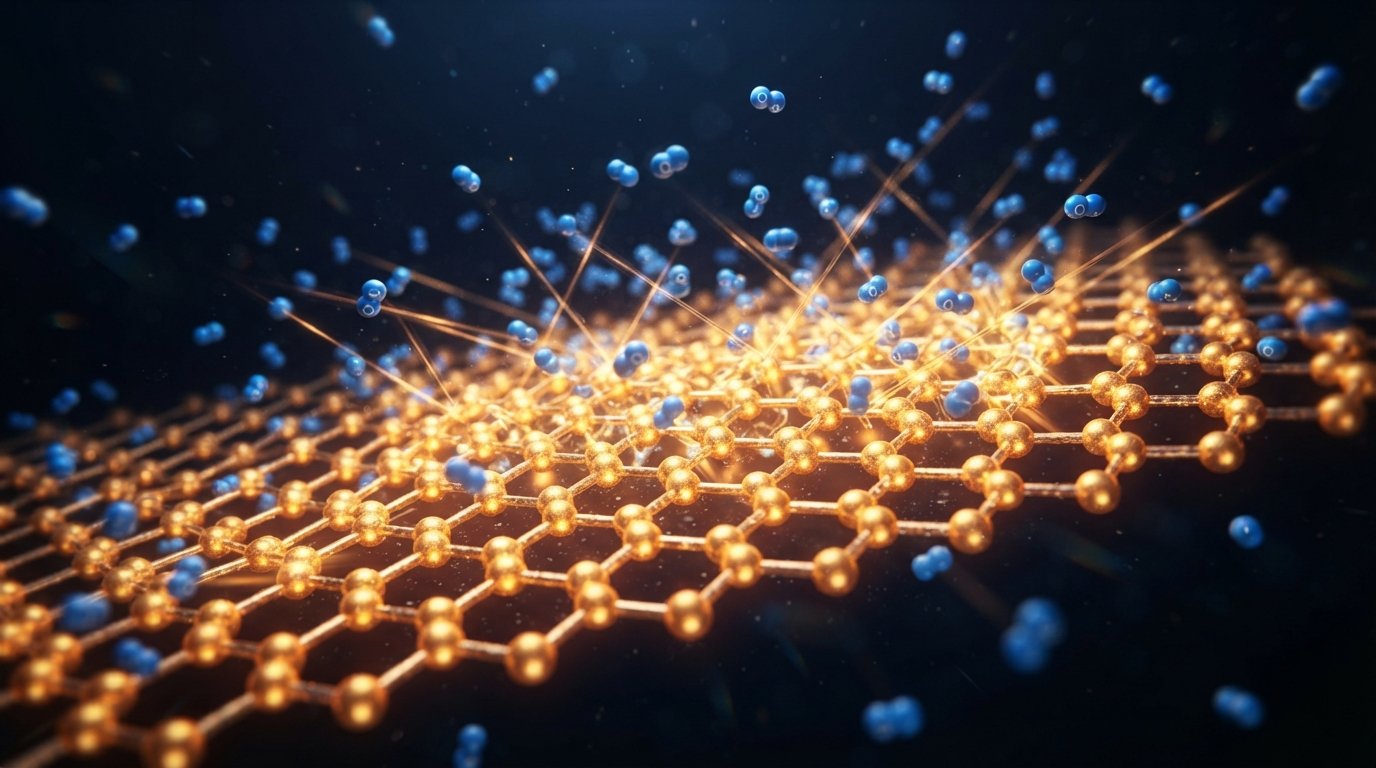
“What we show is that for two of the most common gold surface types, the surface atoms actually rearrange themselves in a way that makes the gold much more resistant to oxidation,” Montemore explained.
In other words, gold’s surface isn’t a static, unchanging arrangement of atoms. It actively reorganizes itself — shifting into specific protective configurations that make it significantly harder for oxygen to interact with and oxidize the underlying metal.
What Happens Without This Protection
To understand the significance of this atomic rearrangement, the researchers also modeled what would happen if gold’s surface atoms stayed in their original, unshifted positions.
The simulations revealed something striking: without this natural atomic reorganization, oxygen molecules could split apart and react with gold far more easily. The chemical process that leads to tarnishing — oxygen molecules breaking apart and bonding with metal atoms — would proceed much more readily on an unshifted gold surface.
This finding was the critical piece of the puzzle. It meant that gold’s famous resistance to tarnishing isn’t simply a passive property of the element itself — it’s an active, structural response happening continuously at the atomic level on the metal’s surface.
A Protective Barrier — By The Numbers
When the researchers modeled gold surfaces with the natural atomic rearrangement in place, the results were dramatic.
The rearranged surface structures suppressed reactions with oxygen by a factor of a billion to a trillion compared to what would occur on an unshifted surface. This is an almost unimaginably large reduction in reactivity — the kind of difference that explains why gold objects can remain essentially unchanged in appearance across centuries, while other metals visibly degrade within years or even months of exposure to air.
In effect, the shifted atoms create a protective barrier at the atomic scale — an invisible, self-generated shield that keeps oxygen from meaningfully reacting with the gold beneath it.
Why This Matters Beyond Jewelry
While the discovery offers a satisfying explanation for one of gold’s most famous and long-appreciated properties, its implications extend well beyond aesthetics and historical curiosity.
Gold plays an increasingly important role in industrial catalysis — the process of using a material to speed up or enable chemical reactions without being consumed in the process. Gold-based catalysts are already used in various manufacturing processes and are being actively researched for applications in clean energy technologies.
Historically, researchers seeking to improve gold’s catalytic performance have focused on strategies like combining gold with other metals or creating tiny gold nanoparticles dispersed across oxide surfaces — approaches designed to increase gold’s reactivity for specific chemical processes, since gold’s natural resistance to reacting with other substances can also limit its usefulness as a catalyst in certain contexts.
Understanding exactly why and how gold’s surface resists oxidation — down to the precise atomic rearrangement responsible — gives researchers a new and more precise lever to work with. If scientists can understand and potentially manipulate this same atomic-level rearrangement mechanism, they may be able to design gold-based catalysts that are deliberately engineered to be more reactive in controlled, useful ways, while still retaining gold’s other valuable properties.
A New Way To Think About Metal Chemistry
This research also carries a broader scientific lesson that extends beyond gold specifically. It demonstrates that a metal’s chemical stability and reactivity cannot always be fully explained by simple, static assumptions about its underlying chemistry alone.
Dynamic, atomic-scale structural behavior — atoms actively rearranging themselves in response to their environment — can play a decisive role in determining how a material behaves in the real world. This kind of insight, made possible through advanced computational modeling of atoms and electrons, is increasingly reshaping how materials scientists understand and design everything from precious metals to industrial catalysts.
The Bottom Line
For thousands of years, gold’s enduring shine has been taken almost for granted — a simple, inherent property of a beautiful metal. Tulane University researchers have now revealed that this shine is the visible result of a remarkably sophisticated, continuously active atomic defense system: gold’s own surface atoms quietly reorganizing themselves to block oxidation, trillion-fold.
The next time you look at a piece of gold jewelry that has outlasted generations, remember — its brilliance isn’t passive. At the atomic level, it’s actively protecting itself, one rearranged atom at a time. ✨🔬
Source: Tulane University — 2026
Journal Reference: Santu Biswas, Matthew Montemore. Published in Physical Review Letters, 2026.