




The deep ocean has long been imagined as one of Earth’s most nutrient-starved environments — a vast, dark expanse where life must scrape by on whatever meager scraps drift down from the sunlit waters above. New research from the University of Southern Denmark (SDU) suggests that picture may be fundamentally incomplete.
Published in Science Advances, the study reveals that deep ocean microbes have access to a food source nobody had properly accounted for — one created by the crushing pressure of the deep sea itself.
What Is Marine Snow?
To understand this discovery, it helps to understand marine snow — a constant, gentle rain of organic material falling through the ocean, made up of tiny clumps of dead algae, microbes, fecal matter, and other biological debris.
Marine snow has long been recognized as one of the primary ways carbon and nutrients travel from the sunlit surface ocean down into the deep sea — and eventually, scientists believed, into permanent burial in seafloor sediments. This process, often called the biological carbon pump, is a critical part of how the ocean regulates atmospheric carbon dioxide over long timescales.
What researchers hadn’t fully appreciated was what happens to these particles during their long journey downward — specifically, what the immense pressure of the deep ocean does to them along the way.
Why The Human Body Has So Many Design Flaws — And Why That’s Actually A Fascinating Story
The “Giant Juicer” Effect
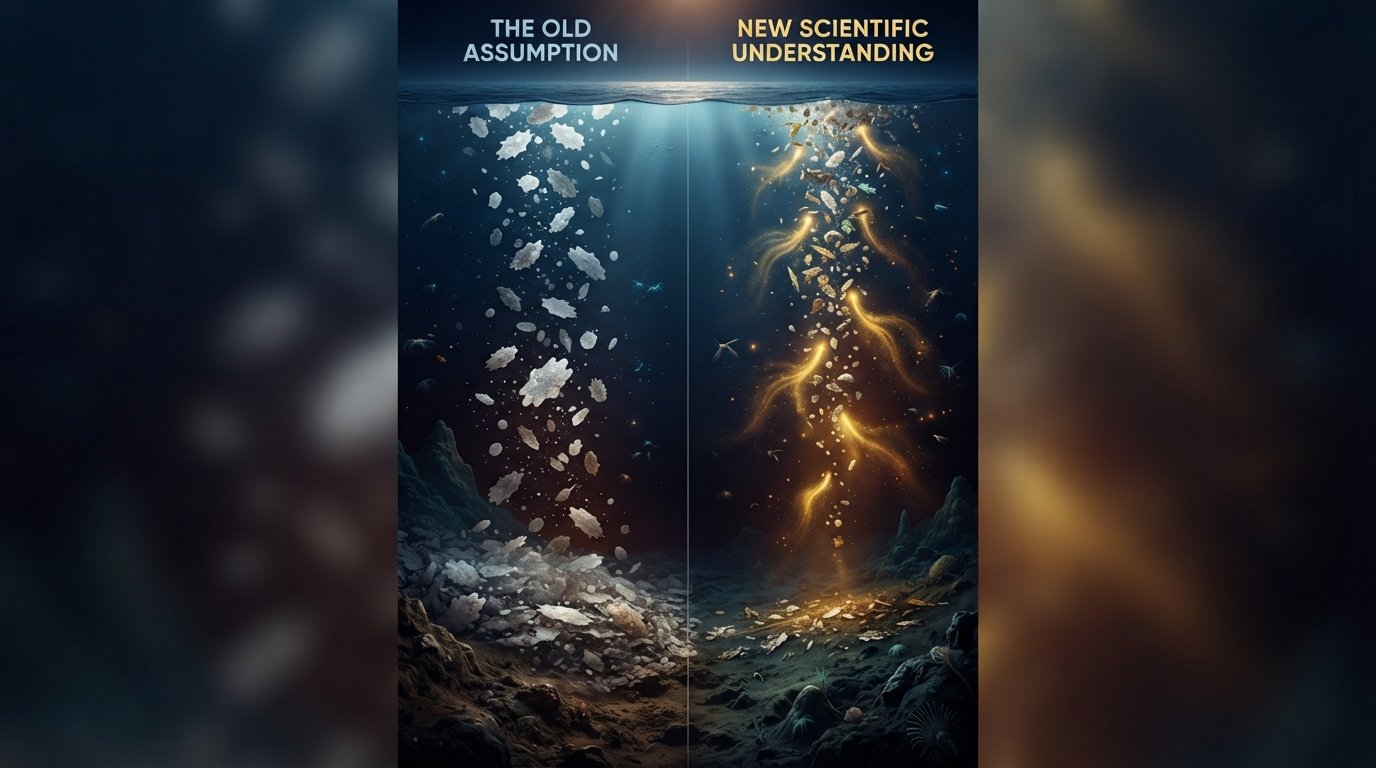
Led by biologist and Associate Professor Peter Stief from SDU’s Nordcee and the Danish Center for Hadal Research, the research team discovered that once marine snow particles reach depths of roughly 2 to 6 kilometers, the enormous hydrostatic pressure at those depths begins forcing dissolved organic matter out of them.
Stief offers a memorable analogy for the mechanism at work: “The pressure acts almost like a giant juicer. It squeezes dissolved organic compounds out of the particles, and microbes can use them immediately.”
In other words, the same crushing pressure that makes the deep ocean so hostile to most life is simultaneously releasing a steady stream of nutrients from sinking organic particles — nutrients that free-living microbes in the surrounding seawater can access and consume immediately, without needing to wait for particles to fully decompose or reach the seafloor.
The Scale Of Nutrient Loss
The scale of this “juicing” effect turned out to be substantial. According to the researchers, sinking marine snow can lose as much as 50% of its original carbon content and between 58% and 63% of its original nitrogen content during its descent through the deep ocean.
That’s an enormous proportion of a particle’s nutritional value being released into the surrounding water column before the particle ever reaches the ocean floor — nutrients previously assumed to be traveling largely intact toward burial in deep-sea sediment.
Recreating Deep-Sea Pressure In The Lab
To investigate this process under controlled conditions, the SDU research team recreated marine snow in the laboratory using diatoms — microscopic algae that naturally clump together into particles as they sink through ocean water, closely mimicking how real marine snow forms.
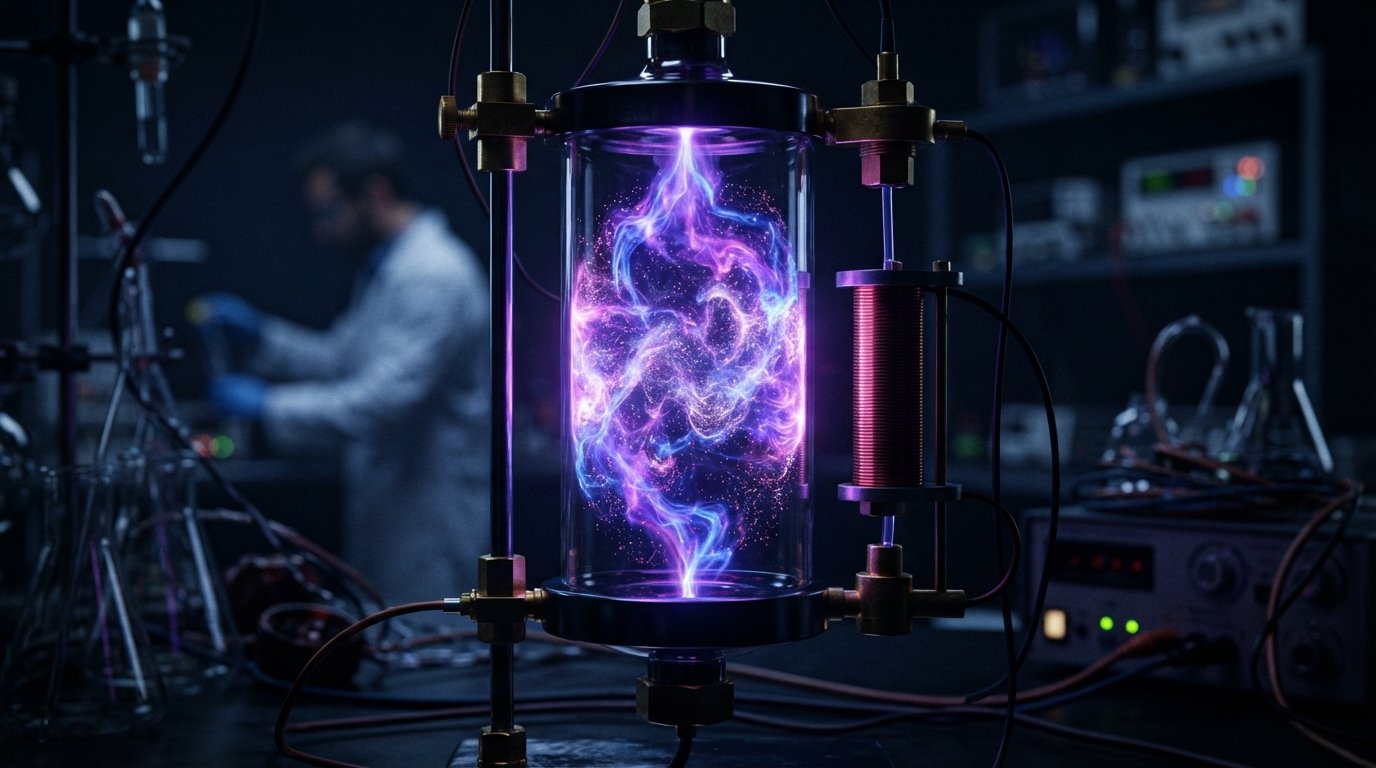
The team placed these artificial particles inside specially designed rotating pressure tanks, engineered to keep the marine snow suspended in the water column rather than simply settling to the bottom of the tank — closely simulating the actual conditions particles experience while sinking through the deep ocean.
This setup allowed the researchers to precisely measure how much carbon and nitrogen leaked out of the particles under pressure conditions similar to those found at real deep-ocean depths. Their experiments confirmed that up to half of a particle’s carbon content leaked out during simulated sinking — and crucially, that most of the released material consisted of proteins and carbohydrates, nutrient forms that free-living deep-ocean microbes can readily and immediately consume.
Microbes Respond Almost Instantly
The most striking evidence for the biological significance of this process came from observing how quickly deep-sea microbes responded to the leaked nutrients.
Within just two days of exposure to the released dissolved organic matter, bacterial abundance increased 30-fold, while microbial respiration rates rose dramatically. This rapid, dramatic response indicates that the nutrients leaking from marine snow under pressure provide a genuinely valuable and immediately usable energy source for microorganisms living at extreme depths — not a marginal or slow-acting food source, but a fast, significant one.
Importantly, the researchers observed this same leakage pattern across multiple species of diatoms, suggesting the mechanism isn’t limited to one specific type of organic particle — it’s likely a widespread phenomenon occurring throughout the world’s oceans wherever marine snow sinks to sufficient depth.
Why This Could Reshape Our Understanding Of The Carbon Cycle
Beyond its implications for deep-sea ecology, this discovery carries significant weight for how scientists understand Earth’s carbon cycle — the complex system governing how carbon moves between the atmosphere, oceans, land, and long-term geological storage.
Scientists have long assumed that a substantial portion of the carbon carried by sinking marine snow eventually becomes permanently buried in deep ocean sediments — locked away for potentially millions of years, similar to the geological processes that formed much of today’s oil and natural gas reserves.
If large amounts of carbon are instead leaking out of these particles before they reach the seafloor, then significantly less carbon may actually be reaching long-term sediment burial than previous models assumed.
Instead, that leaked carbon remains suspended as dissolved organic matter in deep ocean waters — where it can persist for hundreds or even thousands of years before gradually mixing back toward the surface ocean and, eventually, potentially returning to the atmosphere.
“This process affects how much carbon the ocean can store and for how long,” Stief explained. “It’s relevant for understanding climate processes and for improving future models.”
This distinction — carbon locked away for millions of years in sediment versus carbon cycling back to the surface over centuries to millennia — matters enormously for how accurately climate scientists can model the ocean’s long-term role in regulating atmospheric carbon dioxide.
What Comes Next: Testing The Theory In The Arctic
While the laboratory results are compelling, the research team’s next step is to confirm whether this same pressure-driven leakage process is genuinely occurring throughout the real ocean, not just in controlled experimental conditions.
The team plans to search for molecular fingerprints of this leakage process in both surface and deep waters during an upcoming expedition to the Arctic Ocean, aboard the German research vessel Polarstern. Detecting these specific chemical signatures in real ocean samples would provide strong confirmation that the pressure-driven nutrient release observed in the lab is genuinely shaping deep-sea ecosystems and carbon cycling on a global scale.
Key Takeaways
- Deep-sea pressure squeezes dissolved carbon and nitrogen out of sinking “marine snow” particles, acting like a natural “juicer”
- Marine snow can lose up to 50% of its carbon and 58-63% of its nitrogen during descent through the deep ocean
- This leaked nutrient supply fueled a 30-fold increase in bacterial abundance within just two days in laboratory experiments
- The finding suggests deep-ocean microbial ecosystems have access to more food than previously assumed
- Less carbon may reach permanent seafloor burial than scientists previously believed, with implications for climate modeling
- Researchers will next search for evidence of this process in real ocean conditions during an Arctic expedition
Source: University of Southern Denmark — July 12, 2026
Journal Reference: Peter Stief, Jutta Niggemann, Margot Bligh, et al. Hydrostatic pressure induces strong leakage of dissolved organic matter from “marine snow” particles. Science Advances, 2026.