







The human body is often described as a marvel of “perfect design” — elegant, efficient, and finely tuned for its purpose. Look closer, though, and a very different picture emerges.
According to a recent analysis published via The Conversation by Lucy E. Hyde, Lecturer in Anatomy at the University of Bristol, the human body reads less like a masterpiece and more like a patchwork of evolutionary compromises — shaped not by intelligent design, but by millions of years of incremental tinkering.
The key insight is simple but profound: evolution does not design structures from scratch. It modifies what already exists. And that constraint explains many of the body’s most familiar aches, injuries, and vulnerabilities.
The Spine: Built For Trees, Repurposed For Walking
The human spine tells this story especially clearly.
Our vertebral column has changed very little from that of our four-legged, tree-dwelling ancestors, where it functioned primarily as a flexible beam for smooth movement between branches while protecting the spinal cord.
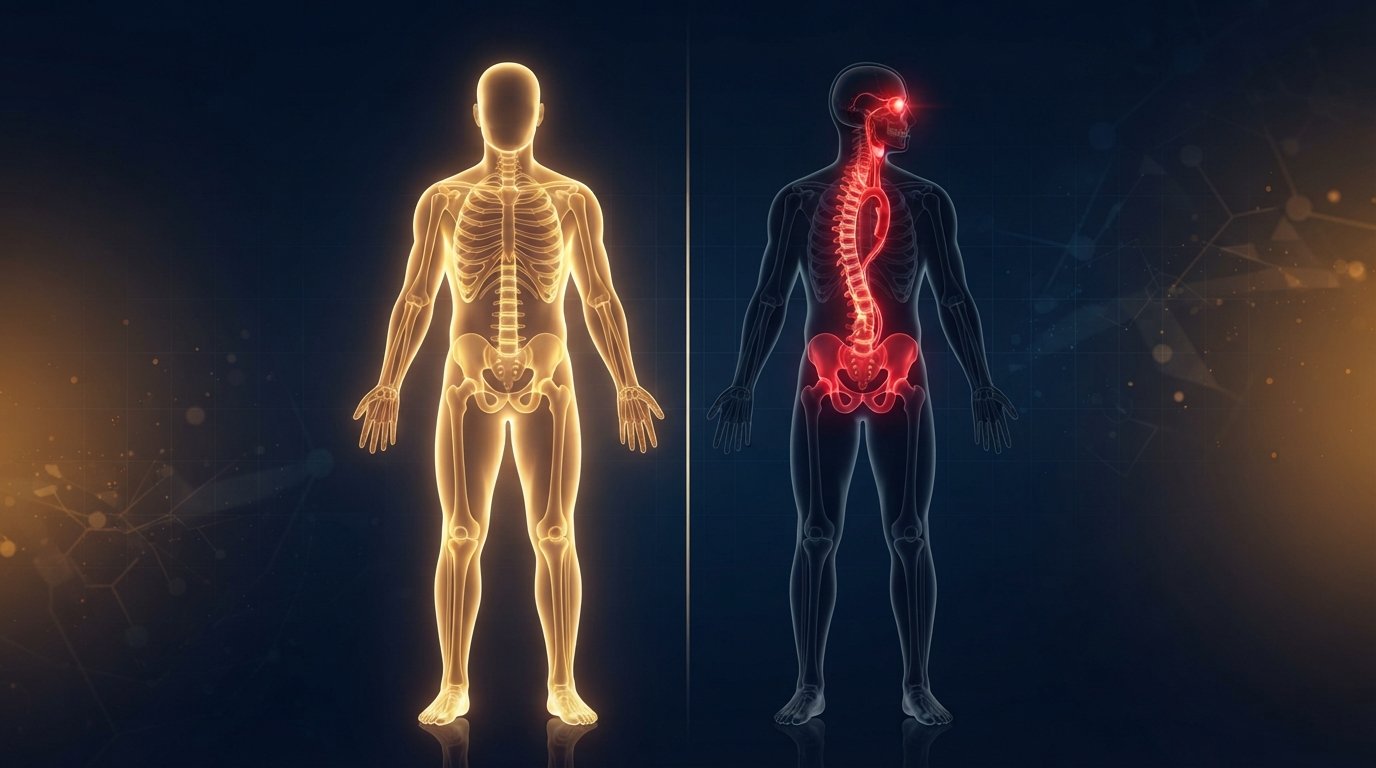
When humans evolved upright, bipedal walking, the spine retained those original functions — but was also repurposed for an entirely new job: supporting the body’s full weight vertically while maintaining balance and center of gravity, all while still needing to stay flexible.
These competing demands create genuine mechanical strain. The spine’s characteristic curves help distribute weight, but they also predispose us to lower back pain, herniated discs, and degenerative changes. These conditions are extraordinarily common — not because the spine is poorly built, but because it’s performing a function it was never originally built for.
The Neck: A Nerve That Makes No Logical Sense
Perhaps the clearest example of evolutionary “good enough” engineering is the recurrent laryngeal nerve, a branch of the vagus nerve that helps control speech and swallowing.
Logically, you’d expect this nerve to take the shortest, most direct route between the brain and the voice box. Instead, it descends from the brain into the chest, loops around a major artery near the heart, and travels all the way back up to reach the larynx.
This bizarre detour isn’t clever engineering — it’s a historical leftover from our fish-like ancestors, when this same nerve took a short, direct path around the gill arches. As vertebrate necks gradually lengthened over evolutionary time, the nerve simply got stretched rather than rerouted to a shorter path.
This inefficiency isn’t just a curiosity — it genuinely increases the risk of nerve injury during certain neck and chest surgeries today.
The Eyes: Wired Backwards
Even human vision reflects evolutionary compromise.
In humans and other vertebrates, the retina is wired “backwards.” Light must pass through layers of nerve fibers before it even reaches the photoreceptor cells responsible for actually detecting light and converting it into signals the brain can interpret.
This backwards wiring creates a specific consequence: the optic nerve must exit through the back of the retina, creating a permanent blind spot just below the horizontal center of each eye’s visual field. Your brain fills in this gap seamlessly using surrounding visual information, which is why you rarely notice it exists.
Remarkable vision came at the cost of a structural gap that a more logically engineered system would never have included in the first place.
The Teeth: Adequate, Not Durable
Human teeth offer another clear example of evolution favoring “good enough” over “built to last.”
Humans develop exactly two sets of teeth across a lifetime — baby teeth, then adult teeth — and that’s it. Unlike sharks, which continuously regenerate teeth throughout their entire lives, once adult human teeth are lost, they are gone for good.
This system worked well for ancestral human populations. For modern humans, it leaves us vulnerable to decay and permanent tooth loss in a way that simply wasn’t as consequential earlier in our evolutionary history.
Wisdom teeth tell a related story of evolutionary lag. Ancestral humans had larger jaws suited to tougher diets requiring heavy chewing. As human diets softened over time, jaw size gradually decreased — but the number of teeth didn’t decrease at the same pace. The result: many modern humans simply don’t have room for their third molars, leading to impaction, crowding, and frequent surgical removal.
The Pelvis: Walking Versus Childbirth
Childbirth represents one of the most consequential evolutionary trade-offs in human anatomy.
Like the spine, the human pelvis must balance two directly competing demands: efficient bipedal walking and the ability to birth large-brained infants. A narrower pelvis improves walking efficiency — but restricts the size of the birth canal.
Meanwhile, human babies are born with unusually large heads relative to body size, compared to other primates. This combination makes childbirth genuinely difficult and sometimes dangerous, frequently requiring outside assistance — a rarity among mammals.
This tension between mobility and brain size hasn’t just shaped anatomy. It’s also thought to have influenced human social behavior, encouraging cooperative childcare and the cultural practices around childbirth that exist across virtually every human society.
Why Some “Useless” Structures Never Disappeared
Evolution doesn’t eliminate structures unless they impose a significant survival disadvantage. This explains why several anatomical features persist despite offering limited modern benefit.
The appendix, once dismissed as a completely useless evolutionary leftover, is now believed to serve minor immune functions. It can still become dangerously inflamed, causing appendicitis — a potentially life-threatening condition that current medicine treats as a routine emergency.
The sinuses have unclear primary functions, possibly lightening the skull or influencing voice resonance. But their drainage pathways lead directly into the nose, making them prone to frequent blockage and infection — a developmental byproduct rather than a purposeful adaptation.
Even the tiny muscles around human ears — remnants that allow many mammals to swivel their outer ears for improved directional hearing — remain present in humans, even though most people can no longer use them effectively at all.
Reframing How We Think About Common Ailments
Understanding anatomy through this evolutionary lens offers something genuinely useful: a different way of thinking about extremely common medical problems.
Back pain, difficult childbirth, dental crowding, and sinus infections aren’t random misfortunes or personal failures of the body. They are, in significant part, the direct consequences of our evolutionary history — inherited structures repurposed for jobs they were never originally built to do.
The human body isn’t a flawless machine. It’s a living archive of evolution — a historical record of adaptation, compromise, and contingency, written into every joint, nerve, and organ system we carry.
Key Takeaways
- Evolution modifies existing structures rather than designing new ones from scratch, leading to functional but imperfect anatomy
- The spine, originally built for quadrupedal movement, now bears strain from upright walking, contributing to common back problems
- The recurrent laryngeal nerve takes an illogical detour around the heart due to its fish-ancestor origins
- The human retina is wired backwards, creating a permanent blind spot in each eye
- The pelvis must balance walking efficiency against the demands of birthing large-brained infants, making childbirth uniquely difficult in humans
- Structures like the appendix, sinuses, and ear muscles persist simply because they were never harmful enough for evolution to eliminate
Source: The Conversation / University of Bristol — July 10, 2026
Original Author: Lucy E. Hyde, Lecturer, Anatomy, University of Bristol