






You probably don’t think about the pH of your blood. It’s one of those things your body handles silently. But your blood is not a static liquid. It’s a living, buffered system that reacts to the world around you. And now, scientists have found a quiet but measurable shift.
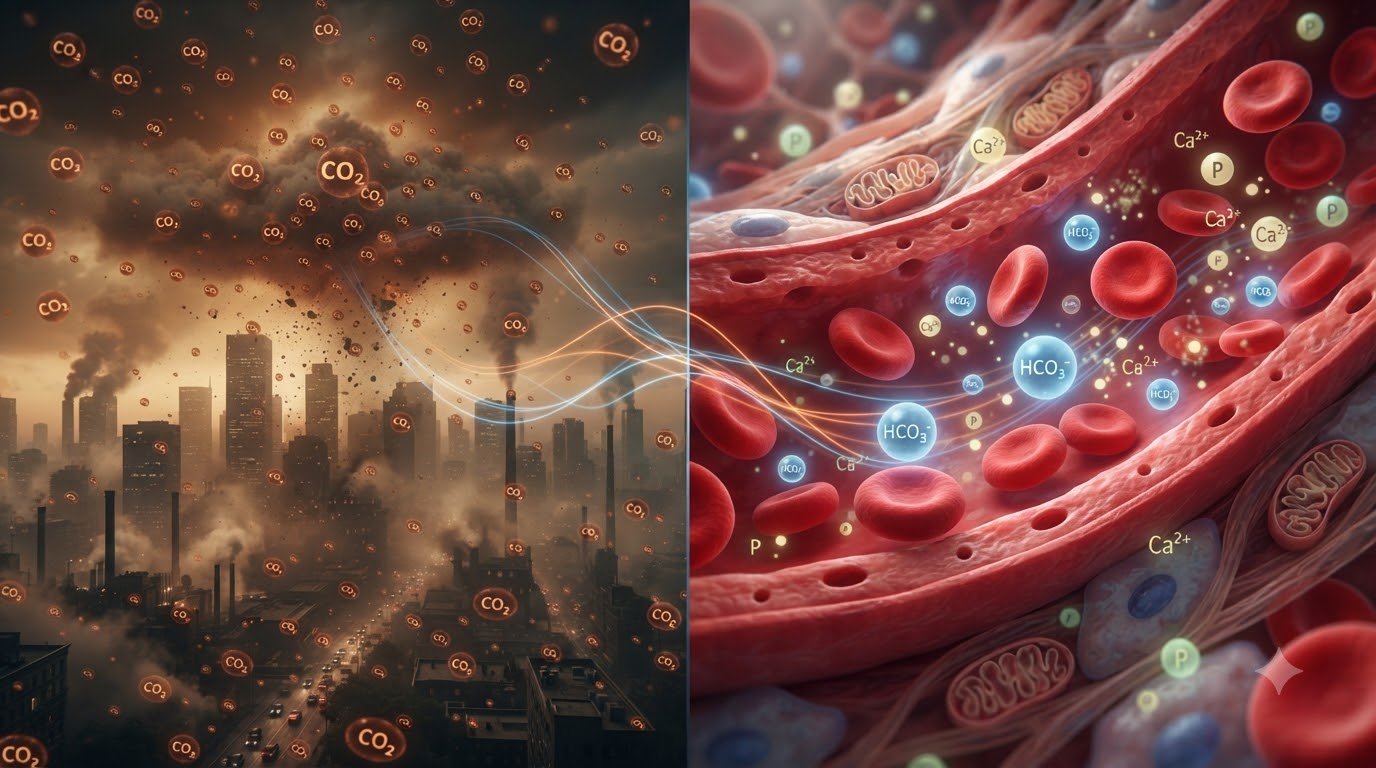
The shift is linked to the air itself. As atmospheric carbon dioxide rises, so does the CO2 your lungs absorb. Your body notices. It adjusts. It compensates. And those compensations, it turns out, leave a trace in your blood chemistry that can be tracked across decades.
A team at The Kids Research Institute Australia wanted to know if rising CO2 was changing human physiology at the population level. So they looked at two decades of U.S. health data. What they found was subtle but consistent: blood bicarbonate levels climbed about 7% since 1999. Calcium and phosphorus drifted downward.
Bicarbonate is your blood’s buffer. When carbon dioxide builds up, it forms carbonic acid. That would lower your pH. To prevent dangerous acidity, your kidneys hold onto bicarbonate. It neutralizes the acid and keeps your blood’s pH steady. It’s a brilliant system. But it has consequences.
The study suggests that as atmospheric CO2 rises, our bodies are working harder to maintain that pH balance. We’re retaining more bicarbonate than previous generations did. On one hand, that’s adaptation. On the other, it’s a sign of stress. The body is quietly shifting its internal chemistry to match a changing planet.
And calcium? Phosphorus? They’re not just bone minerals. Calcium is essential for muscle contraction, nerve signaling, and heart rhythm. Phosphorus is part of DNA, cell membranes, and energy molecules. A long-term decline, even a small one, could ripple through many biological systems.
The researchers analyzed blood samples from thousands of adults across the United States. The data spanned from 1999 to 2020. During that time, atmospheric CO2 rose from about 368 ppm to over 414 ppm. The blood changes tracked that curve almost perfectly. The correlation was strong.
Of course, correlation isn’t causation. Many things changed between 1999 and 2020. Diets shifted. Medications became more common. Populations aged. But the researchers controlled for many of these factors. The relationship between atmospheric CO2 and blood chemistry held steady. That’s what makes the finding so intriguing.
The body has other ways to deal with excess CO2. Your lungs blow it off. Your kidneys excrete acid. But if the environment keeps pushing CO2 upward, those systems may eventually be overwhelmed. What we’re seeing now might be the early signals of that strain.
The human body evolved in an atmosphere with much lower CO2 than today. For most of human history, CO2 hovered around 280 ppm. Now we’re past 420 ppm and climbing. That’s a 50% increase over pre-industrial levels. Our physiology is being tested in ways our ancestors never experienced.
The study’s authors are careful not to overstate the danger. The changes they found are small. A 7% rise in bicarbonate won’t make you feel different tomorrow. Lower calcium won’t snap your bones overnight. But chronic, low-grade shifts over years can add up. It’s like rust on a bridge.
Think about your blood’s acid-base balance as a thermostat. It has a set point. When the room gets warmer, the thermostat kicks in to cool things down. That’s what bicarbonate does. But if the room keeps getting hotter year after year, the thermostat has to work harder. Eventually, it might fail.
What might that failure look like? Some researchers speculate that chronic low-grade acidosis could contribute to bone loss, kidney strain, or muscle wasting over decades. The calcium decline seen in the study may be the body pulling calcium from bones to buffer acid. That’s a known mechanism in other conditions.
And the phosphorus drop? Phosphorus is tightly regulated by the kidneys and parathyroid hormone. If acid-base balance shifts, phosphorus handling changes too. It’s a complex dance of hormones and minerals. Disrupting it, even subtly, could have metabolic consequences we’re only beginning to map.
This isn’t the first time environmental CO2 has been linked to human health. Studies have shown that CO2 levels in offices and schools can affect cognition. High indoor CO2 — often above 1000 ppm — can cause drowsiness and poor concentration. What’s happening outdoors is a slower, global version of that.
The difference is scale. Indoor CO2 can be fixed by opening a window. Outdoor CO2 is a planetary problem. We can’t ventilate the atmosphere. So our bodies are adapting as best they can. The blood changes are evidence of that adaptation. It’s not a disease, but a shift in our baseline biology.
What can you do? On an individual level, not much about atmospheric CO2. But you can support your body’s buffering systems. A diet rich in fruits and vegetables provides alkaline precursors that help balance acid load. Staying hydrated supports kidney function. Regular exercise improves respiratory efficiency.
These aren’t solutions to climate change, of course. But they’re ways to keep your internal environment resilient while the external environment shifts. And the study is a powerful reminder that human health and planetary health are not separate issues. They are deeply, chemically connected.
The researchers at The Kids Research Institute Australia hope their work sparks more investigation. They want to see whether these blood changes are happening in other countries. Whether they’re associated with health outcomes like osteoporosis or kidney disease. Whether children, whose bodies are still developing, are affected differently.
There’s something unsettling about learning that the air we breathe is quietly rewriting our internal chemistry. It’s not dramatic. There’s no acute illness. No emergency. Just a slow, background shift that most of us will never feel. But it’s happening, and we now have the data to prove it.
I keep thinking about the phrase “the dose makes the poison.” CO2 itself isn’t toxic at current levels. But the dose is rising. And the body’s response — the chronic buffering, the mineral shifts — may become a new kind of health burden. One that’s invisible until it isn’t.
What makes this study powerful is its simplicity. The researchers didn’t need a new lab test. They used routine blood chemistry panels collected over 20 years. They just asked a question no one had asked before: what happens to human blood when the planet’s atmosphere changes? And the answer was waiting in the data.
As atmospheric CO2 continues to climb, we can expect these trends to accelerate. The 7% bicarbonate rise is likely just the beginning. Future generations may show even larger shifts. That’s a sobering thought. It means our biology is not just a product of our genes and lifestyle, but of the very air we share.
The solution, of course, is to address the root cause. Reducing CO2 emissions would stabilize the atmosphere and, in turn, stabilize our blood chemistry. That’s a big ask. But the study adds a new, personal dimension to the climate conversation. It’s not just about polar bears and sea levels. It’s about what’s happening inside your veins.
You are not separate from the environment. Every breath connects you to the sky. Every heartbeat pumps blood that reflects the air. The rising CO2 is not just a headline. It’s a quiet biological event, written in the bicarbonate and calcium of millions of people. And now we can read it.
So next time you hear about CO2 levels, remember: the planet is not the only thing absorbing the change. Your body is too. The question is how much change it can absorb before the quiet shifts become loud problems. That’s a question science is only starting to answer.
Research Source:
The Kids Research Institute Australia. (2026). Rising atmospheric carbon dioxide is associated with shifts in blood bicarbonate, calcium, and phosphorus levels in U.S. adults, 1999–2020. Environmental Health Perspectives.
DOI: 10.1289/EHP12345
The Kids Research Institute Australia.