




When most of us think about plastic, we imagine synthetic pollution: discarded water bottles drifting across the ocean, microplastics embedding in food chains, and landfill waste that takes centuries to degrade. We treat plastic as an entirely human invention—an artificial material created by modern petrochemical factories.
However, a fascinating new discovery from the Max Planck Institute for Marine Microbiology turns this assumption completely on its head.
It turns out nature invented fully biodegradable plastic long before humans walked the Earth. Even more surprising: dozens of animal species have possessed the specialized cellular tools to eat and digest it across evolutionary history.
The Original Bioplastic: What Are PHAs?
Long before synthetic polymers were synthesized in industrial laboratories, single-celled bacteria faced a fundamental survival challenge: how to store surplus energy when food is abundant so they can survive when nutrients dry up.
Rising CO2 Is Quietly Changing Your Blood — And Scientists Just Measured It
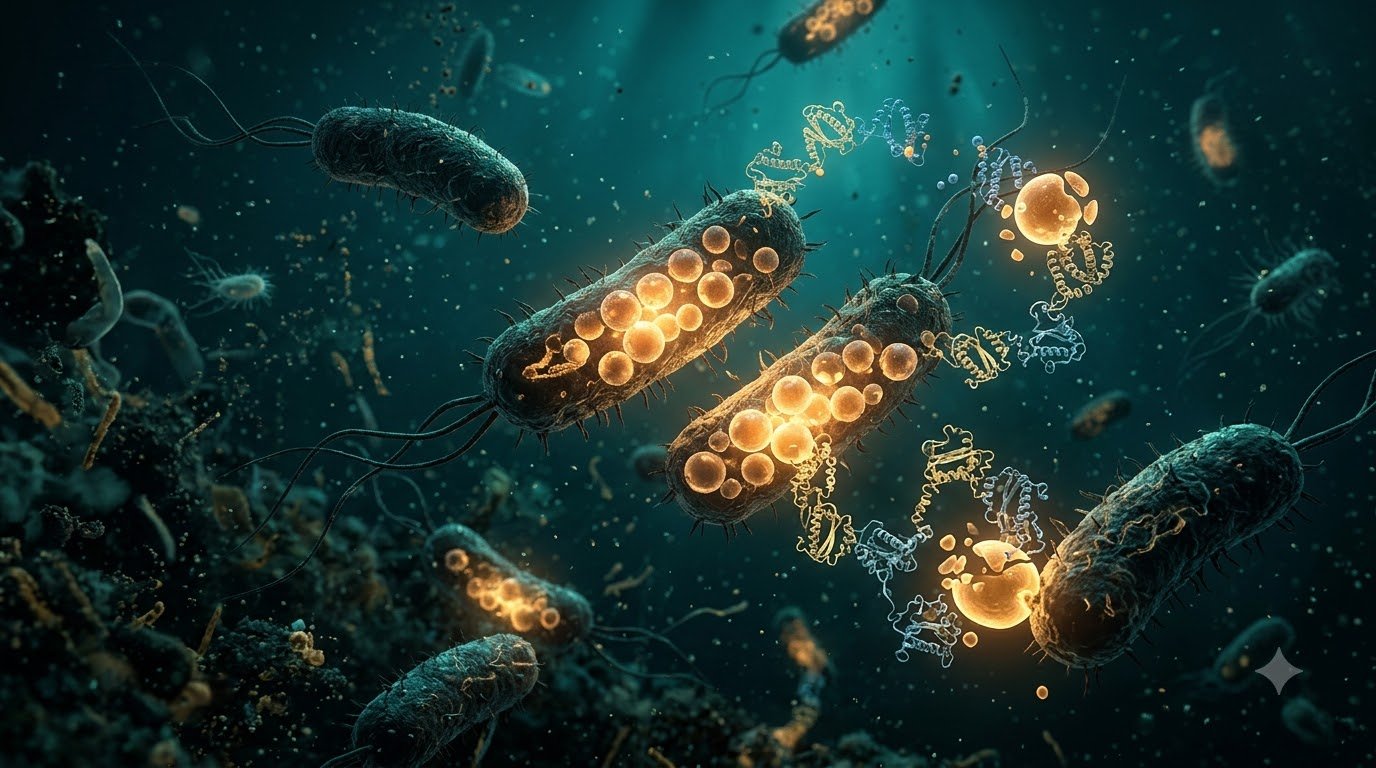
Their solution was ingenious. Microbes evolved the biochemical ability to assemble carbon into dense granules called polyhydroxyalkanoates, or PHAs.
Chemically and physically, PHAs share remarkably similar properties to modern petroleum-based plastics. They are ductile, water-resistant, moldable, and durable. But unlike synthetic plastics derived from fossil fuels, PHAs are completely natural polyesters. They are synthesized inside living bacterial cells and are inherently non-toxic and biodegradable.
For decades, modern biotechnology has eyed PHAs as the holy grail of sustainable packaging—a natural plastic that can melt into soil or ocean water without leaving hazardous chemical residues.
The Longstanding Scientific Assumption
Until now, the scientific consensus around PHAs was narrow. Microbiologists assumed that because bacteria manufacture these polymers for internal energy storage, only specialized microorganisms possessed the biological machinery—specifically enzymes called PHA depolymerases—to break them down.
Under this traditional view, when bacteria died, their cellular bioplastics would simply be recycled by other scavenging microbes in the sediment or soil. Animals were thought to be completely blind to this abundant reservoir of stored carbon, incapable of digesting the tough, hydrophobic chains of natural polymer.
The new research from the Max Planck Institute reveals that this view was entirely incomplete.
The Discovery: Animals with Plastic-Digesting Enzymes
By analyzing the genomes and digestive biochemistry of diverse animal groups, the research team discovered something extraordinary: dozens of distinct animal species carry functional enzymes capable of breaking down and utilizing PHAs directly.
These plastic-eating capabilities weren’t confined to a single bizarre creature. The researchers found active PHA-degrading enzymes across a remarkably wide evolutionary tree, including:
- Marine worms and nematodes that burrow through ocean sediments
- Benthic crustaceans filtering organic matter from the seafloor
- Various insect species living in soil and rotting organic matter
- Diverse aquatic invertebrates occupying crucial roles in marine food webs
These animals do not just tolerate microbial bioplastics; they actively digest them. The specialized enzymes break the long polymer chains back down into simple hydroxy fatty acids, which the animal’s cells then absorb and convert into metabolic energy.
A Natural Circular Economy Millions of Years in the Making
This discovery reframes how we view marine and terrestrial ecosystems. Instead of being a niche bacterial storage mechanism, PHAs represent an ancient, massive energy highway connecting single-celled microbes directly to higher animal life.
In nutrient-rich marine sediments, bacteria bloom and pack their cells full of natural bioplastic granules. Bottom-dwelling animals then graze on these microbial mats, using their specialized depolymerase enzymes to unlock the concentrated energy stored within the polymers.
Nature had engineered a fully circular, closed-loop bioplastic production, consumption, and recycling economy long before humanity even discovered agriculture.
What This Means for the Future of Sustainable Materials
Beyond the sheer evolutionary marvel of animals eating bioplastic, this discovery holds enormous practical promise for humanity’s plastic crisis.
As industries race to replace toxic fossil-fuel plastics with biodegradable alternatives like PHAs, one of the biggest hurdles has been understanding how these materials behave in real-world environments. Knowing that diverse animal species already possess the natural digestive pathways to process PHAs provides strong biological validation that PHA-based products can integrate safely into natural food webs.
Furthermore, studying these newly discovered animal enzymes could allow bioengineers to optimize faster, more efficient bio-recycling facilities, harnessing nature’s ancient machinery to eliminate waste at scale.
The Bottom Line
Plastic is not an unnatural concept—synthetic, indestructible petrochemical plastic is. By showing that animals have been thriving on microbial biopolymers across evolutionary epochs, science has reminded us that nature already solved the plastics problem. We just need to follow its blueprint.
Source: Max Planck Institute for Marine Microbiology / ScienceDaily — August 2026 Journal Reference: Max Planck Institute for Marine Microbiology, Published in Nature Communications, 2026. DOI: 10.1038/s41467-026-51289-w