







When you look up at the night sky, past the planets, stars, and glowing nebulas, you see an overwhelming amount of darkness. For centuries, human beings—and even our brightest astronomers and philosophers—assumed that the dark gaps between celestial bodies were filled with absolutely nothing. We called it the vacuum of space, a void completely devoid of matter, energy, and physical substance. It was the ultimate blank canvas upon which the universe was painted.
But quantum mechanics, the branch of physics that governs the microscopic rules of the universe, has always told a much stranger, far more chaotic story. According to the foundational principles of quantum theory, a true, perfect vacuum simply cannot exist. Instead, empty space is a bubbling, chaotic soup of “virtual particles” that pop in and out of existence so incredibly fast that we can never see them with our own eyes or even detect them with standard scientific instruments.
For nearly a century, this idea was largely viewed as a theoretical quirk—a mathematical necessity that made quantum equations work, but something that might never be directly observed in the physical world. But now, an international team of researchers from Swinburne University of Technology may have finally found the first direct, physical evidence that this bizarre quantum theory is absolutely true. And they did it by looking at one of the most extreme objects in the known universe.
The Mystery of Vacuum Birefringence
The breakthrough centers on a mind-bending, almost science-fiction-esque concept known as “vacuum birefringence.”
First proposed by the legendary physicist Werner Heisenberg and his colleague Hans Euler in the 1930s, the theory suggested that if a magnetic field is strong enough, it will physically alter the vacuum of space itself. Because the vacuum is theoretically filled with those fleeting virtual particles—specifically pairs of electrons and positrons that constantly annihilate each other—a massive magnetic field could force these invisible particles to line up in a specific direction.
If this happens, the vacuum ceases to be empty and transparent. Instead, it begins to act like a giant, invisible prism. When light travels through this highly magnetized vacuum, the light waves should become polarized. In simpler terms, the light waves are forced to vibrate in a specific direction rather than scattering randomly.
The problem with this theory? To generate a magnetic field strong enough to trigger this effect and physically alter the fabric of space, you would need an energy source billions of times more powerful than anything we can create in a laboratory on Earth. Even the most powerful human-made electromagnets, or the colossal magnetic fields generated by the sun, fall incredibly short of the required threshold. Because of this astronomical requirement, for decades, scientists thought we would never actually be able to observe vacuum birefringence in action. It was destined to remain an unproven piece of chalkboard physics.
Enter the Magnetar: Nature’s Ultimate Laboratory
If human beings cannot build a magnet strong enough to bend the vacuum of space, the only alternative is to find one that already exists in nature. To do this, the researchers at Swinburne University turned their attention to deep space, specifically targeting a rare and extreme celestial object known as a magnetar.
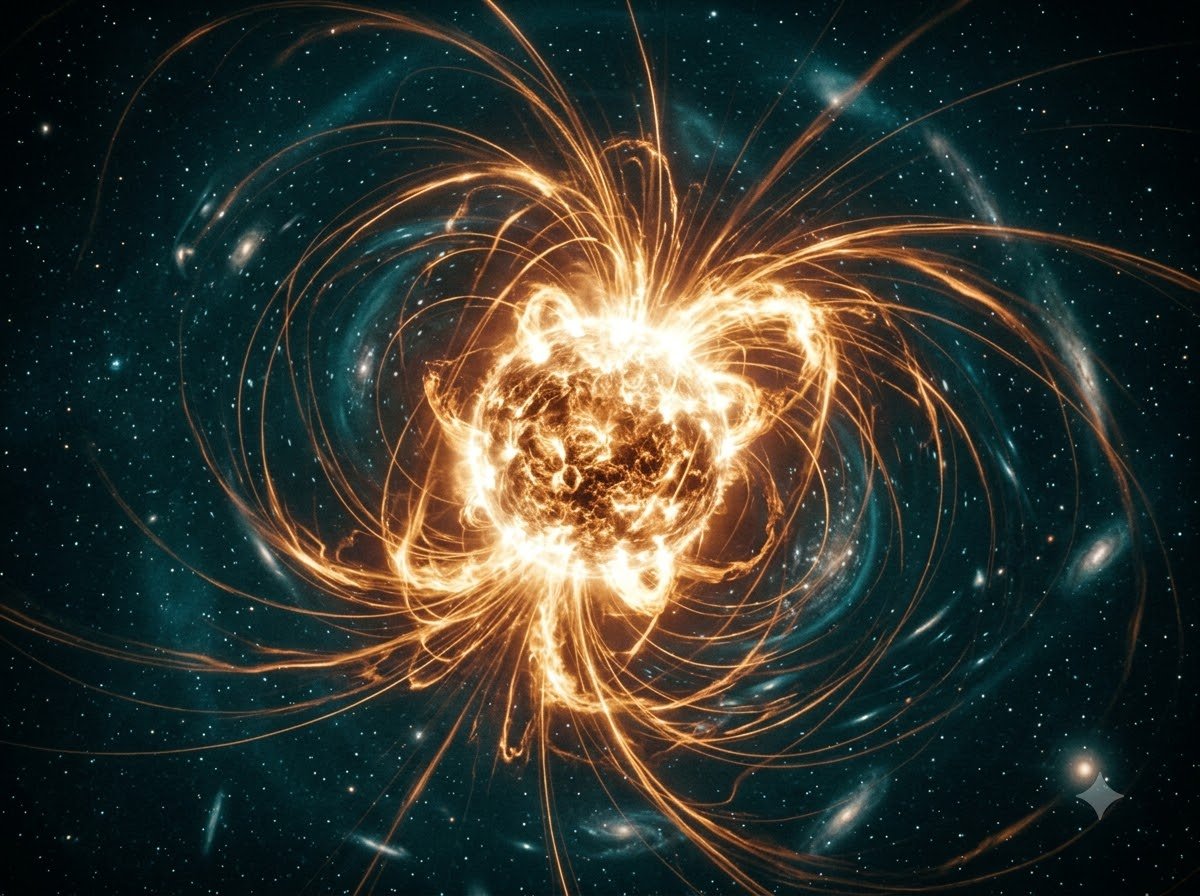
A magnetar is the ultra-dense, burnt-out core of a massive star that exploded in a violent supernova. When these massive stars die, their outer layers are blown away, but the core collapses under its own immense gravity. What remains is a neutron star—an impossibly dense sphere where a mass greater than our entire sun is crushed into a ball roughly the size of a small city like Manhattan.
Magnetars are a specific, rare subclass of neutron stars. As their name suggests, they possess the strongest magnetic fields in the known universe. A magnetar’s magnetic pull is billions of times stronger than Earth’s magnetic field, and millions of times stronger than the strongest magnets we can engineer. To put that tremendous power into perspective: if a magnetar were located halfway between the Earth and the Moon, its magnetic field would be so intense that it would wipe the magnetic stripes off every credit card on our planet and pull the iron straight out of our bloodstreams.
It is exactly this sheer, unadulterated magnetic force that makes magnetars the perfect natural laboratory to test Heisenberg’s wild theory. If vacuum birefringence is real, the space immediately surrounding a magnetar is the only place in the universe where we could witness it happening.
What the Telescopes Revealed
Using highly advanced, incredibly sensitive telescopes—specifically the Very Large Telescope (VLT) operated by the European Southern Observatory in Chile—the research team observed the light radiating from a distant magnetar. They weren’t just looking at the star itself; they were painstakingly measuring how the light behaved as it passed through the seemingly empty space immediately surrounding the star’s hyper-magnetized surface.
Measuring this was an incredibly delicate task. Magnetars are relatively small, incredibly faint in the visible light spectrum, and located thousands of light-years away from Earth. The team had to capture the faint thermal glow emitting from the neutron star’s surface and analyze its polarization—the exact orientation of the light waves.
When the scientists finally analyzed the massive dataset of light captured by the VLT, they found exactly what quantum physics predicted. The light passing through the vacuum around the magnetar was highly polarized.
There was no physical matter—no interstellar gas, no cosmic dust clouds, no stellar atmosphere—causing the light to polarize. Based on everything we know about astrophysics and optics, the light should have traveled straight through uninhibited. The only logical, scientifically sound explanation was that the magnetar’s colossal magnetic field was interacting directly with the virtual particles in the quantum vacuum. The massive magnetic field was turning “empty” space into an active, physical medium that manipulated the passing light rays just as a glass prism bends a ray of sunlight.
This monumental observation represents the first time in human history that scientists have found observational, physical evidence of vacuum birefringence in the natural world.
Why This Discovery Changes Everything
Proving that empty space is actually filled with chaotic quantum activity isn’t just a minor victory for theoretical physicists; it fundamentally shifts how all of humanity understands the very fabric of the universe.
First and foremost, it proves that the universe is far more complex and deeply interconnected than we realize. There is no such thing as true isolation in the cosmos. Even in the coldest, darkest, most seemingly desolate stretches of deep space, the universe is actively buzzing with enormous energetic potential. The void is not a silent stage where the universe happens; the void is an active participant in the physics of the cosmos.
Furthermore, this discovery opens up an entirely new window for modern astronomy. For thousands of years, human beings have studied the universe by looking at matter—mapping out stars, plotting the orbits of planets, and photographing massive galaxies. By proving that the vacuum of space can interact with light, scientists can now start studying the empty gaps themselves.
We can use the polarization of light to map out magnetic fields across the entire galaxy. This will allow astronomers to peer into the chaotic environments surrounding black holes, neutron stars, and other extreme cosmic phenomena that we previously couldn’t measure. It gives us a brand new set of tools to understand how massive cosmic structures form, evolve, and interact with the invisible forces that shape our reality.
The Bridge Between Two Worlds
On a deeper, more philosophical level in physics, this observation helps bridge the frustrating gap between the two most successful scientific theories in human history: quantum mechanics (the physics of the incredibly small) and general relativity (the physics of the incredibly large). For decades, these two frameworks have refused to cooperate, operating under completely different mathematical rules.
By observing a macroscopic, cosmic event (the enormous magnetic field of a star) directly causing a microscopic, quantum effect (the physical alignment of virtual particles in a vacuum), scientists have witnessed the two worlds interacting in real-time. It is a crucial stepping stone toward the ultimate goal of modern physics: a unified theory of everything.
The Bottom Line
When you look up at the night sky tonight, remember that the darkness between the stars isn’t a void. It is a dynamic, boiling sea of quantum energy, constantly churning just outside the limits of our perception.
Thanks to a single dead star located thousands of light-years away, and the relentless curiosity of astronomers here on Earth, we finally have the ultimate proof. The universe isn’t just stranger than we imagine—it is stranger than we can ever possibly imagine. And sometimes, the most profound discoveries aren’t found by looking at the brightest stars, but by finally understanding the deep, dark spaces hidden right in between all of them.
Source: Swinburne University of Technology Journal Reference: Swinburne University of Technology Research, Published in Science Advances, 2026. DOI: 10.46298/jsedi.17268