









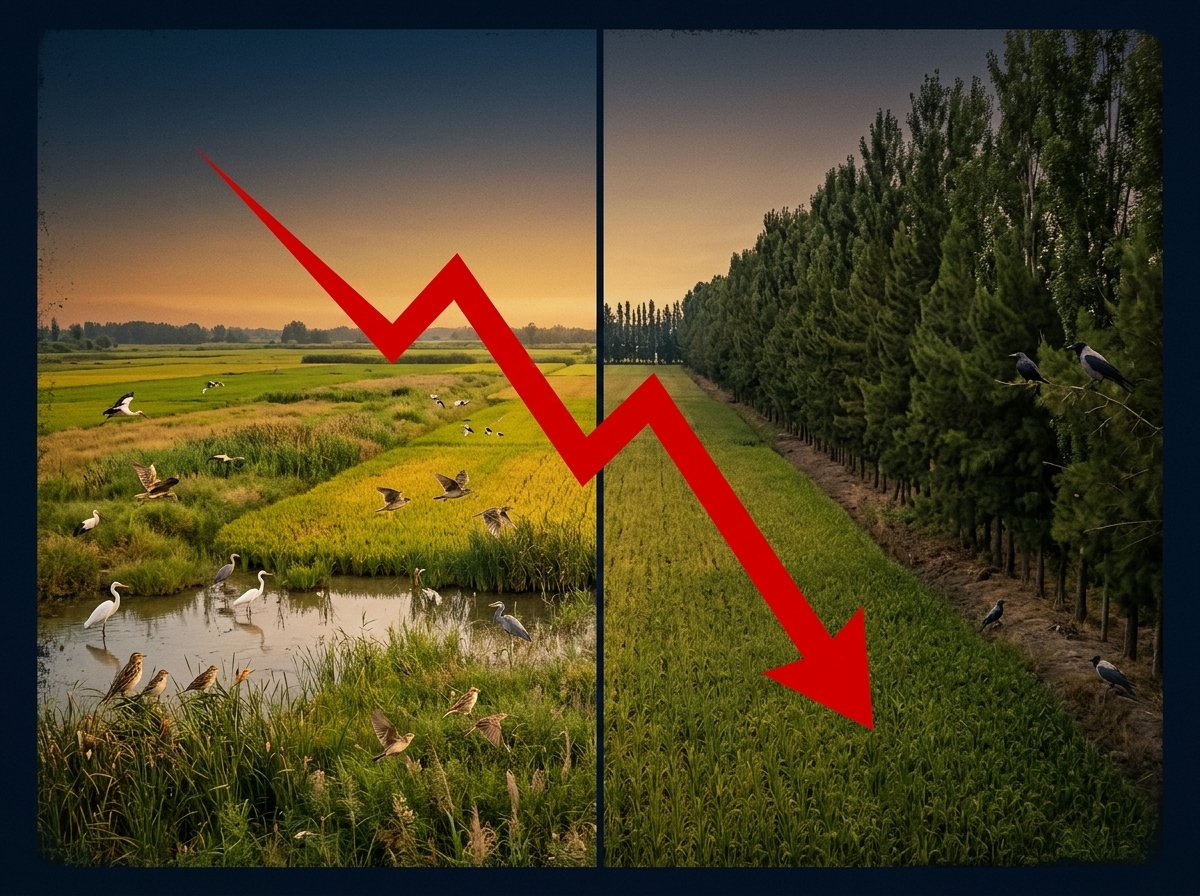
It’s one of conservation’s most comfortable assumptions: more trees means more biodiversity. Plant windbreaks, add hedgerows, increase woody cover, and nature will reward you. This idea has driven agricultural conservation policy across Europe, North America, and increasingly Asia for decades.
New research from Hiroshima University is complicating that assumption in a significant way — and the findings matter not just for farmers in Japan, but for anyone designing land management policies intended to protect wildlife.
The Study Setting
Published in the Journal of Environmental Management, the research was led by Masumi Hisano, assistant professor at Hiroshima University’s Graduate School of Advanced Science and Engineering. The team studied farmland wetlands surrounding Lake Kahokugata on Japan’s western coast — an agriculturally active landscape of rice paddies, lotus fields, cropland, and pastureland.
The region experiences strong winter winds and storms, making shelterbelts a common and practical feature. These rows of trees, planted along field edges to protect crops from wind damage, are also widely assumed to boost local biodiversity by adding structural complexity and habitat variety to otherwise open agricultural landscapes.
A Chinese Sodium Battery Just Matched Tesla’s Design — And It Could Make EVs Dramatically Cheaper
But Kahokugata isn’t just any farmland. It sits along the East Asian-Australasian Flyway — one of the world’s most significant migratory bird routes — and regularly hosts nearly 300 bird species. Migratory birds use the area as a critical stopover and wintering ground. Whatever happens to habitat quality here has consequences that reach across entire continental flyways.
The Bird Surveys
The research team conducted bird surveys in February and March 2021 and again in June 2023, using point count methodology at multiple survey sites positioned at varying distances from shelterbelt rows.
The surveys allowed the team to compare bird abundance and diversity near shelterbelts to that found at open sites roughly one kilometer away — capturing the measurable difference in bird communities that the trees were creating.
What The Data Showed
The results were unambiguous, and they directly challenge the uncritical assumption that shelterbelts are straightforwardly good for bird biodiversity.
Shelterbelts did support some species — specifically birds associated with shrubs and habitat edges. These species benefit from the structural complexity, cover, and foraging opportunities that rows of trees provide in an otherwise open landscape.
But for grassland and wetland specialist birds — species that require open, unobstructed space to nest, forage, and move — the effect was sharply negative.
“We found that the abundance of grassland birds was more than 70 percent lower at sites next to shelterbelts compared with open sites located about one kilometer away,” said Hisano.
Wetland bird diversity was similarly reduced in the vicinity of shelterbelts. The trees were effectively reshaping which species could occupy the landscape — creating winners among edge-tolerant birds while simultaneously eliminating the habitat conditions that open-country specialists need to survive.
The Ecological Wall Effect
Hisano offered a vivid way of understanding what shelterbelts are doing to the landscape at an ecological level.
“A useful way to think about this is that shelterbelts act like ecological walls,” he said.
This framing captures something important. A shelterbelt doesn’t just add habitat — it fundamentally restructures the spatial character of the landscape. By introducing vertical structure into an open environment, it fragments the continuous open space that grassland and wetland birds navigate and rely on. It potentially increases exposure to predators for species that evolved in open habitats where visibility is their primary defense. And it may alter the microclimatic conditions — wind patterns, moisture levels, temperature gradients — that determine where certain species choose to feed and nest.
The result is a landscape that feels more biodiverse in a superficial sense — more structural variety, more habitat types — while actually losing the specific ecological character that open-country specialists require.
Why This Is Especially Important In Wetland Landscapes
The researchers emphasize that their findings are particularly significant in the context of agricultural wetlands, for a reason that extends well beyond local ecology.
Wetland farming landscapes — rice paddies and similar systems — are widespread across Asia and serve a dual ecological role. They produce food while simultaneously functioning as surrogate wetlands for birds that have lost natural wetland habitat to development and drainage. These agricultural wetlands support migratory species traveling thousands of miles along major flyways, providing essential stopover habitat in landscapes where natural wetlands have become increasingly scarce.
If shelterbelts are degrading the open-habitat quality of these agricultural wetlands, conservation programs that encourage their planting without considering these trade-offs could be inadvertently harming the very bird populations they’re meant to support — and doing so across some of the most ecologically important landscapes on the continent.
What The Research Recommends
Hisano and his colleagues are careful not to frame their findings as an argument against trees in agricultural landscapes. The message is more nuanced and more practically useful than that.
“Biodiversity-friendly farmland management must balance structural complexity with the ecological needs of open-habitat species, especially in landscapes where wetlands have already been heavily modified by humans,” Hisano said.
The key variables — where shelterbelts are placed, how wide and tall they are, how they are configured across the landscape, and what tree species they contain — all influence the ecological trade-offs they create. Future research will investigate how specific shelterbelt characteristics can be adjusted to minimize harm to open-habitat species while still providing the agricultural wind protection they were designed for.
The broader implication for land management policy is clear: biodiversity isn’t just about adding more types of habitat. It’s about understanding which species depend on which landscape conditions, and ensuring that well-intentioned interventions don’t inadvertently eliminate the habitat that the most vulnerable species — often the ones least adapted to human-modified environments — need most.
Sometimes, in conservation, the most important thing to add is open space.
Source: Hiroshima University — June 22, 2026
Journal Reference: Masumi Hisano, Shota Deguchi, Wenhuan Xu, Xike Xiao, Keinosuke Sannoh, Xinli Chen, Ken Motomura. Shelterbelts support edge birds but limit grassland and wetland specialists in agricultural landscape. Journal of Environmental Management, 2026; 398: 128583.
DOI: 10.1016/j.jenvman.2026.128583