








For anyone living with chronic knee pain, the medical conversation has traditionally followed a familiar and frustrating arc. Start with anti-inflammatories. Try physical therapy. Move on to steroid injections. And when none of those hold the pain at bay anymore, face the prospect of major knee replacement surgery — a significant operation with a long recovery, real risks, and no guarantee of perfect outcomes.
A minimally invasive procedure called genicular artery embolization, or GAE, is beginning to change that story.
The Gap In Knee Pain Treatment
Osteoarthritis is the most common form of joint disease worldwide, and the knee is one of its most frequent targets. Millions of people live with knee pain that significantly limits their daily activities — gardening, walking, cycling, climbing stairs — without being quite severe enough to justify full joint replacement surgery, or while not yet being ready for that level of intervention.
“For treating osteoarthritis in the knees, we often think of medications, physical therapy, maybe a steroid injection, and then on the far end of the spectrum is a total knee replacement,” said Dr. Leigh Casadaban, assistant professor of radiology and vascular interventional radiologist at the University of Colorado Anschutz School of Medicine. “There really hasn’t been anything for patients in between.”
GAE, Casadaban says, is filling that gap.
How The Procedure Works
GAE was originally developed in Japan a little more than a decade ago and has been steadily gaining attention in the United States and internationally as early data on its effectiveness has accumulated. In the U.S., the FDA has granted breakthrough device status to multiple related devices since 2021.
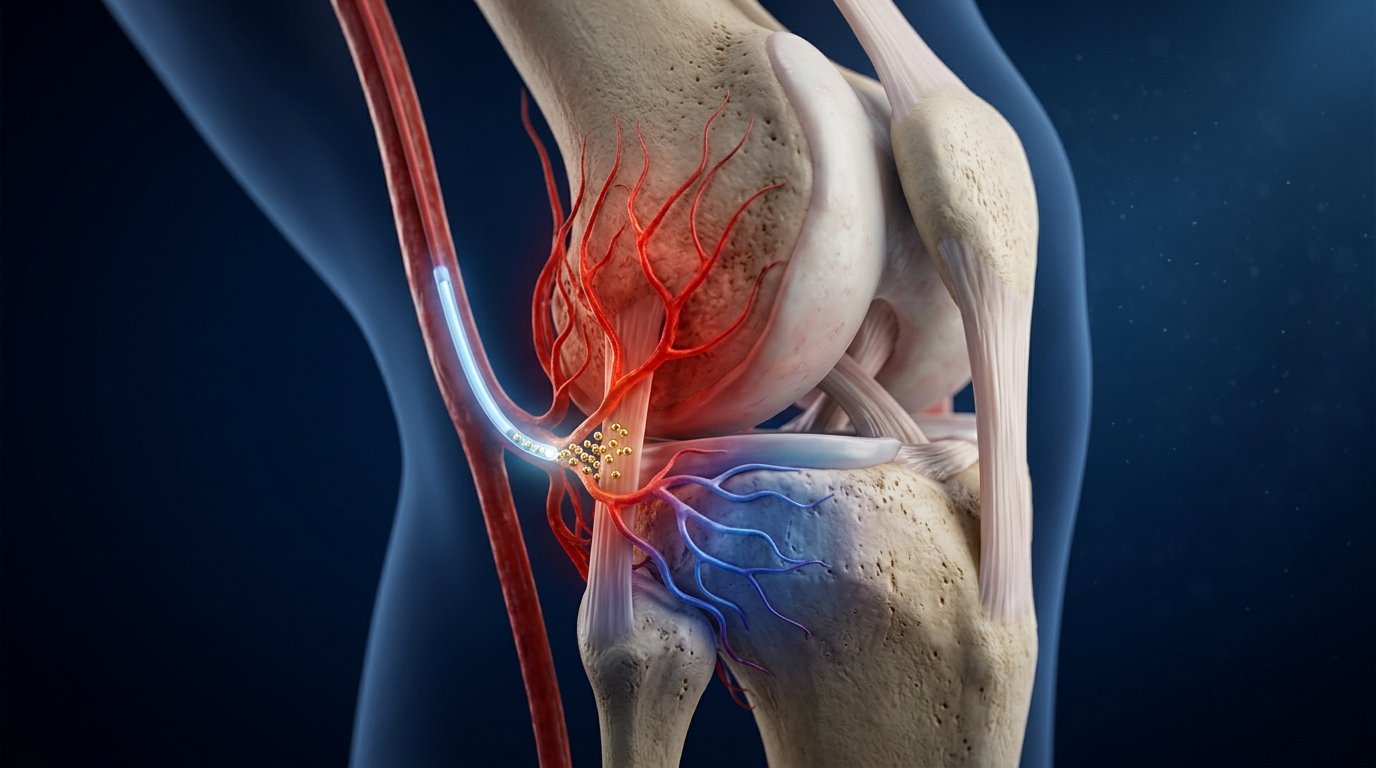
The procedure is performed under conscious sedation and typically takes between one and two hours. A small incision is made near the crease of the leg, and an interventional radiology team advances a tiny catheter through the femoral artery using X-ray imaging and contrast dye for precise guidance. The catheter is threaded until it reaches the genicular arteries — the blood vessels surrounding the knee joint.
Once in position, the team releases microscopic beads through the catheter. These beads selectively block blood flow to the abnormal, inflammation-driving vessels in the areas the patient has identified as most painful. By reducing blood supply to these abnormal vessels, the procedure targets the inflammatory process driving the chronic pain directly at its source.
Patients are monitored for a few hours following the procedure and are typically able to return home the same day. A few days of rest is generally recommended before returning to normal activities.
What The Results Look Like
The outcomes, at least for patients with mild to moderate osteoarthritis, have been genuinely encouraging.
“We find about 70% of patients have phenomenal results. They cut their pain scores in half, sometimes more. We have a few patients with no pain at all after the procedure,” said Casadaban. “Patients that have tried a lot of other treatments and haven’t had pain relief are happy to get back to their normal activities.”
Among the patients who have experienced this relief is Cynthia Schraf-Fletcher, 74, who received GAE on her right knee nearly a year ago. Having previously undergone total knee replacement on her left knee, she was reluctant to face another major surgery and wanted to explore a less invasive alternative.
The results exceeded her expectations. “I couldn’t be more pleased,” Schraf-Fletcher said, noting that the relief from GAE is comparable to what she experienced after her full knee replacement. Today she reports that gardening and riding a stationary bicycle are far more enjoyable activities because of her significantly reduced pain.
How Long Does Relief Last?
One of the most important questions about any chronic pain treatment is durability — how long does it actually last?
The early data on this front is encouraging. Four-year follow-up data published from Japan shows that a single GAE procedure can provide sustained pain relief for up to four years. In the United States, two-year data has now accumulated showing that patients who respond well maintain that relief over that period.
“The theory is that GAE reduces inflammation inside the knee joint, and symptom relief can last years,” Casadaban said. “Four-year data published in Japan shows that if you have one outpatient procedure, your pain relief can last for those four years. That really speaks to the theory that we’re hopefully modifying something in the joint.”
Patients with more advanced osteoarthritis can still undergo the procedure, though Casadaban notes that the effects are generally less durable in those cases. The strongest candidates for GAE are people with mild to moderate disease who have already tried conservative treatments without adequate relief.
Ongoing Research And Future Directions
Casadaban is currently leading two clinical trials at the University of Colorado Anschutz Medical Campus. One study is examining changes in knee fluid composition among patients receiving GAE, to better understand the biological mechanisms behind the pain relief. The second is evaluating a temporary arterial treatment device called Nexsphere-F that blocks small blood vessels contributing to inflammation and pain.
Beyond knee osteoarthritis, the underlying principle of GAE — blocking abnormal blood vessels associated with inflammation — is beginning to attract interest for other painful musculoskeletal conditions. Researchers and physicians are exploring whether the approach could offer relief for frozen shoulder, tennis elbow, and plantar fasciitis, all of which involve similar inflammatory processes in soft tissue around joints and tendons.
What This Means For Patients
For the millions of people living in the difficult middle ground between manageable knee pain and the threshold for joint replacement surgery, GAE represents something genuinely meaningful: a real therapeutic option where very few existed before.
It won’t be the right choice for everyone — patient selection matters, and people with very advanced osteoarthritis may find limited benefit. But for those who qualify, the combination of outpatient convenience, strong early efficacy data, and durability measured in years rather than weeks represents a meaningful advance in how chronic knee pain can be managed.
The gap between a steroid injection and a total knee replacement has long been one of the most frustrating spaces in musculoskeletal medicine. It’s getting smaller.
Source: University of Colorado Anschutz School of Medicine — June 22, 2026
Note: No formal journal DOI available for this news release. Research referenced includes four-year Japanese follow-up data and ongoing U.S. clinical trials led by Dr. Leigh Casadaban at CU Anschutz.