








If you’ve ever stood next to someone at a barbecue while they remained completely untouched and you walked away covered in itchy bites, you already know the truth scientists just confirmed: mosquitoes really do prefer some people over others.
“It’s not a misconception — mosquitoes are attracted to some people more than others,” medical entomologist Frederic Simard of France’s Institute of Research for Development told AFP. “But we are not all magnets all the time.”
How Mosquitoes Actually Find You
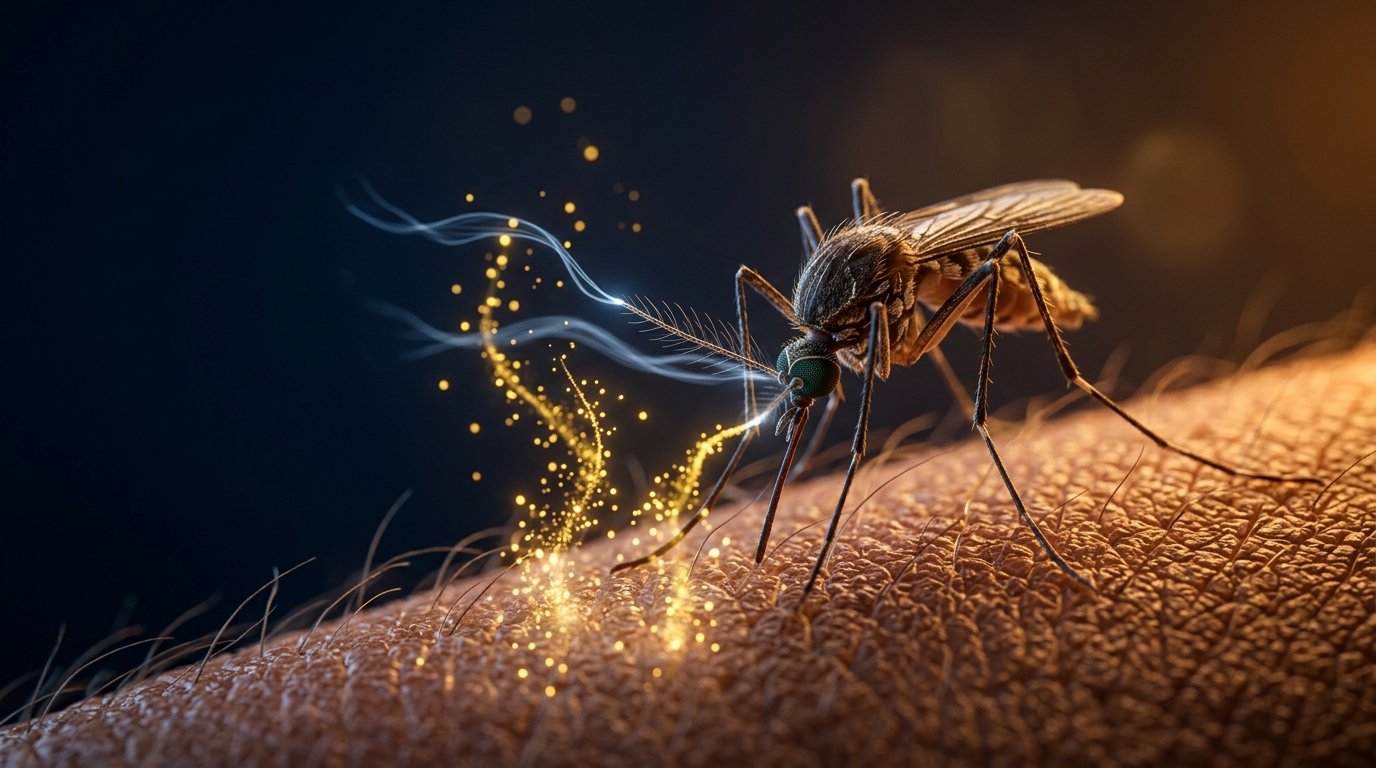
Mosquitoes don’t choose targets randomly. They follow a layered sequence of sensory cues that activate at different distances, gradually narrowing in on the most appealing target nearby.
“We have known for over 100 years that mosquitoes are attracted by the carbon dioxide that we exhale — this is the first signal that triggers their behavior” when they’re dozens of meters away, explained Swedish scientist Rickard Ignell.
As mosquitoes get within about 10 meters, they begin detecting individual body odor in combination with that CO2 signal, which sharpens their targeting considerably. At close range, body temperature and humidity become the final deciding factors, helping mosquitoes zero in on exactly where to land.
Female mosquitoes — the only ones that bite, since they need blood protein to develop their eggs — use finely-tuned receptors to detect and process all of these signals before selecting their target.
Popular Myths That Don’t Hold Up
Before getting into what actually matters, it’s worth clearing up what doesn’t. The widely repeated idea that mosquitoes prefer certain blood types “has no scientific basis,” according to Simard. “There have been some studies, but only involving very few people,” he noted. Skin, eye, or hair color also play no meaningful role.
What actually matters is far more chemical than cosmetic.
The Scent Secret: 27 Compounds Out Of A Thousand
“A soup of molecules produced by our microbiota is more — or less — appealing to mosquitoes,” Simard explained. Humans collectively release somewhere between 300 and 1,000 distinct odorous compounds, and scientists have only recently begun identifying which specific ones actually drive mosquito attraction.
In a detailed study led by Ignell, researchers released Aedes aegypti mosquitoes — a species known for spreading yellow fever and dengue — into a lab setting with 42 women, observing carefully which women the mosquitoes preferred to bite.
“We have shown that mosquitoes use a blend of odorous compounds — we identified 27 that the mosquitoes will detect, out of the possible 1,000 — for their attraction to us,” Ignell said.
The women who attracted the most mosquito attention, including pregnant women in their second trimester, produced significantly higher levels of a specific compound called 1-octen-3-ol, commonly known as mushroom alcohol, which forms from the natural breakdown of skin oil (sebum).
What genuinely surprised Ignell was how small a change made a measurable difference. “Even a small increase of this compound made a difference came as a surprise,” he said. “Mosquitoes are fascinating creatures.”
The Beer Connection
There’s also a behavioral factor worth knowing about: alcohol consumption. Several studies have found that drinking beer makes people measurably more attractive to mosquitoes — likely because it raises body temperature, increases exhaled CO2, and subtly alters skin odor.
In standardized field research conducted in Burkina Faso, volunteers drank beer on one occasion and water on another several days later, to compare mosquito preference. The Anopheles mosquito — the species responsible for spreading malaria — was consistently more attracted to the scent of beer drinkers.
A separate 2023 study conducted in the Netherlands involved 465 volunteers placing their arms into cages containing female Anopheles mosquitoes. Volunteers who had consumed beer within the previous 24 hours were found to be 1.35 times more attractive to the mosquitoes than those who hadn’t.
Why This Research Matters More Than Ever
Understanding exactly what draws mosquitoes to specific people has become an increasingly urgent public health priority as climate change expands the geographic range these insects can survive and thrive in.
The tiger mosquito, a known vector for the chikungunya virus, has been steadily spreading into new regions. Last year, chikungunya reached as far north as France’s Alsace region for the first time in recorded history — a clear sign that mosquito-borne disease risk is no longer confined to traditionally tropical or subtropical zones.
“This risk is affecting more and more people,” Simard warned.
What You Can Actually Do About It
Given that the underlying chemistry varies meaningfully between individuals, there’s no universal trick to becoming mosquito-proof. But practical steps remain effective regardless of your personal attractiveness to these insects.
Simard recommends loose-fitting clothing that covers exposed skin, mosquito nets in higher-risk areas, and standard insect repellent as the most reliable defenses currently available.
The science is becoming clearer every year, but for now, if mosquitoes seem to single you out at every outdoor gathering, the explanation lies somewhere in your skin’s unique chemistry — not your blood type, and certainly not bad luck. 🦟🔬
Source: Agence France-Presse (AFP) / Institute of Research for Development (IRD) — June 2026
Key Reference: Rickard Ignell et al., olfactory attraction study on Aedes aegypti mosquito preference, recent publication referenced via AFP reporting.