








Quantum computing holds the promise of solving problems entirely beyond the reach of classical computers — but building one large enough to matter has run into a stubborn physical obstacle that has nothing to do with the quantum mechanics itself.
Researchers at the University of Hong Kong just developed something that could finally remove that obstacle. And the breakthrough comes from teaching an ordinary transistor to think a little more like a brain cell.
The Problem Holding Quantum Computers Back
Quantum computers rely on qubits — quantum bits — that are extraordinarily sensitive to their environment. To function correctly, qubits must be kept at millikelvin temperatures, just a hair above absolute zero, inside elaborate cryogenic refrigeration systems.
The challenge is that qubits need to be controlled and read by electronic systems, and conventional silicon-based control electronics generate heat and consume meaningful amounts of power. Placing that heat-generating control hardware too close to the ultra-sensitive qubits would disrupt the very quantum states the system depends on.
A Digital Program Could Prevent Falls In Older Adults — But Real-World Testing Revealed The Gap Between Research And Practice
The current workaround is to physically separate the control electronics from the qubits, positioning them outside the coldest part of the refrigeration system. But this creates an enormous tangle of wiring connecting the warm control hardware to the cold qubit chamber — wiring that becomes increasingly unwieldy and limiting as quantum computers attempt to scale up to the thousands or millions of qubits that will eventually be needed for genuinely transformative applications.
Solving this wiring and thermal load problem has become one of the central engineering challenges standing between today’s experimental quantum computers and tomorrow’s large-scale, practically useful quantum systems.
A Brain-Inspired Solution
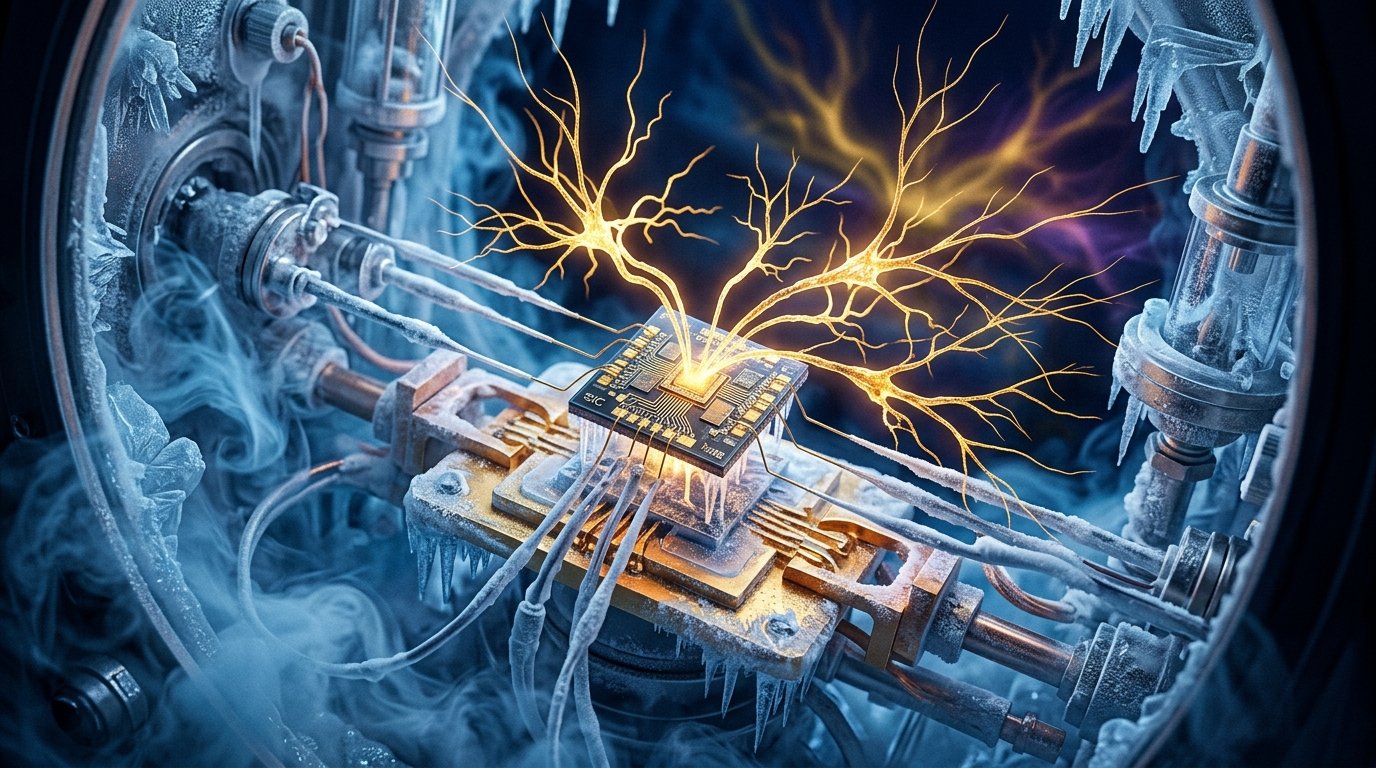
A research team at HKU’s Department of Electrical and Computer Engineering and the Centre for Advanced Semiconductors and Integrated Circuits, led by Professor Yuhao Zhang and PhD student Xin Yang, approached the problem from an unconventional angle: neuromorphic computing — hardware designed to mimic how biological neurons process information.
Biological neurons communicate through brief, energy-efficient electrical pulses called spikes, rather than the continuous power draw used by conventional digital electronics. If control hardware near a quantum computer’s qubits could replicate this spiking behavior, it could potentially operate with dramatically lower power consumption and heat generation — solving the core problem limiting how close control electronics can sit to the qubits themselves.
The team found a way to create and precisely control a phenomenon called negative differential resistance (NDR) in industry-standard silicon carbide (SiC) MOSFETs — a type of transistor already widely manufactured for other industrial applications. Using this approach, they demonstrated for the first time that a single transistor could reproduce energy-efficient, biological-style spiking activity at temperatures as low as 10 millikelvin — colder than the depths of interstellar space.
“Our work introduces a hardware platform that can be integrated alongside quantum processors,” said Professor Zhang. “By using the unique carrier dynamics in silicon carbide, we can create circuits that are thousands of times more energy-efficient than conventional electronics, significantly reducing the thermal load on cryogenic systems.”
Why Silicon Carbide Behaves Differently In The Cold
The researchers discovered that silicon carbide MOSFETs undergo a notable transformation when cooled below 2 Kelvin. At these extreme temperatures, the devices exhibit a strong “S-shape” negative differential resistance effect, driven by a process called electron-donor impact ionization (EDII).
What makes this finding particularly valuable for practical engineering purposes is its origin. Unlike many electronic phenomena that depend on heat-related processes — which tend to become unreliable or simply stop working at extreme cold — this effect emerges directly from the material’s atomic structure itself. That gives it a level of stability and reproducibility across different manufacturing batches that heat-dependent approaches simply cannot match.
“This is a robust and scalable approach,” said Mr. Yang. “Because SiC is already used globally in electric vehicles and power grids, we can leverage existing industrial foundries to manufacture these cryogenic chips on 300-mm wafers.”
This is a significant practical advantage. Rather than requiring entirely new, specialized manufacturing infrastructure, this breakthrough could be produced using semiconductor factories that already exist and already mass-produce silicon carbide components for the automotive and energy industries.
Scaling Toward Larger Quantum Systems
The research also demonstrated that these artificial neurons could be “cascaded” together into larger interconnected networks — a capability that opens the door to more sophisticated local data processing happening directly within the extreme cold environment surrounding a quantum computer’s qubits.
This local processing capability could meaningfully improve critical quantum computing functions including quantum error correction and real-time quantum control — both essential capabilities for building quantum computers that are large enough, stable enough, and reliable enough for practical, large-scale applications beyond today’s experimental prototypes.
Beyond Quantum Computing: A Path To Deep Space
The implications of this research extend well beyond quantum computing labs.
Because these neuromorphic circuits are specifically designed to operate reliably in extremely cold conditions, they may also prove well suited for deep-space exploration missions. Spacecraft and scientific instruments venturing to the lunar surface, the outer solar system, or other extremely cold environments face many of the same fundamental engineering challenges as quantum computer control systems — the need for reliable, low-power electronics that function correctly in conditions where conventional silicon technology struggles or fails entirely.
A chip platform proven to operate efficiently at temperatures approaching absolute zero could become valuable infrastructure for the next generation of deep-space probes, lunar instruments, and scientific missions exploring the coldest reaches of our solar system.
What Comes Next
The findings, published in Nature Communications, represent a foundational breakthrough rather than a finished commercial product. Significant engineering work remains before this neuromorphic platform could be integrated into operational quantum computing systems or spacecraft instrumentation.
But the combination of genuine technical novelty, manufacturing compatibility with existing industrial infrastructure, and dual relevance to both quantum computing and space exploration makes this research a particularly promising direction — one small transistor, behaving a little more like a brain cell, working at the edge of absolute zero. 🧠❄️🚀
Source: University of Hong Kong / Nature Communications — March 23, 2026
Journal Reference: Xin Yang, Matthew Porter, Yuan Qin, Zineng Yang, Hehe Gong, Liyang Jin, Zichen Xi, Han Wang, Liyan Zhu, Yuhao Zhang, Linbo Shao. Cryogenic neuromorphic circuits using gate-controlled negative differential resistance in silicon carbide. Nature Communications, 2026.
DOI: 10.1038/s41467-026-70963-6