






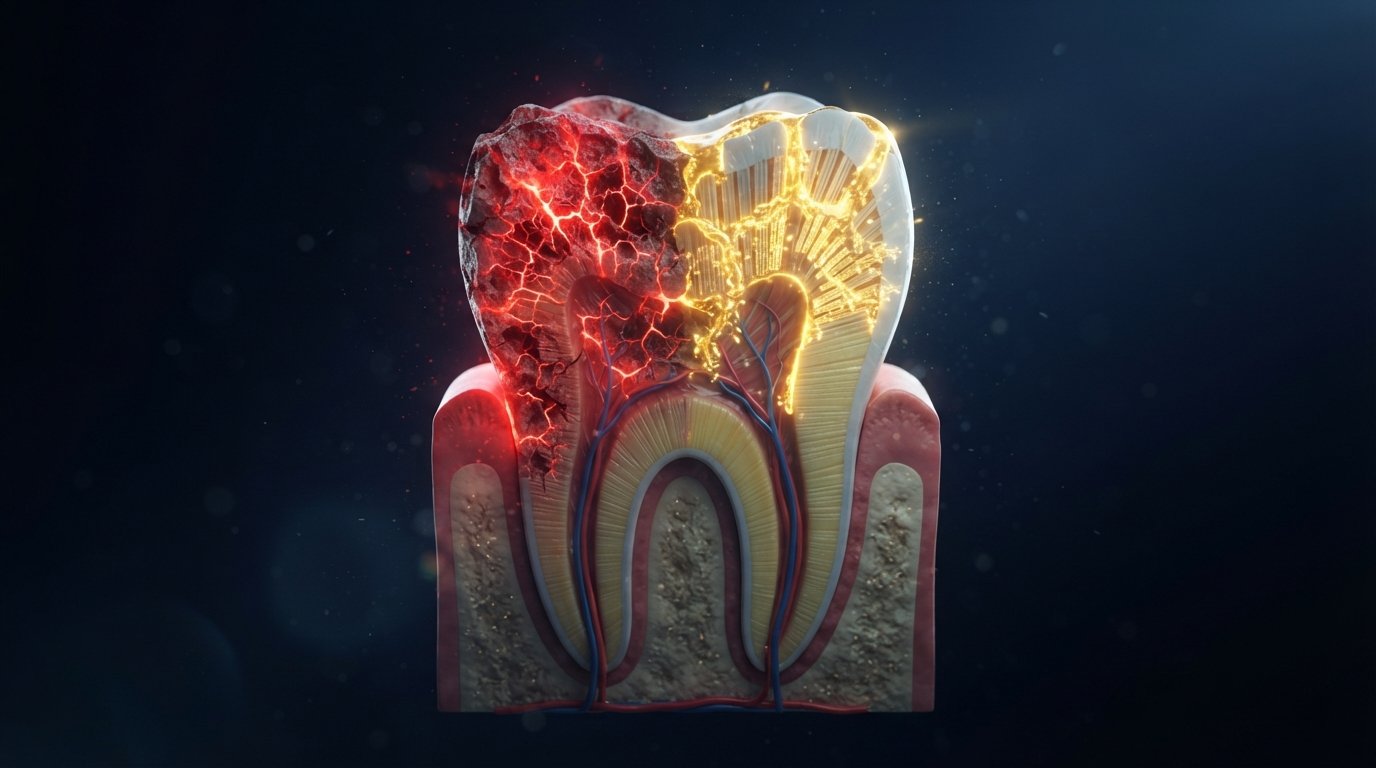
Tooth enamel is remarkable. It’s the hardest tissue in the human body, protecting your teeth against pressure, temperature changes, acids, and decades of daily wear. But enamel has one critical flaw: it contains no living cells, which means once it’s damaged or lost, your body has no way to repair it naturally.
Researchers at the University of Nottingham may have just solved that problem. Published in Nature Communications, their newly developed gel appears capable of actually regrowing damaged tooth enamel — not simply strengthening what remains, but building genuinely new, organized enamel structure.
Why Enamel Loss Is Such A Widespread Problem
Enamel damage sits at the center of tooth decay and other dental conditions that affect nearly half the world’s population. Left untreated, severe dental disease can lead to pain, infection, and eventual tooth loss. Poor oral health has also been linked to broader systemic health conditions, including diabetes and cardiovascular disease.
Currently available treatments — fluoride varnishes and standard remineralization products — can help strengthen the enamel that’s still present or reduce symptoms like sensitivity. But none of these existing options can effectively rebuild the original enamel structure once it’s genuinely lost. This has remained one of dentistry’s most persistent unsolved problems.
Exercise Doesn’t Just Strengthen The Heart. It Rewires It
A Gel Inspired By How Your Teeth Formed In Infancy
The Nottingham research team, working across the School of Pharmacy and the Department of Chemical and Environmental Engineering, designed their material to mimic the biological processes that naturally build enamel — processes that only occur once in a lifetime, during infant tooth development.
Unlike conventional dental products, this new gel contains no fluoride at all. Instead, it’s built from proteins specifically engineered to reproduce the key functions of the natural proteins responsible for enamel formation before birth and in early infancy.
Dentists could apply the gel using a process similar to how fluoride treatments are administered today — making it a practical, clinically familiar procedure rather than something requiring entirely new equipment or training.
How The Gel Actually Rebuilds Enamel
Once applied to a tooth, the gel forms a thin but durable coating that penetrates the tooth’s surface, filling small cracks, pores, and other areas of damage.
This coating then functions as a structural framework for rebuilding the tooth’s mineral architecture. Critically, the gel draws calcium and phosphate ions directly from saliva — nutrients already naturally present in your mouth — and uses them to guide the controlled formation of new mineral crystals.
This process is called epitaxial mineralization. In practical terms, it means the new mineral crystals grow in precise alignment with the tooth’s existing structure, connecting seamlessly with the natural tissue beneath rather than simply sitting on top as a separate, disorganized coating.
According to the researchers, this organized, aligned growth is exactly what allows the repaired surface to recover both the microscopic architecture and the physical properties of genuinely healthy enamel — a meaningful distinction from previous remineralization approaches.
A Potential Solution For Tooth Sensitivity Too
Beyond repairing enamel itself, the gel may offer a specific benefit for people struggling with exposed dentine — the softer layer of tooth structure beneath enamel that becomes exposed when enamel wears away or gums recede.
Dentine contains microscopic channels leading directly toward the tooth’s nerves. When exposed, these channels can cause the sharp, sudden sensitivity many people experience in response to heat, cold, sweetness, or touch.
When applied to exposed dentine, the gel can grow an enamel-like mineral layer directly over the exposed surface. This could reduce sensitivity while simultaneously creating a stronger, more reliable surface for dental restorations — such as fillings or crowns — to bond to more effectively.
Testing The Regrown Enamel Under Real-World Conditions
A crucial question for any dental regeneration technology is whether the newly formed material can actually withstand the mechanical stresses of daily use — brushing, chewing, and exposure to acidic foods that naturally erode enamel over time.
“Dental enamel has a unique structure, which gives enamel its remarkable properties that protect our teeth throughout life against physical, chemical, and thermal insults,” explained Dr. Abshar Hasan, postdoctoral fellow and lead author of the study. “When our material is applied to demineralized or eroded enamel, or exposed dentine, the material promotes the growth of crystals in an integrated and organized manner, recovering the architecture of our natural healthy enamel.”
To test durability, the research team subjected the regenerated enamel to conditions specifically designed to simulate real-life dental stress — repeated brushing motions, realistic chewing forces, and exposure to acidic foods known to gradually dissolve natural enamel.
The results were encouraging: the restored tissue displayed mechanical behavior similar to healthy natural enamel, suggesting it could genuinely hold up to the demands of everyday use rather than functioning as a fragile, temporary coating.
“We have tested the mechanical properties of these regenerated tissues under conditions simulating ‘real-life situations’ such as tooth brushing, chewing, and exposure to acidic foods, and found that the regenerated enamel behaves just like healthy enamel,” Hasan noted.
Moving Toward Real Dental Products
The research team is now actively working to bring this technology from the laboratory into actual clinical use.
“We are very excited because the technology has been designed with the clinician and patient in mind,” said Professor Alvaro Mata, Chair in Biomedical Engineering & Biomaterials, who led the study. “It is safe, can be easily and rapidly applied, and it is scalable. Also, the technology is versatile, which opens the opportunity to be translated into multiple types of products to help patients of all ages suffering from a variety of dental problems associated with loss of enamel and exposed dentine.”
The team has already established a start-up company, Mintech-Bio, specifically to pursue commercialization. According to Professor Mata, the goal is to have a first product available by next year — a notably fast timeline for translating laboratory research into clinical availability.
Potential Future Applications
Because the gel can reportedly be applied quickly and manufactured at scale, the researchers see multiple possible product directions emerging from this core technology:
- Professional in-clinic treatments for enamel erosion and demineralization
- Products specifically targeting sensitive teeth caused by exposed dentine
- Materials that improve the durability and bonding of dental fillings and other restorations
This versatility could allow the underlying technology to be adapted into several distinct dental products, each addressing a different clinical need, rather than a single narrow application.
What This Means Going Forward
While this remains a research breakthrough rather than an available treatment today, the combination of strong laboratory evidence, realistic durability testing, and an active path toward commercialization makes this genuinely promising. If the timeline holds and a first product does emerge from Mintech-Bio within the coming year, this could represent one of the most significant advances in restorative dentistry in decades — a way to actually rebuild the one dental tissue that has, until now, never been able to heal itself.
Key Takeaways
- Researchers at the University of Nottingham developed a fluoride-free gel that can regrow tooth enamel — a tissue the body cannot naturally repair once lost
- The gel mimics the proteins responsible for enamel formation during infancy, filling cracks and using calcium and phosphate from saliva to grow new, organized mineral crystals
- The regenerated enamel closely matches the structure and mechanical properties of healthy natural enamel, even under simulated brushing, chewing, and acid exposure
- The gel may also help reduce sensitivity in exposed dentine by growing a protective enamel-like layer over it
- The research team’s start-up, Mintech-Bio, aims to release a first commercial product within the next year
Source: University of Nottingham — July 23, 2026
Journal Reference: Abshar Hasan, Andrey Chuvilin, Alexander Van Teijlingen, et al. Biomimetic supramolecular protein matrix restores structure and properties of human dental enamel. Nature Communications, 2025; 16 (1).
DOI: 10.1038/s41467-025-64982-y