









Most adult butterflies live for two to four weeks. They emerge, mate, lay eggs, and die — the entire adult stage of their existence measured in days. It’s one of nature’s most compressed timelines, and it’s what makes a new study from the University of Bristol so genuinely extraordinary.
Researchers have documented a group of tropical butterflies that appear to have evolved the ability to slow aging itself — living far longer than closely related species and showing almost no physical deterioration as they age. Published in Nature Communications, the findings are drawing attention not just for what they reveal about butterflies, but for what they might eventually tell us about aging in general.
The Heliconius Exception
The butterflies in question belong to the Heliconius tribe, found across the rainforests of Central and South America. Well known for their striking wing patterns and their unusual ecological and behavioral complexity, Heliconius have long been studied by evolutionary biologists. But their longevity hadn’t been systematically compared to their relatives until now.
The research team, led by Dr. Jessica Foley from the University of Bristol’s School of Biological Sciences and working with scientists at the Smithsonian Tropical Research Institute in Panama, combined data from butterfly houses, mark-release-recapture field studies, and controlled insectary experiments to build a comprehensive picture of lifespan and aging across the Heliconiini tribe.
Scientists Finally Solved Why Mosquitoes Bite You And Ignore Everyone Else At The Same Party
The differences they documented are extraordinary. Heliconius butterflies consistently showed longer average and maximum lifespans, lower baseline mortality rates, and slower rates of aging compared to related species outside the Heliconius group.
The 25-Fold Difference
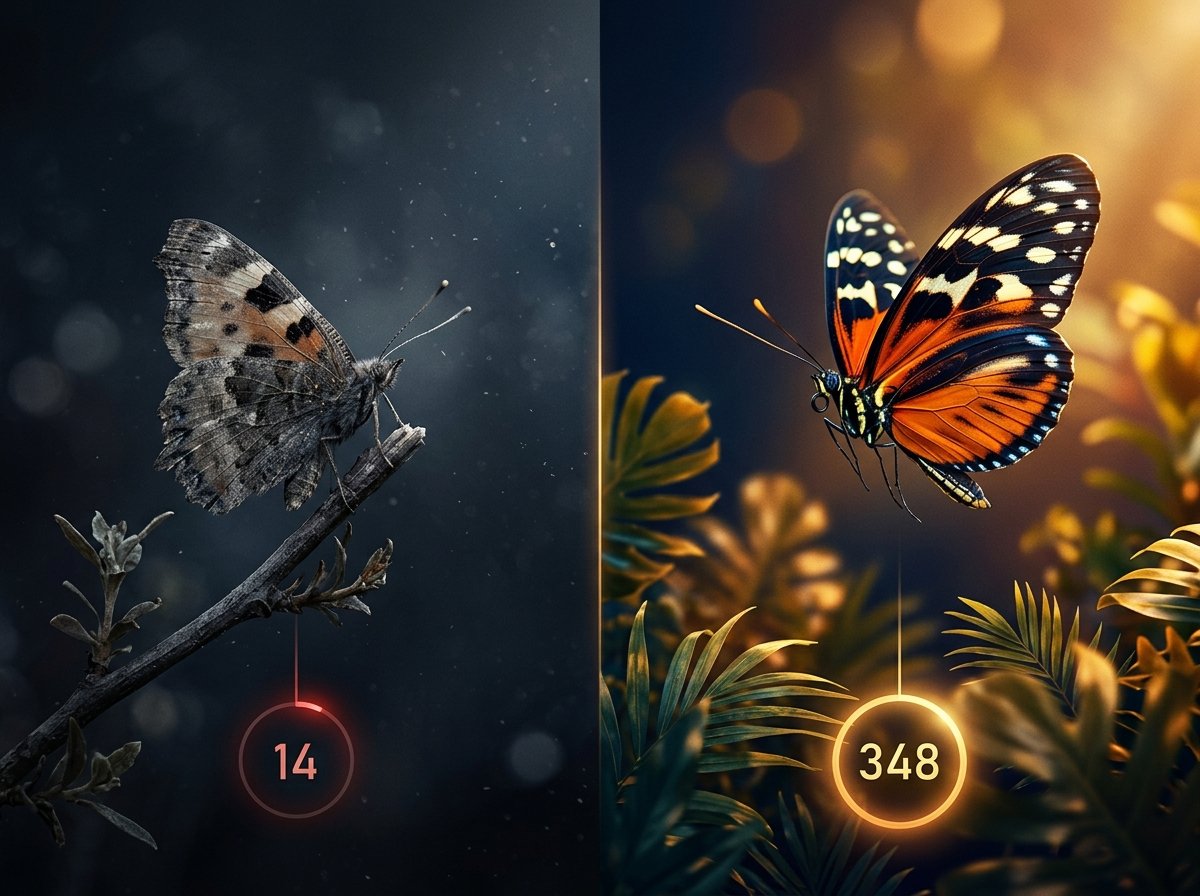
The most striking single comparison in the study involves two closely related species. Heliconius hewitsoni, a Heliconius group member, reached a maximum documented lifespan of 348 days — nearly a full year. Its close relative Dione juno, which is not a Heliconius species, survived only 14 days at maximum. A 25-fold difference in maximum lifespan between two species that diverged relatively recently in evolutionary time.
On average, Heliconius butterflies live about three times longer than their closest non-Heliconius relatives. This isn’t a modest statistical difference — it’s a dramatic, biologically fundamental divergence in lifespan that evolved within a single group of butterflies over a relatively short evolutionary timescale.
Aging Slower, Not Just Living Longer
What makes this research particularly compelling for longevity science goes beyond lifespan alone. It’s the evidence that these butterflies aren’t just living longer while deteriorating at the same rate — they appear to be aging more slowly.
To assess physical performance as the butterflies aged, the team used a grip strength test. In Heliconius hecale, older individuals performed just as well as younger ones, showing no measurable decline in physical capability over time. By contrast, Dryas iulia, a closely related species with a shorter lifespan, showed clear age-related physical deterioration in the same test.
This pattern — maintained physical performance across age — is precisely what researchers mean by “slower aging” as distinct from simply “longer survival.” The animal isn’t just managing to stay alive longer while gradually breaking down. It’s maintaining functional capacity in a way that closely related species do not.
More Than Just Diet
One of the most distinctive features of Heliconius butterflies is their unusual diet. Unlike most butterfly species, which rely entirely on nectar as adult food, Heliconius butterflies feed on pollen. This rare behavior makes them capable of synthesizing amino acids and proteins as adults — something almost unheard of in the butterfly world.
Scientists have long suspected this nutritional advantage might explain their longevity. And it does appear to play a role — comparison between the pollen-feeding Heliconius hecale and its non-pollen-feeding relative Dryas iulia showed that the Heliconius species maintained body mass and muscle performance longer.
But here’s the critical finding: when pollen was removed from Heliconius hecale’s diet entirely, it still outlived its shorter-lived relative by a substantial margin. The longevity advantage persisted even without the nutritional component that was assumed to drive it.
This means that pollen feeding is part of the story, but not the whole story. Something deeper — evolutionary changes in the biological machinery governing aging itself — is also contributing to Heliconius longevity. And it’s that deeper something that makes these butterflies so potentially valuable as a research model.
A Natural Evolutionary Experiment
Dr. Foley articulated precisely why the Heliconius system is so scientifically powerful.
“Heliconius butterflies are among the longest-lived butterflies, but what makes them particularly remarkable is that they appear to have evolved not only longer lifespans, but also slower aging,” she said. “This allows them to live significantly longer than closely related species from which they diverged relatively recently in evolutionary time.”
“The exciting implication of this lifespan extension is that it provides a powerful opportunity to identify the mechanisms that underpin longevity. By comparing long-lived Heliconius butterflies with their short-lived relatives, we have a natural evolutionary experiment that can help reveal how lifespan is extended, making them a highly promising new model for research into the biology of aging and longevity.”
The phrase “natural evolutionary experiment” captures the value precisely. Most laboratory approaches to aging research manipulate specific genes or pathways in model organisms to observe what changes. Heliconius offers something different — a naturally occurring case study where evolution itself has already run the experiment, producing a large and measurable change in lifespan and aging rate through whatever biological changes occurred as this group diverged from its shorter-lived relatives.
Identifying those biological changes — which genes, which pathways, which cellular processes were altered to produce 25-fold differences in maximum lifespan — is now the research priority. And whatever answers emerge from that investigation may have implications that reach far beyond the rainforests where these remarkable butterflies spend their long, barely-aging lives. 🦋🧬
Source: University of Bristol / Nature Communications — June 22, 2026
Journal Reference: Jessica Foley, Josie McPherson, Made Roger, et al. Evolution of increased longevity and slowed ageing in a genus of tropical butterfly. Nature Communications, 2026; 17 (1).
DOI: 10.1038/s41467-026-73635-7