







You began as a single cell. One microscopic unit of life, containing the instructions for everything you would ever become.
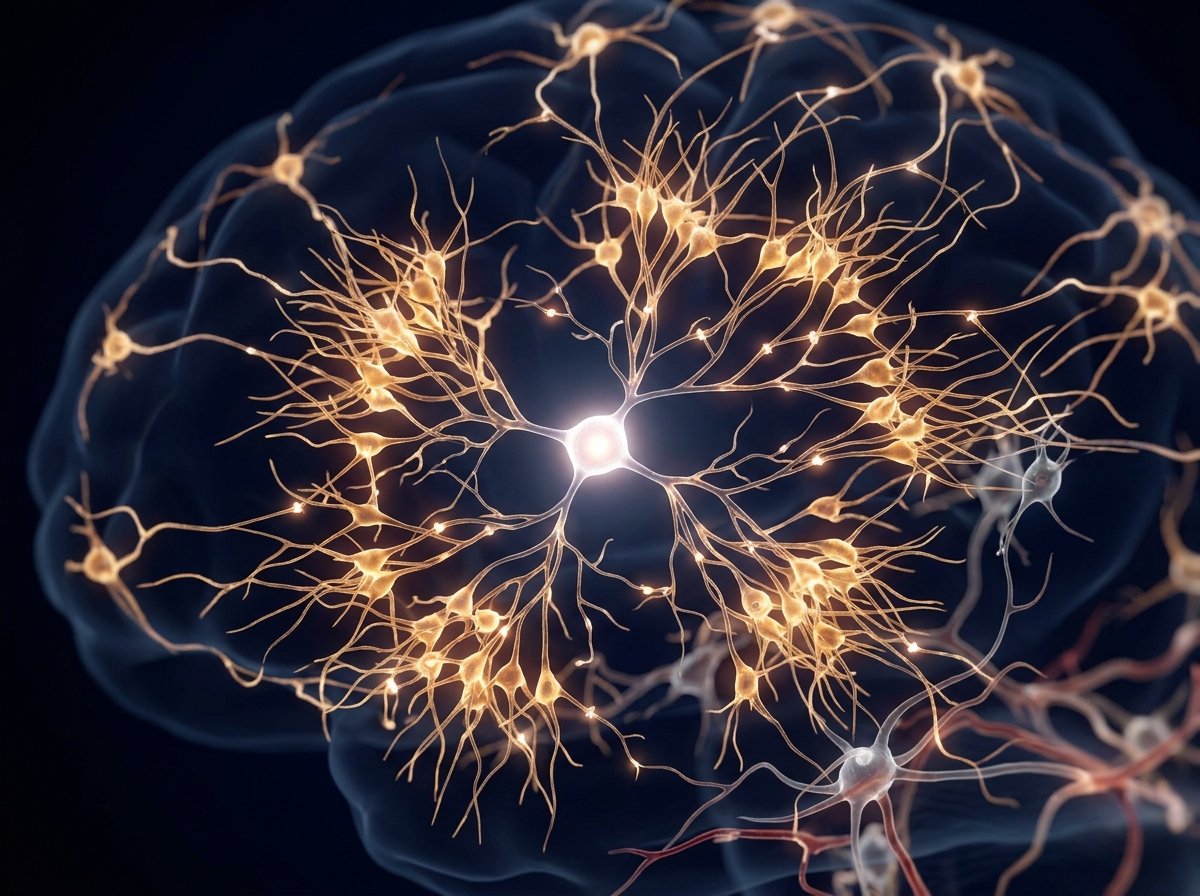
From that single cell, your brain eventually emerged — 170 billion cells, each in exactly the right place, connected to exactly the right neighbors, forming circuits of staggering complexity that produce thought, memory, emotion, and consciousness.
How does that happen? How does a single cell build a brain with billions of precisely organized neurons without an architect, a blueprint, or a central command?
Researchers at Cold Spring Harbor Laboratory just proposed an answer — published in the journal Neuron — and it’s one of the most elegant solutions in modern biology.
The Tiny Creature That Digests Your Food Before You Even Get a Chance To
The Problem: Chemical Signals Aren’t Enough
For decades, the dominant theory of brain development centered on chemical signals called morphogens.
The idea: cells release chemicals that diffuse through tissue, creating concentration gradients. Cells read those gradients to determine their position — high concentration means “front of the brain,” low means “back” — and develop accordingly.
This mechanism works well in small systems. But the developing human brain contains billions of neurons that must each arrive at a precise destination.
The problem with chemical signals:
- They weaken significantly over distance
- A brain the size of a human’s is far too large for gradients alone to reliably guide every cell
- No chemical signal can reach deep into the growing brain with enough precision to direct billions of individual cells
So something else must be helping. Researcher Stan Kerstjens at Cold Spring Harbor Laboratory, working with Professor Anthony Zador and collaborators from Harvard University and ETH Zürich, believed they knew what it was.
The Discovery: Cells Use Their Family Tree As A Map
The key insight is that brain cells use lineage — their cellular ancestry — as positional information.
“Consider how human populations spread across a country over generations,” said Kerstjens. “Descendants settle near their parents, so people who share ancestry end up in neighboring regions, producing large-scale geographic structures without long-range communication. We argue that a similar principle operates in the developing brain.”
In simple terms:
- Every neuron in your brain descended from a progenitor cell through a series of divisions
- Cells that share a recent common ancestor tend to stay physically close to each other
- This proximity creates natural spatial clustering — regional brain structure — without requiring any long-range signals
- The brain’s cellular family tree becomes its organizational map
“The only thing a cell sees is itself and its neighbors,” Kerstjens explained. “But its fate depends on where it sits. A cell in the wrong place becomes the wrong thing, and the brain doesn’t develop right. So, every cell must solve two questions: Where am I? And who do I need to become?“
Lineage answers both questions simultaneously.
How Researchers Tested The Theory
The team didn’t just propose an idea — they tested it systematically across multiple species and methods:
- Theoretical modeling — mathematical calculations confirmed the mechanism could work at scale
- Mouse brain gene expression — patterns in developing mouse brains showed cells from common lineages clustering together spatially
- Zebrafish confirmation — the same lineage-based clustering appeared in zebrafish, suggesting the principle is universal across vertebrates
The convergence of evidence across multiple species and research approaches gives the theory substantial weight. Brain development appears to use this lineage-based positional system in combination with chemical signaling — not as a replacement, but as a complementary, scalable mechanism that extends precision where chemical gradients alone cannot reach.
Why This Could Matter Beyond Biology
The implications of this discovery extend well beyond developmental neuroscience.
For cancer research:
- Tumors grow through uncontrolled cell division — understanding how lineage shapes spatial organization in normal tissue could provide new insights into how tumors develop their internal structure
For artificial intelligence:
- Future self-replicating AI systems that pass information between generations of models could potentially use similar lineage-based organizational principles to build internal structure without centralized control
For understanding intelligence itself:
- “The brain somehow makes us intelligent,” said Kerstjens. “How did it manage to accumulate this capability, not just over its developmental time, but over evolutionary time? This is one piece in that big puzzle.”
Understanding how a brain organizes itself may ultimately be inseparable from understanding how intelligence itself arises.
The Bottom Line
The answer to one of biology’s most profound questions — how a single cell builds a brain with 170 billion precisely placed neurons — may be surprisingly elegant.
Cells don’t need a detailed external map. They don’t need long-range chemical signals to reach every corner of a growing brain.
They just need to stay close to family.
That simple rule, repeated across billions of cell divisions, creates the organized structure from which the human mind eventually emerges. And discovering it may be one of the most important steps yet toward understanding how life builds its most extraordinary creation. 🧠🧬
Source: Cold Spring Harbor Laboratory — June 25, 2026
Journal Reference: Stan Kerstjens, Florian Engert, Rodney J. Douglas, Anthony M. Zador. A lineage-based model of scalable positional information in vertebrate brain development. Neuron, 2026; 114 (9): 1623.
DOI: 10.1016/j.neuron.2025.12.043