







Science just rewrote one of nature’s most iconic stories — and the real version is far more breathtaking.
For years, the explanation for queen bee development seemed almost elegant in its simplicity: feed a larva enough royal jelly, and it becomes royalty. New research published in Nature reveals that explanation was always incomplete. Behind every queen bee is an entire colony working in secret — building, warming, and engineering her rise to power.
The Old Story Science Just Overturned
The idea that diet alone determines a queen’s fate has dominated biology textbooks for decades. Royal jelly, a nutrient-rich secretion produced by worker bees, was seen as the magic ingredient. Give a larva enough of it, and biology would do the rest.
But researchers at the University of California, Riverside, found something far more complex hiding in plain sight inside the hive.
Their discovery? The physical environment surrounding a developing queen matters just as much as what she eats.
One Butterfly Group Evolved To Barely Age And Shows Almost No Physical Decline With Age
A Royal Nursery Built from Scratch
At the heart of this discovery are the structures known as queen cells — the specialized chambers where future queens develop. Scientists had always known these cells existed. What they didn’t fully understand was how extraordinary they truly are.
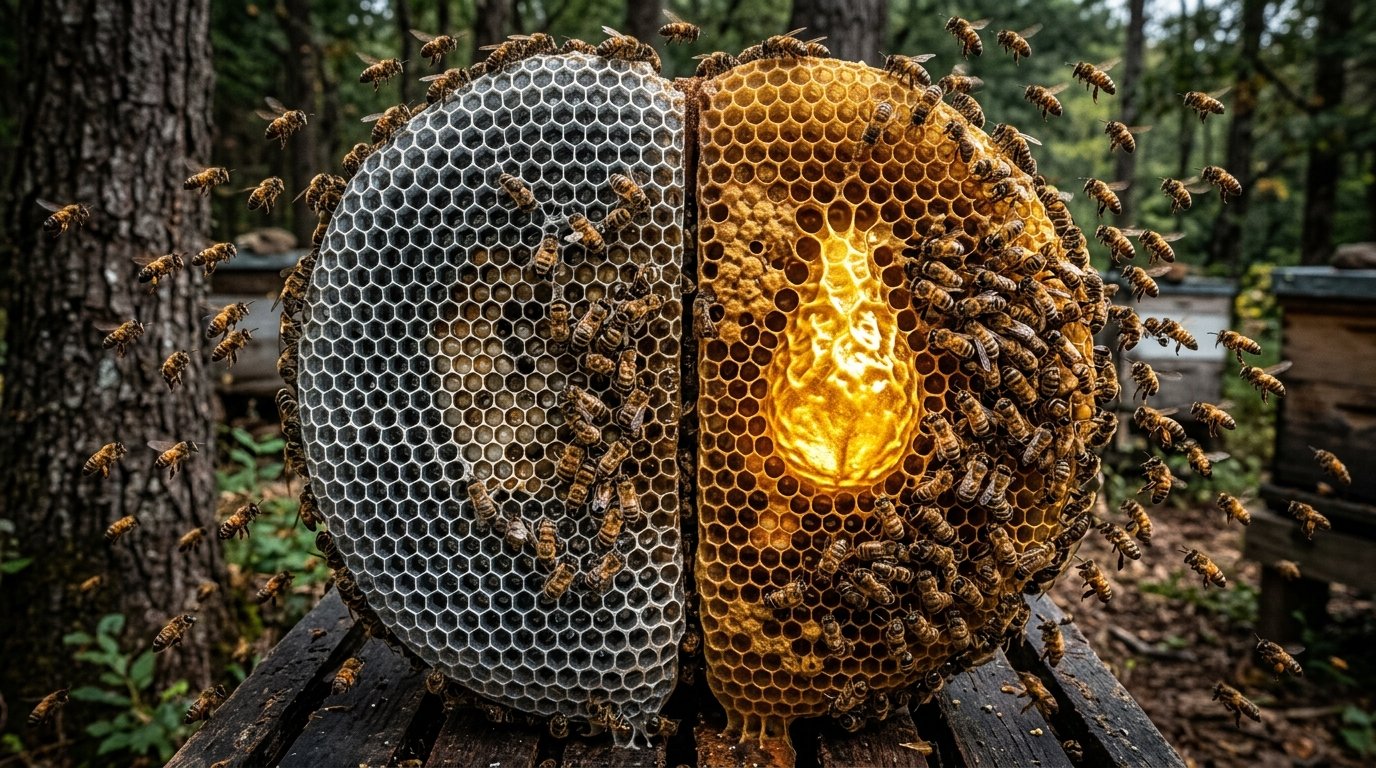
Queen cells are built in a distinctive peanut-like shape, and they’re constructed from wax that is fundamentally different from the ordinary hexagonal chambers where worker bees develop. Using thermal imaging, behavioral monitoring, and chemical analysis, the research team found that royal wax is:
- Less dense and more structurally flexible
- Better at retaining heat and moisture
- Chemically distinct, with different fatty acids and signaling compounds
This isn’t accidental variation. The colony is deliberately engineering a specific developmental environment.
What Makes Royal Wax Different
To test whether the wax itself truly matters, scientists raised queen larvae in cells built from either royal wax or standard worker wax — while keeping their diet identical.
The results were striking. Larvae raised in standard wax were significantly more likely to die during development. Those that survived grew into smaller queens than those raised in properly constructed royal chambers.
The environment itself helps determine the queen’s fate — independent of nutrition.
Meet the Queen Cell Builders
One of the study’s most surprising findings was the identification of a previously unknown group of bees: queen cell builders.
These are younger worker bees who take on a remarkably specialized role. While performing their duties, they:
- Maintain higher body temperatures than typical workers
- Undergo unique physiological changes linked to their role
- Actively collect, modify, and chemically enrich wax materials from across the hive
To confirm this last point, scientists added tiny amounts of graphite to ordinary honeycomb. Over time, darkened wax began appearing inside queen cells — direct evidence that workers were selectively harvesting and transforming hive materials for royal use.
These bees aren’t just caregivers. They’re architects and engineers.
Why Environment Is Just as Powerful as Diet
The implications of this research extend well beyond honeybees. For decades, queen bee development has been used as a textbook example of how nutrition alone can reshape biology.
This study challenges that model fundamentally. Development, it turns out, is shaped by a triad of factors: genetics, diet, and the physical and social environment.
“You can think of it as something like Buckingham Palace,” said Dr. Boris Baer, director of the Center for Integrative Bee Research at UC Riverside. “There is a dedicated group of bees focused entirely on raising the queen, and if they don’t get it right, the colony cannot reproduce.”
The same pattern was found in both Asian and European honeybee species — suggesting this elaborate system evolved long ago and runs deep in bee biology.
What This Means for Science and Nature
The discovery carries meaning far beyond the hive.
If environment shapes development this profoundly in bees, it raises important questions about other species — including how physical conditions during early development influence outcomes we’ve long attributed to genetics or diet alone.
It also reframes how we think about insect colonies. A honeybee hive isn’t just a collection of individual insects. It’s a coordinated biological system capable of engineering its own internal environments to ensure survival and reproduction.
“This work highlights how much sophistication exists inside insect societies,” Baer said.
The Takeaway
Queen bee development is no longer a story about a magic food. It’s a story about community, engineering, and collective intelligence operating at a scale we’re only beginning to understand.
The next time you see a hive, remember: somewhere inside, a team of dedicated worker bees is building something extraordinary — one carefully crafted cell at a time.
Source: University of California – Riverside (June 24, 2026)
Journal Reference: Fang, Y., Ma, B., Jin, X., Buttstedt, A., Al Naggar, Y., Darragh, K., … Baer, B., & Wang, K. (2026). Queen cell architecture shapes honey bee queen development. Nature, 654(8119), 689. DOI: 10.1038/s41586-026-10534-3
⚠️ This article is for educational and informational purposes only. It does not constitute veterinary or scientific advice.