









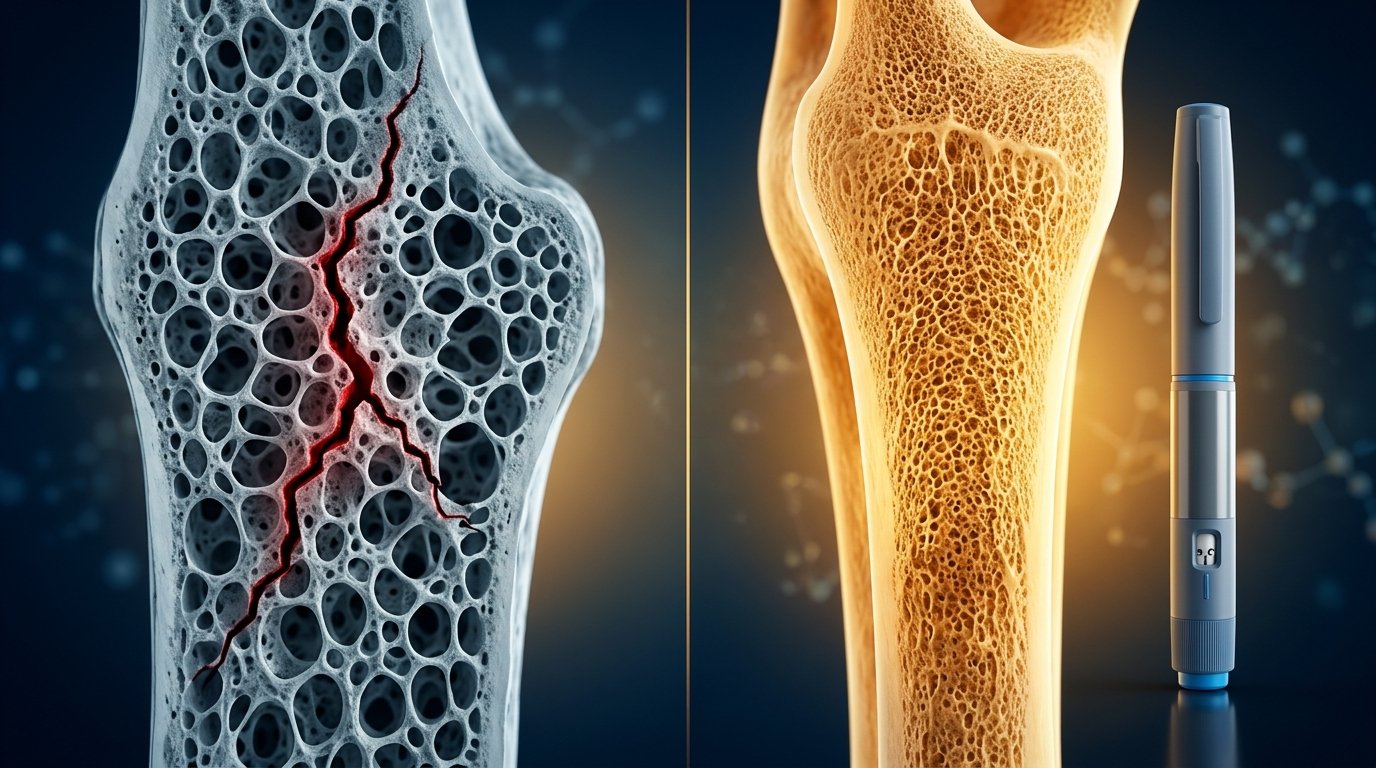
For years, there’s been a nagging concern hovering over the rapid weight loss achieved with GLP-1 medications like semaglutide. Losing weight quickly — whatever the method — has long been associated with bone thinning and a higher risk of fractures, particularly in older adults. The faster the weight comes off, the theory goes, the more bone density may be at risk.
New research presented at ENDO 2026, the Endocrine Society’s annual meeting in Chicago, just turned that assumption on its head — at least for one of the most widely used weight-loss drugs on the market.
The Research Question
Semaglutide belongs to a class of medications called GLP-1 receptor agonists, originally developed and prescribed for managing type 2 diabetes, and now widely used for weight loss as well. It’s well established that semaglutide tends to produce more significant weight loss than many older anti-obesity medications.
What hadn’t been clearly established was how semaglutide’s bone health effects compared to those of other weight-loss drugs. Given the established link between rapid weight loss and reduced bone density, researchers wanted to know whether semaglutide’s stronger weight-loss effect came with a correspondingly higher fracture risk — or something different entirely.
Dr. Jairo Noreña, a former endocrinology fellow at Stanford University Medical Center, led a team examining exactly this question.
A Large-Scale Retrospective Analysis
The researchers conducted a retrospective cohort study using the Atropos Health Eos electronic health record database — an enormous dataset covering 161 million patients treated across U.S. community hospitals and academic medical centers between January 2016 and December 2023.
From this database, they identified adults aged 18 and older with type 2 diabetes who had no prior history of fractures and had never used osteoporosis medications — controlling for pre-existing bone health issues that could confound the results.
The semaglutide group included 26,324 participants. The comparison group consisted of 33,555 people treated with dulaglutide, phentermine/topiramate, or bupropion/naltrexone — none of whom had previously used semaglutide.
The Findings
The results showed two things happening simultaneously, in a way that challenges the conventional wisdom about rapid weight loss and bone health.
First, as expected, semaglutide users experienced significantly greater reductions in BMI compared to those using the comparison medications — confirming semaglutide’s reputation as a more powerful weight-loss treatment.
Second, and far less expected, semaglutide users also experienced fewer fractures. There were 794 fractures recorded among the 26,324 people in the semaglutide group, compared with 1,045 fractures among the 33,555 people in the comparison group. After accounting for the different group sizes, this worked out to a 15 percent lower fracture risk among semaglutide users relative to those taking other weight-loss medications.
In other words, despite losing more weight — the factor traditionally associated with increased fracture risk — semaglutide users had fewer fractures, not more.
What This Could Mean
“This work is an important early step toward understanding the impact of semaglutide-induced weight loss on bone health in patients with type 2 diabetes,” said Noreña.
The researchers emphasize that bone fractures carry significant real-world costs beyond the immediate injury. “Bone fractures are painful, expensive, and can seriously affect quality of life — especially as people get older,” Noreña noted. “We hope this study encourages monitoring of bone health in weight-loss programs.”
The exact mechanism behind this apparent protective effect isn’t yet understood. Several possibilities could be at play. Semaglutide’s effects on metabolic health, inflammation, or insulin sensitivity could indirectly support bone health in ways unrelated to the weight loss itself. It’s also possible that the pattern, pace, or composition of weight loss achieved with semaglutide differs meaningfully from other weight-loss approaches in ways that happen to be more bone-protective. Without further research, these remain hypotheses rather than established explanations.
Important Limitations To Understand
This was a retrospective observational study, not a randomized controlled trial. That distinction matters significantly when interpreting the results.
Retrospective studies can identify associations between variables, but they cannot definitively prove that one factor caused another. There could be other differences between the semaglutide group and the comparison group — beyond the medication itself — that contributed to the observed fracture rate difference. Patient characteristics, disease severity, concurrent treatments, lifestyle factors, and other variables not fully captured in electronic health record data could all play a role.
The researchers themselves are appropriately cautious about over-interpreting the findings. They explicitly state that prospective studies — research specifically designed in advance to test this relationship under more controlled conditions — are needed to verify whether semaglutide truly offers a bone health benefit, and if so, to understand why.
Why This Matters
Semaglutide and related GLP-1 medications have rapidly become some of the most widely prescribed drugs in the world, used by millions of people for both diabetes management and weight loss. Understanding the full range of their effects — including potential benefits and risks beyond their primary intended use — is a significant and ongoing area of medical research.
If semaglutide’s apparent association with lower fracture risk is confirmed through future prospective research, it could represent a meaningful and previously unrecognized benefit for patients already using the medication for diabetes or weight management — adding bone health to a growing list of effects researchers continue to uncover for this class of drugs.
For now, the finding stands as an encouraging early signal rather than a confirmed benefit — but for patients and clinicians navigating weight-loss treatment options, it’s a genuinely promising one worth watching closely as more research emerges. 💉🦴
Source: Endocrine Society / ENDO 2026 Annual Meeting, Chicago — June 2026
Note: This research was presented as a conference abstract. Lead researcher: Dr. Jairo Noreña, formerly of Stanford University Medical Center, Palo Alto, California.