








Inflammatory bowel disease is one of the most debilitating chronic conditions affecting millions of people worldwide. It is also one of the most frustrating — not just for those living with it, but for the researchers and clinicians who have spent decades trying to understand what actually causes it and why some people experience far more severe disease than others.
A new study published in The New England Journal of Medicine just answered one of the field’s longest-standing questions. And the answer opens a direct path toward targeted treatment for a specific subset of patients.
The 30-Year Mystery
For three decades, scientists had known something important but puzzling: a specific variant of a gene called HLA-DRB1 — specifically the variant HLA-DRB1*01:03 — appeared more frequently in patients with IBD than in the general population, and was particularly associated with severe disease.
The connection was consistent across studies. But the mechanism — what this gene variant was actually doing to make IBD worse — remained completely unknown.
Understanding the mechanism isn’t just a matter of scientific curiosity. Without knowing how a genetic variant contributes to disease, you cannot design treatments that target it. You cannot identify which patients carry the variant and intervene early. You cannot build a precise therapeutic strategy around what is actually going wrong at the molecular level.
Scientists Found A Hidden Depression Warning Sign In Children’s Eyes — And It Appears Years Before Any Diagnosis Is Made
Now, a team of researchers from the UK and Denmark has finally filled that gap.
What They Found
The researchers began with a large-scale blood analysis. They tested samples from approximately 4,900 people with IBD and around 1,000 healthy controls, specifically looking for antibodies that neutralize interleukin 10 — a chemical messenger known as IL-10 that plays a critical role in regulating inflammation throughout the gut.
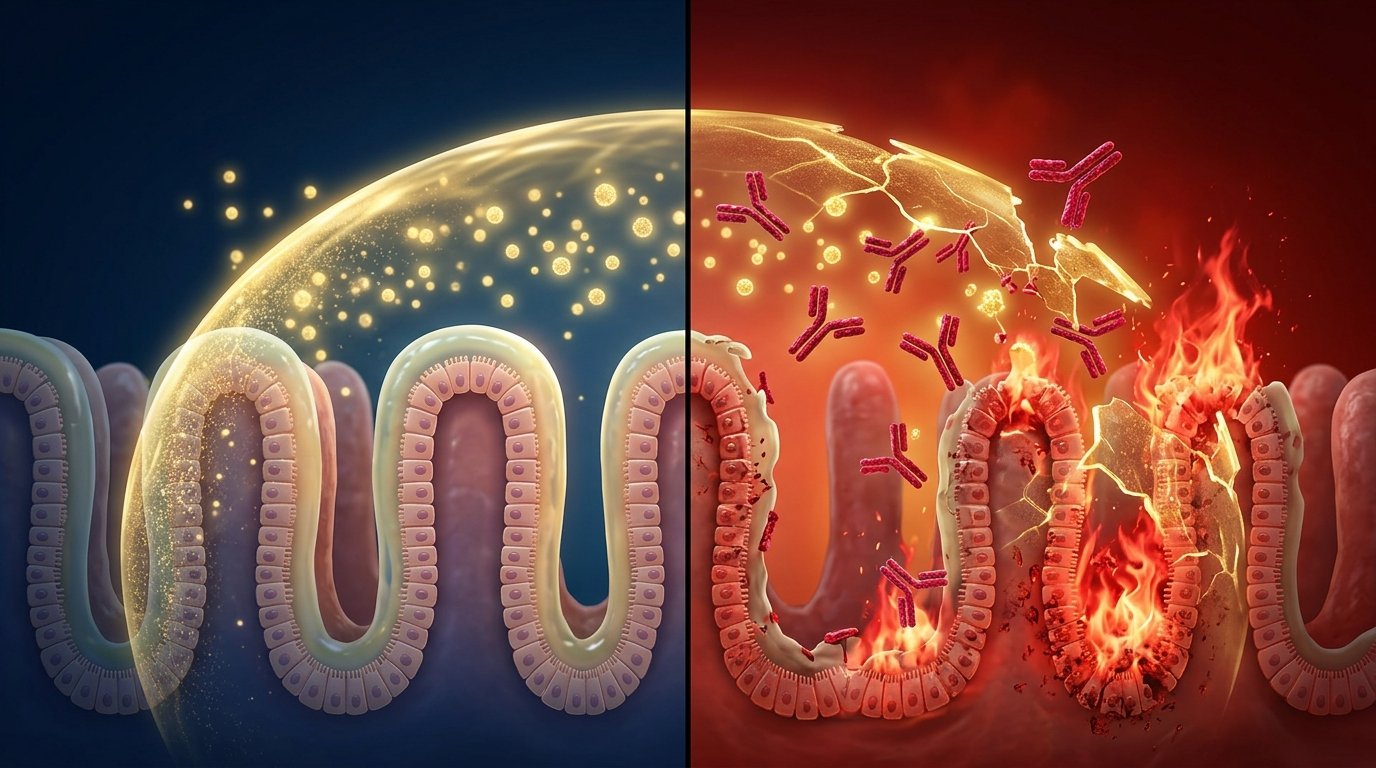
IL-10 functions essentially as an anti-inflammatory brake. When the gut’s immune system becomes activated — as it constantly does in response to bacteria, food, and other triggers — IL-10 helps bring that response back under control, preventing it from spiraling into the chronic, damaging inflammation that defines IBD.
If something neutralizes IL-10, the brake fails. Inflammation is no longer controlled. The gut wall is exposed to sustained immune attack — exactly the kind of damage seen in Crohn’s disease and ulcerative colitis.
The antibodies were found in approximately 3.5 percent of IBD patients. They were found in none of the healthy controls. That stark contrast was the first significant signal.
Breaking it down further: roughly 2.5 percent of people with Crohn’s disease carried these neutralizing antibodies, while 4.4 percent of those with ulcerative colitis did — suggesting the mechanism may be somewhat more common in ulcerative colitis.
The Genetic Connection
The next step was to examine whether the HLA-DRB1*01:03 gene variant was associated with the presence of these antibodies — and it was, strongly and consistently.
People carrying the HLA-DRB1*01:03 variant were significantly more likely to produce antibodies that attack their own IL-10, neutralizing the body’s primary anti-inflammatory mechanism in the gut. The gene variant doesn’t cause IBD directly — it makes the immune system more likely to mount this specific misdirected response, which then drives chronic gut inflammation.
“We’ve suspected an important role of interleukin 10 in patients with inflammatory bowel disease for decades,” said pediatric gastroenterologist Holm Uhlig from the University of Oxford. “The study now provides clear evidence and contributes the missing link between a well-known genetic variant that had been linked to severe inflammatory bowel disease in the past and the very recently discovered autoimmunity to interleukin 10.”
Why This Is A Landmark Discovery
For clinical gastroenterologist Simon Travis, also from Oxford, the significance of this finding was immediate and personal.
“This is the most exciting discovery in a lifetime specializing in IBD,” Travis said. “It means that we can now identify a group where we know what is causing the disease — and that creates a real opportunity to change how we manage this disease.”
That phrase — “we know what is causing the disease” — is one that has rarely been used with such confidence in IBD research. The condition is complex, multifactorial, and has resisted simple explanations for decades. Knowing the precise molecular cause for a specific patient subgroup is something qualitatively different from identifying risk factors or associations.
It means that for patients carrying the HLA-DRB1*01:03 variant with detectable IL-10 antibodies, the target for intervention is now known. Rather than broadly suppressing the immune system — the approach of most current IBD therapies — treatments could potentially be designed to specifically restore IL-10 signaling, remove the neutralizing antibodies, or prevent their production.
“By identifying patients early and giving them targeted treatment, we could reduce reliance on expensive ongoing therapy and prevent complications,” said clinical immunologist Rainer Doffinger from Cambridge University Hospital.
The Broader Picture
While 3.5 percent may sound like a small proportion of IBD patients, the global scale of the disease means this still represents a very large number of people. IBD affects tens of millions worldwide, and incidence continues to rise across many countries.
The researchers are careful to note that this discovery doesn’t explain all IBD — it explains a specific molecular mechanism operating in a specific subset of patients. IBD is heterogeneous, and different causes likely drive the disease in different people. Previous research has identified overactive immune cells driving ulcerative colitis in some patients, and gene variants that compromise immune cell defenses in certain Crohn’s disease cases.
Building a complete picture of IBD means understanding all these mechanisms — and this study fills in one of the most important and long-elusive pieces.
“This discovery shows how the study of rare, inherited disorders can shed new light on common conditions,” said immunologist Sophie Hambleton from Newcastle University.
For the millions living with IBD — managing a condition for which current treatments offer management but not cure — this discovery represents something genuinely new: a precise molecular target, identified after 30 years of searching, that finally makes truly personalized treatment possible. 💙🔬
Source: University of Oxford / Newcastle University / Cambridge University Hospital — 2026
Journal Reference: Published in The New England Journal of Medicine, 2026.