





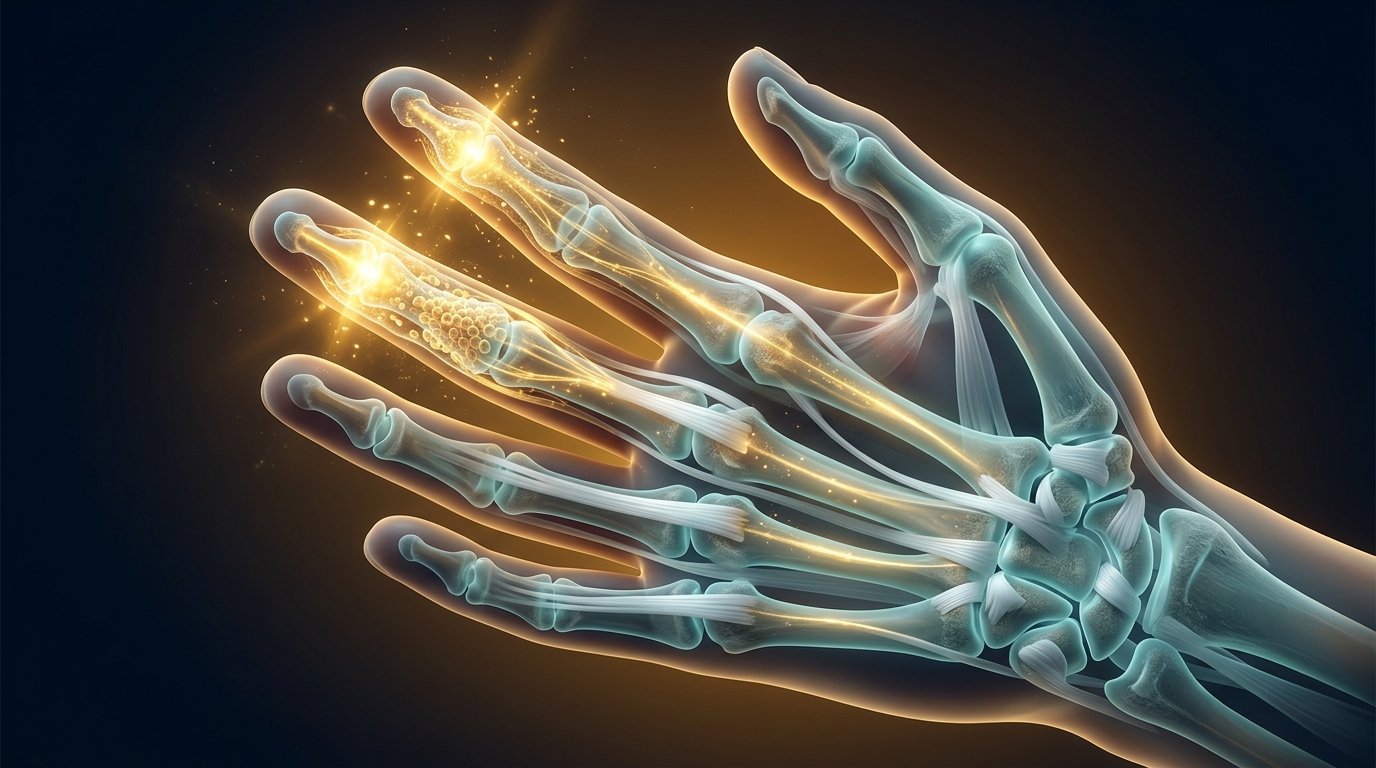
Since Aristotle first described how salamanders could regrow severed limbs, scientists have been asking one of biology’s most persistent questions: why can some animals do it, and we cannot?
A landmark new study from Texas A&M University just suggested that the premise of that question may have been wrong all along.
The Question That Drove Decades Of Research
Dr. Ken Muneoka has spent his career at the intersection of developmental biology and regenerative medicine, focused specifically on understanding why mammals — including humans — heal by forming scar tissue rather than rebuilding what was lost.
“Why some animals can regenerate and others, particularly humans, can’t is a big question that has been asked since Aristotle,” Muneoka said. “I’ve spent my career trying to understand that.”
The conventional scientific view held that regenerative ability was simply absent in mammals — an evolutionary trade-off made somewhere along the lineage that diverged from salamanders and other regenerating animals hundreds of millions of years ago. Mammals heal fast and resist infection through rapid fibrosis — scar formation — but they pay for that speed by losing the ability to rebuild complex structures.
This new study, published in Nature Communications, challenges that view in a fundamental way.
Scientists Found A Hidden Depression Warning Sign In Children’s Eyes — And It Appears Years Before Any Diagnosis Is Made
Scar Formation vs Regeneration: Two Roads From The Same Starting Point
When a mammal is injured, fibroblast cells rush to the wound site and close it by laying down scar tissue. This response is fast and effective at preventing infection and further damage — but it’s also a one-way road. Once scar formation is underway, regrowth doesn’t happen.
In salamanders and other regenerating animals, the same type of cells follow a different path. Rather than forming scar tissue, they gather into a structure called a blastema — a mass of cells that serves as the biological foundation from which new tissue grows.
Muneoka’s insight was that these might not be two fundamentally different biological programs. They might be the same program, taking different forks in the road — and it might be possible to redirect which fork mammalian cells take.
“It’s as if these cells can move in two different directions,” he said. “They could either make a scar or make a blastema. Our research focused on redirecting the behavior of fibroblasts already present at the injury site.”
The Two-Step Treatment That Changed Everything
The research team developed a treatment using two well-established growth factors, applied in sequence.
The first step involved waiting until the initial wound had already healed over — allowing the body to complete its normal first-stage response — and then applying fibroblast growth factor 2 (FGF2) to the healed site. This growth factor encouraged the formation of a blastema-like cellular structure at the injury site, something that does not normally occur in mammals at this stage of healing.
Several days later, the researchers applied the second growth factor: bone morphogenetic protein 2 (BMP2). This signal prompted the blastema-like cells to begin building new tissues — providing both the trigger and the blueprint for what to construct.
“This is really a two-step process,” Muneoka said. “You first shift the cells away from scarring, and then you provide the signals that tell them what to build.”
What They Actually Regrew
The results were extraordinary by the standards of mammalian regenerative research.
After amputation in animal studies, the two-step FGF2-BMP2 treatment successfully restored all of the major structural components that had been removed: bone, joint tissue, ligaments, and tendons. The regenerated structures were not perfect anatomical replicas — their architecture was somewhat imprecise compared to the original tissue — but they were genuinely new structures, not scar tissue, and they included all the components you would expect to find at that level of the body.
The study also found evidence of something called positional re-specification — cells being redirected to build structures outside their normal location, suggesting a flexibility in mammalian cell programming that had not previously been demonstrated in this context.
No External Stem Cells Required
One of the most scientifically significant aspects of this finding is what the treatment did not require.
Stem cell transplantation has long been one of the dominant approaches in regenerative medicine — the idea being that if the body’s own cells can’t regenerate, you add new stem cells from outside to do the job. This study suggests that approach may be solving the wrong problem.
“You don’t have to actually get stem cells and put them back in,” Muneoka said. “They’re already there — you just need to learn how to get them to behave the way you want.”
Dr. Larry Suva, another Texas A&M professor involved in the study, put it even more directly: “The cells that we thought to be unprogrammable, in fact are. The capacity is not absent — it’s just obscured.”
A Closer Path To Human Application Than Most Expect
One of the most practically encouraging aspects of this research is that both treatment components are already well along the path toward human use.
BMP2 already holds FDA approval for certain orthopedic applications, including spinal fusion procedures. FGF2 is currently being evaluated in multiple active clinical trials. Neither molecule is experimental in the broadest sense — both have established safety profiles and documented biological effects in humans.
This doesn’t mean regenerative therapy is imminent. Significant work remains to be done in understanding how to optimize the treatment, how to ensure the regenerated tissues are structurally sound enough for functional use, and how to translate findings from animal models into human applications.
But it does mean the path from this discovery to clinical testing may be significantly shorter than with many experimental therapies that rely on entirely novel compounds.
What This Changes
“Regenerative failure in mammals can be rescued,” Muneoka said. “Now we have a model to begin figuring out how.”
That sentence may turn out to be one of the most significant in regenerative medicine in years. Not because it means humans will regrow limbs tomorrow — but because it fundamentally reframes the question from “can this be done” to “how do we do it better.”
The switch exists. It can be turned on. Everything that follows is just science doing what science does — learning, step by patient step, how to use it. 🧬
Source: Texas A&M University / Nature Communications — June 17, 2026
Journal Reference: Ling Yu, Mingquan Yan, Katherine Zimmel Scaturro, et al. Digit regeneration in mice is stimulated by sequential treatment with FGF2 and BMP2. Nature Communications, 2026; 17 (1).
DOI: 10.1038/s41467-026-72066-8