








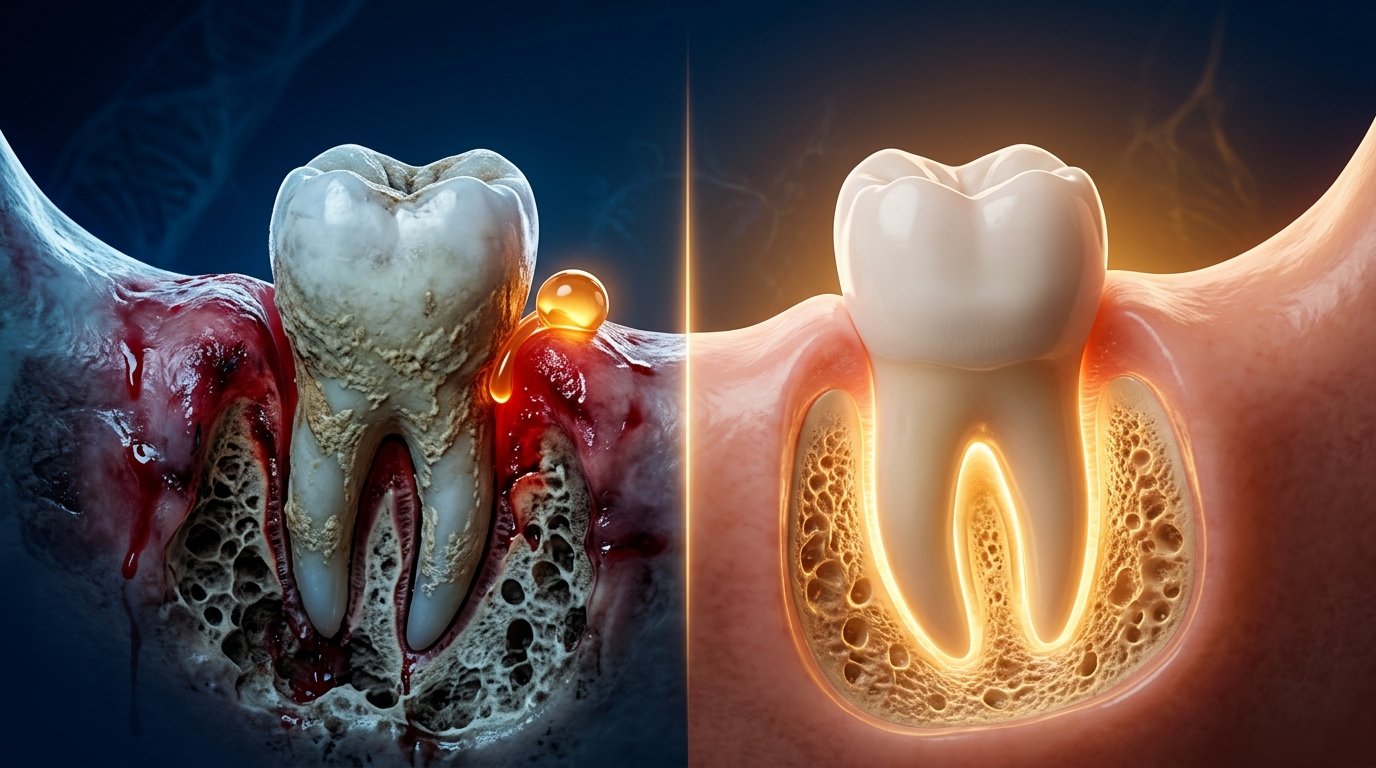
Periodontitis affects millions of people worldwide, and for those living with it, the disease follows a frustratingly familiar pattern. Chronic infection triggers ongoing inflammation. That inflammation slowly destroys the tissue and bone structures that hold teeth firmly in place. Treatment can control the infection. Treatment can manage the inflammation. But rebuilding what’s already been lost? That has remained largely out of reach.
A team of Brazilian researchers just developed something that could change that — and the source materials are about as unexpected as medical science gets.
The Problem With Current Gum Disease Treatment
Periodontitis is a chronic inflammatory disease driven by bacterial infection in the tissues surrounding the teeth. Left untreated or inadequately managed, it gradually destroys the periodontal ligament and underlying bone, eventually leading to tooth mobility and loss.
Current treatment approaches — antibiotics, deep cleaning procedures, anti-inflammatory medications — are effective at controlling the active infection and inflammation. But they do little to regenerate tissue and bone that has already been destroyed. More advanced regenerative approaches exist, including guided tissue regeneration techniques and bone grafting procedures, but these methods produce variable results and remain difficult to predict reliably across patients.
A Digital Program Could Prevent Falls In Older Adults — But Real-World Testing Revealed The Gap Between Research And Practice
This gap — effective infection control without effective regeneration — is exactly what researchers at the Pontifical Catholic University of São Paulo set out to address.
An Unconventional Combination
Led by Professor Eliana Aparecida de Rezende Duek from the Department of Surgery at PUC-SP’s Faculty of Medical and Health Sciences, the research team developed a biomaterial combining three distinctly different ingredients: latex extracted from jackfruit, pomegranate peel extract, and simvastatin, a widely used cholesterol-lowering medication.
The choice of jackfruit latex was driven by a specific functional property. “We began to view latex extracted from jackfruit as an interesting alternative, as it has adhesive properties,” Duek explained. “This led us to believe that it could remain longer at the site affected by periodontitis, promoting a more targeted release of therapeutic compounds and potentially reducing the need for systemic antibiotic use.”
In other words, jackfruit latex’s natural stickiness could allow a treatment to stay precisely where it’s needed — directly at the site of infection and tissue damage — rather than dispersing throughout the body, where it would need to be administered in much higher doses to achieve the same local effect.
Pomegranate peel extract was added for its well-documented antimicrobial properties when applied topically, helping the material actively fight the bacterial infection driving the disease. Simvastatin, while primarily known as a cholesterol medication, has been separately studied in previous research for its ability to stimulate bone formation — making it a logical addition for a treatment aiming to rebuild lost periodontal bone.
Together, these three components were combined into what researchers describe as a mucoadhesive matrix — a gel-like material designed to stick to and act directly on damaged gum tissue.
A Smart Solution To An Old Drug Delivery Problem
One particularly clever aspect of this approach involves how it solves a known limitation of simvastatin.
When taken as an oral medication, most simvastatin is captured and processed by the liver before it ever reaches general circulation in meaningful amounts. This means that achieving therapeutic effects elsewhere in the body — like stimulating bone growth at a gum disease site — typically requires higher oral doses, which in turn increases the risk of side effects, including a serious condition involving acute muscle breakdown.
By incorporating simvastatin directly into a gel applied at the site of disease, researchers may be able to bypass this liver-processing bottleneck entirely, delivering effective concentrations directly where they’re needed without the systemic dose escalation that creates safety concerns.
What The Lab Testing Showed
To develop and test the biomaterial, the research team manually collected latex from freshly harvested jackfruit, carefully purified it, and incorporated pomegranate peel extract into the resulting material. They then conducted extensive physicochemical and biological analysis to characterize how the biomaterial was structured and how it behaved under laboratory conditions.
The team conducted in vitro testing using human adipose-derived stem cells, incorporating simvastatin into the gel at three different concentrations — 0.3%, 0.6%, and 1.2%. Importantly, none of these concentrations altered the gel’s underlying structure, and all were considered technically safe based on the testing conducted.
All three concentrations successfully promoted osteoinduction — the biological process through which cells are encouraged to develop into bone-forming tissue — within just 14 days. The effect grew even more pronounced after 21 days, providing meaningful early evidence supporting the material’s potential as a periodontitis treatment.
Promising But Early
Duek and her team describe the results as genuinely encouraging. “Overall, the results were very encouraging for us,” she said. “We observed that the developed biomaterial has great potential for future applications in treating periodontitis and in other areas as well, especially since it involves a material that has received little attention in the scientific literature for biomedical use.”
That last point is notable — jackfruit latex remains a relatively unexplored material in biomedical research, which means this study may represent an early step into a genuinely novel area of regenerative medicine, with potential applications beyond gum disease as research continues.
Duek is appropriately cautious about the path ahead, however. “Despite these promising results, we’re continuing to move forward with new studies to more thoroughly evaluate the efficacy and safety of the system,” she noted.
The research, supported by FAPESP and published in the journal Polymer Bulletin, represents laboratory-stage findings rather than a clinical treatment ready for patient use. Significant additional research — including animal studies and eventually human clinical trials — will be needed before this biomaterial could become an available periodontitis treatment.
Why This Matters
What makes this research particularly compelling is its dual-action approach — simultaneously combating the bacterial infection driving gum disease while actively promoting the bone regeneration needed to repair the damage that infection has already caused. Most current treatments address only one side of that equation.
If future research confirms these early laboratory findings, an unassuming tropical fruit best known for its enormous size and distinctive smell could end up playing a genuinely meaningful role in how dentists and periodontists treat one of the most common and destructive chronic diseases affecting human oral health worldwide. 🍈🦷
Source: Fundação de Amparo à Pesquisa do Estado de São Paulo (FAPESP) / Pontifical Catholic University of São Paulo / Polymer Bulletin — June 19, 2026
Journal Reference: Bruna V. Quevedo, Barbara B. T. de Lima, Kaique G. Hergesel, Jessica Asami, Daniel Komatsu, Eliana Aparecida de Rezende Duek. Jackfruit latex-pomegranate extract biomaterial incorporated with simvastatin as a potential osteoinductive system for periodontal applications. Polymer Bulletin, 2026; 83 (6).
DOI: 10.1007/s00289-026-06358-w